
Euthyrhynchus floridanus
(Linnaeus, 1767)
Florida predatory stink bug
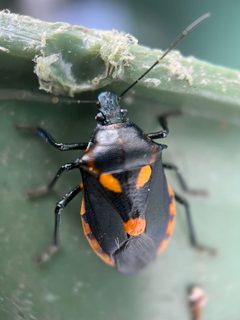
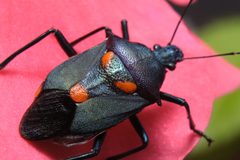
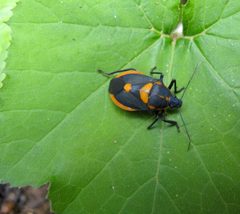
Euthyrhynchus floridanus, commonly known as the Florida predatory stink bug, is a shield bug in the Pentatomidae and the sole in its . Native to tropical and semi-tropical regions of the Americas, it has expanded its range northward in recent decades due to climate warming. This beneficial insect is a that feeds on numerous agricultural and garden pests, including caterpillars, larvae, and other stink bugs. Its distinctive orange and black coloration makes it easily recognizable among predatory true bugs.
Pronunciation
How to pronounce Euthyrhynchus floridanus: /juːˈθaɪrɪnˌkəs flɔːrɪˈdeɪnəs/
These audio files are automatically generated. While they are not always 100% accurate, they are a good starting point.
Identification
Distinguished from similar predatory stink bugs by the combination of: a prominent spine on the humerus; absence of a spine on the underside of the front ; short, thick first segment of the rostrum; and the distinctive pattern of red to orange spots on a dark background. The overall orange and black coloration separates it from the more commonly encountered brown or green herbivorous stink bugs. Nymphs have bluish-black and with red .
Images
Habitat
Found on a wide range of plant types including ornamental plants, citrus, weeds, grasses, trees, and bushes. In northern expansion areas, observed on elm bark and other deciduous trees. Historically restricted to hottest parts of southeastern United States, but now regularly found in mid-Atlantic region and as far north as New Hampshire and the Dakotas due to warming winters.
Distribution
Native to tropical and semi-tropical regions from Peru to the southeastern United States. Historical range: hottest parts of southeastern United States. Expanded range: now regular in mid-Atlantic region (Maryland, Virginia, District of Columbia), with records north to New Hampshire and the Dakotas. Also recorded in coastal Virginia and College Park, Maryland.
Seasonality
and nymphs active throughout warm months in expanded northern range. Multiple possible in warmer climates. Adults observed in autumn in northern areas, with survival through mild winters allowing establishment.
Diet
feeding on soft-bodied insects. Prey includes: caterpillars (fall armyworm, cabbage looper, velvetbean caterpillar, tobacco budworm, , long-tailed skipper larvae), larvae (Mexican bean beetle, Colorado potato beetle larvae), other stink bugs (brown marmorated stink bug, southern green stink bug, kudzu bug), planthoppers, weevils, and greater wax moth larvae. Uses to inject toxic venom and digestive , then consumes liquefied tissues.
Host Associations
- Mexican bean beetle (Epilachna varivestis) - preyLaboratory and field observations
- Fall armyworm (Spodoptera frugiperda) - preyLaboratory rearing
- Cabbage looper (Trichoplusia ni) - preyLaboratory rearing
- Velvetbean caterpillar (Anticarsia gemmatalis) - preyField observations
- Brown marmorated stink bug (Halyomorpha halys) - preyObserved in expanded northern range
- Kudzu bug (Megacopta cribraria) - preyLaboratory feeding studies
Life Cycle
Females deposit in clusters of 20-90 barrel-shaped eggs on leaves. Eggs dark brown to black with small projections at edge of . At 26-27°C, eggs hatch in 5-6 days; at 24°C, hatching takes 35 days. Five nymphal instars: first instar 4-5 days, second instar 3-4 days, third instar 3-4 days, fourth instar 4-5 days, fifth instar 6-8 days. Total nymphal development 20-40 days depending on temperature. First instars remain aggregated near egg mass and do not feed; second instars begin dispersing and feeding. female takes approximately two weeks to mature and lays total of about 140 eggs. Development period longer than close relatives in Asopinae, resulting in slower buildup.
Behavior
First instar nymphs exhibit aggregative , remaining near mass without feeding. Later instars and are active that hunt prey. Nymphs sometimes feed communally on single prey items. Adults and nymphs use a seemingly gentle poke of the beak to attack, immobilizing prey with toxic venom before injecting digestive . Has been observed resting on tree bark and on electric utility meters. Range expansion behavior documented: moving northward as winter temperatures become less lethal.
Ecological Role
of agricultural and garden pests; considered beneficial for . Potential biological control agent for lepidopteran pests and the Mexican bean beetle. In expanded range, contributes to suppression of pests such as brown marmorated stink bug and kudzu bug. Slower growth compared to some other predatory may limit rapid response to pest .
Human Relevance
Considered beneficial insect for agriculture and gardening due to on pest . No known negative impacts; does not bite humans or damage plants. Valued as natural agent. Subject of interest for monitoring climate change effects on insect range expansion. Observations in northern areas often reported by citizen scientists and extension .
Similar Taxa
- Spined soldier bug (Podisus maculiventris)Similar predatory and ecological role; distinguished by different body shape and color pattern
- Two-spotted stink bug (Perillus bioculatus)Another orange and black with similar hunting ; distinguished by two prominent spots and different body proportions
- Brown marmorated stink bug (Halyomorpha halys)Often confused due to shared , but herbivorous pest with mottled brown coloration and different body shape; E. floridanus is with distinct orange-black pattern
More Details
Climate change and range expansion
The Florida predatory stink bug has become a notable example of climate-driven range expansion in insects. First reported in Maryland in 2012 during what was then the hottest year on record, subsequent observations have documented regular establishment in the mid-Atlantic region. Following the second warmest winter on record in 2022-2023, were observed in force throughout the summer and autumn. This expansion is attributed to increasingly mild winters that allow survival of individuals that would previously have been killed by lethal cold temperatures.
Sources and further reading
- BugGuide
- Wikipedia
- GBIF taxonomy match
- iNaturalist taxon
- NCBI Taxonomy
- Bembicid Holdings | Entomology Research Museum
- Bugs in Orange and Black, Part II: A spooky southern predator heads north in a warming world – Florida predatory stink bug, Euthyrhynchus floridanus — Bug of the Week
- Northern hospitality for the Florida predatory stink bug, Euthyrhynchus floridanus, and wax scales, Ceroplastes spp. — Bug of the Week
- Archive — Bug of the Week
- Bugs in orange and black, Part 3 – Trick or treat? Two-spotted stink bug, Perillus bioculatus, has a lethal trick that turns Colorado potato beetle, Leptinotarsa decemlineata, into a tasty treat — Bug of the Week
- Amped-Up Ants: Caterpillars' Sugary Treats Earn Carpenter Ant Care
- Immature Stages and Notes on the Biology of Euthyrhynchus floridanus (L.) (Hemiptera: Pentatomidae)1