
Urbanus proteus
(Linnaeus, 1758)
Long-tailed Skipper, Bean Leafroller, Cabeça-de-fósforo
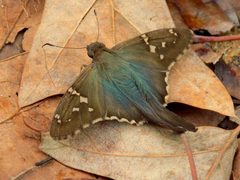
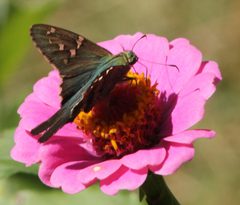
Urbanus proteus is a spread-winged distributed from the southern United States through tropical and subtropical South America to Argentina. The cannot survive in areas with prolonged frost. Caterpillars are known as bean leafrollers, feeding primarily on legume foliage and folding leaves for protection. are showy with iridescent blue-brown wings and distinctive long hindwing tails.
Pronunciation
How to pronounce Urbanus proteus: /ˈʊr.bə.nəs ˈproʊ.ti.əs/
These audio files are automatically generated. While they are not always 100% accurate, they are a good starting point.
Identification
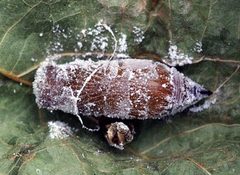
distinguished by long hindwing tails and iridescent blue-brown coloration; caterpillars identified by leaf-folding , dark coloration, and prominent . From similar Urbanus by tail length and color pattern.
Images
Habitat
Tropical and subtropical environments; agricultural fields with legume crops; cannot persist where frost is prolonged.
Distribution
Southern United States; Mexico; Central America; South America through Argentina. Specific records from Colombia, Brazil (Amazonas, Bahia, Ceará, Minas Gerais, Pará, Pernambuco, Rio de Janeiro, Rio Grande do Sul, São Paulo), and Caribbean.
Diet
Caterpillars feed on foliage of legumes, primarily soybean (Glycine max) and common bean (Phaseolus vulgaris); also recorded on cowpea (Vigna unguiculata), pea (Pisum sativum), faba bean (Vicia faba), Centrosema pubescens, and Clitoria fairchildiana. diet not specified in sources.
Host Associations
- Glycine max - larval food plantprimary , soybean
- Phaseolus vulgaris - larval food plantprimary , common bean
- Vigna unguiculata - larval food plantcowpea
- Pisum sativum - larval food plantpea
- Vicia faba - larval food plantfaba bean
- Centrosema pubescens - larval food plant
- Clitoria fairchildiana - larval food plant
Life Cycle
Five larval instars; caterpillar stage 16.7 days at 25°C; prepupal stage 1.1 days; pupal stage 11.4 days; total caterpillar-to- period 29.2 days with 84.8% viability. Mortality occurs only during first instar; no pupal mortality observed in laboratory study. stage and oviposition not studied.
Behavior
Caterpillars fold leaves to create shelters for protection against natural enemies. Fourth and fifth instars responsible for 96.9% of total leaf consumption, with fifth instar alone consuming 87%.
Ecological Role
Defoliating pest of legume crops; considered minor pest that causes significant damage only at high densities. Serves as for , sarcophagid Sarcodexia innota, tachinid parasitoid Chrysotachina alcedo, and prey for predatory Euryhynchus floridanus and Polistes .
Human Relevance
Agricultural pest of soybean and bean crops. estimated at 17 large caterpillars per sampling based on consumption rate of 214.3 cm² total leaf area per individual. Subject of research due to viral and natural enemy complex.
Similar Taxa
- Other Urbanus speciesSimilar spread-winged skipper ; distinguished by tail length and wing coloration patterns
More Details
Viral Disease
Naturally associated with a singly-embedded (NPV), the first documented from this . Virus increases through the soybean growing season and primarily affects late instar larvae.
Natural Enemies
Sarcophagid Sarcodexia innota parasitizes mainly diseased larvae but cannot complete development; tachinid Chrysotachina alcedo is the predominant larval and emerges only from healthy larvae; Euryhynchus floridanus nymphs and Polistes sp. feed on infected cadavers.
Laboratory Development Data
Development times based on rearing at 25±2°C, 70±10% RH, 14-hour photophase on soybean cultivar 'FT-109'; actual rates may vary with temperature, cultivar, and other factors.
Sources and further reading
- BugGuide
- GBIF taxonomy match
- iNaturalist taxon
- NCBI Taxonomy
- Catalogue of Life
- Development and soybean leaf consumption by Urbanus proteus proteus (L.)
- A singly‐embedded nuclear polyhedrosis virus and entomophagous insects associated with populations of the bean leafroller Urbanus proteus L. (Lepid., Hesperiidae)