
Epilachna varivestis
Mulsant, 1850
Mexican bean beetle
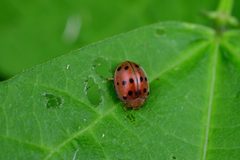
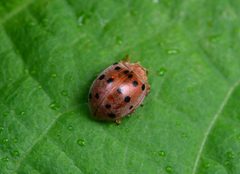
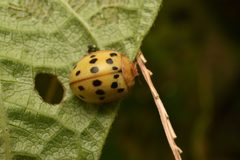
Epilachna varivestis, commonly known as the , is a phytophagous lady beetle native to the high elevations of western Mexico and Central America. It is one of few North American coccinellids that feeds exclusively on plants rather than other insects. The became established in the western United States in the late 1800s and spread rapidly across the eastern United States during the 1920s, reaching southern Canada within five years. It remains a significant agricultural pest of leguminous crops, particularly in the Mid-Atlantic region.
Pronunciation
How to pronounce Epilachna varivestis: //ˌɛpɪˈlæknə ˌværiˈvɛstɪs//
These audio files are automatically generated. While they are not always 100% accurate, they are a good starting point.
Identification
Distinguished from predatory lady beetles by its phytophagous habits and the yellowish pronotum that matches the . Most other lady beetles have a dark pronotum contrasting with lighter elytra. The 16-spot pattern (eight per elytron) and bronze- coloration of mature help separate it from similar . Epilachna borealis (squash lady beetle) feeds on cucurbits rather than legumes. The bright yellow and spiny yellow larvae are distinctive among bean-feeding insects.
Images
Habitat
Agricultural and garden environments with cultivated legumes. All life stages prefer the shaded undersides of leaves. Thrives in areas with moderate temperatures (mid-70s to mid-80s °F), consistent rainfall, and high humidity. Does not tolerate extremely dry conditions.
Distribution
Native to high elevations of western Mexico and Central America. Established throughout Mexico, the eastern United States, and southern Canada (Quebec, Ontario, New Brunswick). Present in western states with irrigation. Also reported in Japan (Honshu) and parts of Central America ( Rica, El Salvador, Guatemala, Honduras). Current severe concentrated in western Virginia, western North Carolina, western Maryland, eastern Tennessee, southern Pennsylvania, and eastern Kentucky.
Seasonality
emerge from in spring when temperatures warm. hatch in approximately one week. Larval development and occur through summer. Adults seek shelter in decaying vegetation or leaf litter to overwinter as temperatures decline in autumn. Peak occur during wet springs and warm summers with high humidity.
Diet
Specialized herbivore feeding on leguminous plants. Strongly prefers Phaseolus including wax beans and green snap beans. Will feed on all types of legumes including lima beans, pinto beans, soybeans, cowpea, and alfalfa. Both larvae and feed by scraping epidermal tissue from leaves, creating skeletonized damage between the .
Host Associations
- Phaseolus vulgaris - primary green snap beans, wax beans
- Phaseolus lunatus - lima beans
- Glycine max - soybeans
- Vigna unguiculata - cowpea
- Medicago sativa - alfalfa
Life Cycle
Complete with four stages. Females deposit bright yellow in clusters on undersides of leaves. Eggs hatch in approximately 7 days. Larvae pass through four instars, feeding on leaf tissue and creating etching damage that progresses to skeletonization as they grow. Larvae complete development and form pupae suspended from leaf undersides. emerge from pupae, initially bright yellow, developing characteristic coloration over several days. Adults feed, mate, and reproduce through summer. As temperatures decline, adults enter and seek shelter in decaying vegetation or leaf litter to overwinter. Single per year in northern areas, multiple generations possible in southern range.
Behavior
Strongly photophobic; all life stages aggregate on shaded undersides of leaves and move to avoid direct light. When disturbed, and larvae release defensive secretions containing noxious alkaloidal compounds that can irritate skin and stain fingers orange. Gregarious feeding , particularly in larval stages. Adults and larvae scrape leaf tissue rather than chewing, removing and mesophyll while leaving intact.
Ecological Role
Agricultural pest causing significant economic damage to legume crops. Subject to by introduced Pediobius foveolatus, which lays in larvae; wasp larvae consume from inside. Serves as prey for including spined soldier bug (Podisus maculiventris). influenced by weather patterns, with favored by cool, wet conditions.
Human Relevance
Major pest of snap beans, lima beans, and soybeans in North America. Can devastate unprotected crops, causing complete crop loss in severe . Management strategies include reflective mulch to exploit light-avoidance , floating , trap cropping with early-planted snap beans, mechanical removal, and with Pediobius foveolatus. Defensive secretions can cause skin irritation and orange staining. Historical in 1960s-1970s Mid-Atlantic region led to widespread crop damage; declined after 1981 due to warming and reduced precipitation, but remain problematic in core range.
Similar Taxa
- Epilachna borealisSquash lady beetle with similar appearance and , but feeds on cucurbits (Cucurbitaceae) rather than legumes; can be distinguished by plant association
- Epilachna vigintioctopunctata28-spotted lady beetle with more spots and different range (Solanaceae, Cucurbitaceae); introduced in South America, not established in North America
- Harmonia axyridisMulticolored Asian lady beetle is predatory on other insects, not phytophagous; has highly variable spot pattern but typically more spots and different body shape
- Coccinella septempunctataSeven-spotted lady beetle is predatory, with seven spots and contrasting dark pronotum; does not feed on plants
More Details
Reflective Mulch Management
Research at Virginia Tech demonstrated that metalized plastic mulch reflecting light onto leaf undersides significantly reduces numbers by exploiting their photophobic . Field trials showed significantly fewer individuals of all life stages and reduced plant damage compared to black plastic or bare ground treatments.
Biological Control Limitations
The Pediobius foveolatus provides effective control but cannot overwinter in North America because the overwinters as while the wasp requires larvae. reintroduction is necessary, making this approach expensive for growers. The wasps also perform poorly in cool, wet weather—the same conditions that favor .
Climate and Population Dynamics
Major in the 1960s-1970s were associated with cooler temperatures, consistent rainfall, and high humidity. declines after 1981 correlated with rising temperatures and reduced precipitation. Recent cooler, wetter conditions along the East Coast may favor renewed population increases.
Sources and further reading
- BugGuide
- GBIF taxonomy match
- iNaturalist taxon
- NCBI Taxonomy
- Catalogue of Life
- Seeing Spots at the Bohart | Bug Squad
- JIPM Article on Mexican Bean Beetles Offers Tips on Controlling These Crop-Damaging Pests
- Bichos Argentinos #11 – Takes Two to Tango | Beetles In The Bush
- Bad lady beetles: Mexican bean beetles, Epilachna varivestis — Bug of the Week
- Lady beetles with a taste for beans: Mexican bean beetles, Epilachna varivestis — Bug of the Week
- Epilachna varivestis . [Distribution map].
- Epilachna varivestis . [Distribution map].
- Mexican Bean Beetle (suggested common name), Epilachna varivestis Mulsant (Insecta: Coleoptera: Coccinellidae)
- The Effect of Host-plant Density on the Numbers of Mexican Bean Beetles, Epilachna varivestis
- Life History of Podisus maculiventris Given Low Numbers of Epilachna varivestis as Prey
- The Chemical Basis of the Host Selection in the Mexican Bean Beetle, Epilachna varivestis (Coleoptera, Coccinellidae)1
- A MODEL OF PREDATION BY PODISUS MACULIVENTRIS (SAY) ON MEXICAN BEAN BEETLE, EPILACHNA VARIVESTIS MULSANT, IN SOYBEANS
- Feeding and Nutrition of Insects Associated with Soybeans: 1. Growth and Development of the Mexican Bean Beetle, Epilachna varivestis,1 on Artificial Media
- Oviposition Choice of Mexican Bean Beetle (Epilachna varivestis) Depends on Host Plants Cyanogenic Capacity
- Beneficial rhizobacteria and virus infection modulate the soybean metabolome and influence the feeding preferences of the virus vector Epilachna varivestis.