
Epilachna
Dejean, 1836
leaf-eating lady beetles, bean beetles
Species Guides
3- Epilachna borealis(Squash Lady Beetle)
- Epilachna tredecimnotata(Southern Squash Lady Beetle)
- Epilachna varivestis(Mexican bean beetle)
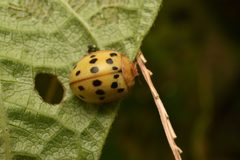
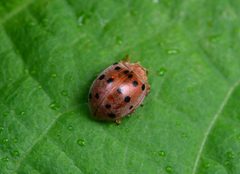
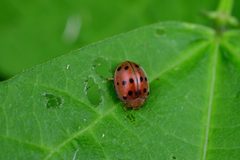
Epilachna is a of leaf-eating lady beetles in the Coccinellidae, comprising approximately 300 primarily distributed in the Western Hemisphere. Unlike the predominantly predatory members of Coccinellidae, Epilachna species are phytophagous, feeding on plant foliage rather than other insects. Several species are significant agricultural pests, including the (E. varivestis) and the squash lady beetle. The genus has been subject to taxonomic revision, with some species historically placed in Epilachna now assigned to related genera such as Henosepilachna.
Pronunciation
How to pronounce Epilachna: /ˌɛpɪˈlæk.nə/
These audio files are automatically generated. While they are not always 100% accurate, they are a good starting point.
Identification
Epilachna resemble typical lady beetles in overall body shape but can be distinguished from predatory Coccinellidae by their phytophagous habits and associated . often have a pronotum colored similarly to the , unlike many predatory lady beetles where the pronotum contrasts sharply with the elytra. Larvae are typically bright yellow with prominent spines, in contrast to the often darker, more cryptic larvae of -feeding lady beetles. Definitive identification to species requires examination of genitalic characters and reference to specialized taxonomic literature.
Images
Habitat
Agricultural fields and gardens where plants occur; natural include areas with native Solanaceae and Cucurbitaceae. occupy environments from high elevation plateaus to lowland regions, with moisture availability being a key factor in persistence.
Distribution
Primarily Western Hemisphere, with native range centered in the Americas. The (E. varivestis) is native to high elevations of western Mexico and Central America, introduced and established across the eastern United States and southern Canada. Some have been introduced outside native ranges; E. vigintioctopunctata, native to India and southeastern Asia, has established in South America. Records exist from North, Central, and South America, with some species extending into the Caribbean.
Seasonality
Activity period varies by and climate. In temperate regions, emerge from refugia in spring, with multiple possible during the growing season. are favored by cool, wet conditions with temperatures in the mid-70s to mid-80s °F and high humidity. Adults seek shelter in decaying vegetation or leaf litter to overwinter.
Diet
Foliage of plants in Solanaceae and Cucurbitaceae; some feed on Leguminosae. and larvae feed by scraping leaf tissue, creating characteristic skeletonized damage. Specific associations vary by species: E. varivestis favors Phaseolus beans, soybeans, and other legumes; E. vigintioctopunctata attacks solanaceous and cucurbitaceous crops including potato, eggplant, and cucumber; E. dodecastigma feeds on cucurbits and brinjal.
Host Associations
- Phaseolus vulgaris (common bean) - primary preferred by E. varivestis, especially wax and green snap beans
- Glycine max (soybean) - secondary for E. varivestis during
- Solanum tuberosum (potato) - significant for E. vigintioctopunctata in India
- Solanum melongena (eggplant/brinjal) - preferred for E. dodecastigma and E. vigintioctopunctata
- Cucumis sativus (cucumber) - preferred most preferred for E. dodecastigma among tested cucurbits
- Cucurbita spp. (squash, pumpkin) - for multiple Epilachna
- Lagenaria siceraria (bottle gourd) - least preferred cucurbit for E. dodecastigma
Life Cycle
Females deposit bright yellow in clusters on the undersides of leaves. Larvae hatch and feed gregariously, passing through multiple instars while consuming leaf tissue. Larval development is followed by , with pupae typically attached to the undersides of leaves. emerge from pupae and continue feeding. In temperate regions, adults overwinter in protected locations. Developmental rates and are temperature-dependent, with 25°C being optimal for some .
Behavior
and larvae preferentially occupy the shaded undersides of leaves, moving to avoid direct light exposure. When disturbed, adults and larvae release defensive secretions containing alkaloidal compounds that can irritate skin and stain fingers orange. Larvae often feed in groups of 2–3 individuals. Adults are capable of and disperse to find new plants.
Ecological Role
Herbivore; agricultural pest causing defoliation and yield reduction in susceptible crops. can result in complete crop loss. Some may serve as for plant , including viruses. Natural enemies include , particularly Pediobius foveolatus, which attacks larvae.
Human Relevance
Significant agricultural pest requiring management in bean, squash, and other vegetable crops. Control methods include reflective mulch to exploit light-avoidance , , trap cropping, mechanical removal, and using . The has historically caused major crop losses in the eastern United States, with particularly severe in the Mid-Atlantic region during the 1960s–1970s. Climate change may be expanding suitable for some .
Similar Taxa
- HenosepilachnaHistorically included now separated based on morphological characters; both contain phytophagous lady beetles with similar habits and associations
- Aphid-feeding Coccinellidae (e.g., Harmonia, Coccinella)Similar appearance but predatory rather than phytophagous; distinguished by , larval coloration, and ecological context
Misconceptions
Despite being lady beetles (Coccinellidae), Epilachna are not beneficial but destructive plant feeders. The 'lady beetle' or 'ladybug' applied to E. varivestis and related species may mislead growers into delaying control measures. Additionally, E. vigintioctopunctata has been referred to by both Epilachna and Henosepilachna in literature, causing taxonomic confusion.
More Details
Taxonomic history
The was revised by R.D. Gordon in 1975, who treated nearly 300 in Epilachninae for the Western Hemisphere. Subsequent work has reassigned some species to related genera.
Light-avoidance behavior
Research has demonstrated that all life stages avoid illuminated leaf surfaces, a exploited by reflective mulch management strategies that reduce by increasing light exposure on normally shaded undersides.
Defensive chemistry
Defensive secretions contain alkaloidal compounds that serve as antipredator adaptations; these compounds can cause skin irritation and discoloration in humans handling the beetles.
Sources and further reading
- BugGuide
- Wikipedia
- GBIF taxonomy match
- iNaturalist taxon
- NCBI Taxonomy
- Catalogue of Life
- Bad lady beetles: Mexican bean beetles, Epilachna varivestis — Bug of the Week
- Lady beetles with a taste for beans: Mexican bean beetles, Epilachna varivestis — Bug of the Week
- Coccinelidae | Beetles In The Bush
- JIPM Article on Mexican Bean Beetles Offers Tips on Controlling These Crop-Damaging Pests
- Host Preference of Epilachna Beetle, Epilachna dodecastigma (Wied.) among Cucurbitaceous Vegetables
- Status, bioecology and management of Epilachna beetle, Epilachna vigintioctopunctata (Fab.) (Coleoptera: Coccinellidae) on potato in India: A review
- Studies on the chemical basis of hostplant selection in the genus Epilachna (Coleoptera, Coccinellidae)—I. A volatile phagostimulant in Solanum campylacanthum for Epilachna fulvosignata
- Effect of Temperature on the Bahaviour of Epilachna Beetle (Epilachna dodecastigma Wied.) among Different Brinjal Varieties
- Efficacy of Neem Oil on the Biology and Food Consumption of Epilachna Beetle, <i>Epilachna dodecastigma</i> (Wied.)
- Comparative study on host preference and damage potentiality of Red pumpkin beetle, Aulacophora foveicollis and Epilachna beetles, Epilachna dodecastigma
- Epilachna varivestis . [Distribution map].
- Epilachna chrysomelina . [Distribution map].
- Beneficial rhizobacteria and virus infection modulate the soybean metabolome and influence the feeding preferences of the virus vector Epilachna varivestis.
- The Role of Henosepilachna vigintioctopunctata in Facilitating the Spread of Tomato Brown Rugose Fruit Virus (ToBRFV) Among Hosts.