
Thyridopteryx ephemeraeformis
(Haworth, 1803)
Evergreen Bagworm Moth, Eastern Bagworm, Common Bagworm, Common Basket Worm, North American Bagworm
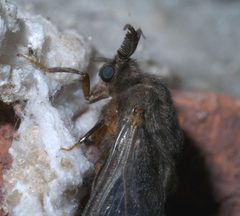
Thyridopteryx ephemeraeformis, the evergreen , is a pest in the Psychidae. Larvae construct distinctive silken bags decorated with plant fragments, which they carry throughout their development. Males emerge as winged with nearly -free, transparent wings—reflected in the name derived from Greek thyris (window) and ptera (wing). Females remain wingless and never leave their bags, releasing to attract mates. The species exhibits remarkable in both and , with males and females showing differential stratification on trees and distinct heights.
Pronunciation
How to pronounce Thyridopteryx ephemeraeformis: //ˌθaɪrɪˈdɒptərɪks ˌɛfɪmərɛəˈfɔːrmɪs//
These audio files are automatically generated. While they are not always 100% accurate, they are a good starting point.
Identification
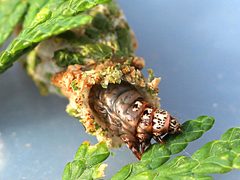
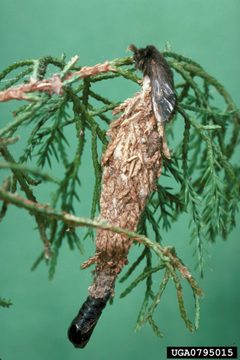
Males distinguished from other Psychidae by nearly -free transparent wings; females identified by presence within decorated silken bag. Larval bags distinguished from plant parts by attached fragments of multiple plant oriented with ends downward, and by visible and legs of caterpillar on warm days. Bags on evergreens often mistaken for cones or fruits. Differentiated from Dahlica triquetrella and other bagworm species by larger size and use of diverse plant material rather than uniform substrate.
Images
Habitat
Urban and landscape settings, particularly in Florida and eastern North America; occurs in areas with trees and shrubs including regions below USDA hardiness zone 8A where preferred plants are limited. Found on Juniperus virginiana (eastern red cedar), Thuja (arborvitae), and numerous ornamental evergreens. In Bangladesh, found on guava, mango, pomegranate, and other fruit trees.
Distribution
North America, primarily eastern and central United States; recorded in Missouri in 49 counties with 285 occurrences. Southwestern T. alcora and T. meadii distinct. Also established in southern Australia and Bangladesh as introduced pest.
Seasonality
activity in late summer, primarily August through September; larval by ballooning occurs mid-May and lasts approximately one month; overwinter within female bags.
Diet
Highly , feeding on foliage of over 50 and more than 125 of woody plants. Preferred are Juniperus and Thuja species; also feeds on spruce, pine, Leyland cypress, maple, sycamore, and numerous ornamental shrubs. In Bangladesh, documented on guava, arborvitae/juniper, Ixora, Mussaenda, Acalypha, henna, mango, pomegranate, and betel nut.
Host Associations
- Juniperus virginiana - primary Eastern red cedar; preferred in North America
- Thuja occidentalis - primary Arborvitae; preferred in North America
- Thuja standishii - Documented in Bangladesh
- Psidium guajava - Guava; highest levels recorded in Bangladesh study
- Cupressocyparis leylandii - Leyland cypress; common ornamental
- Juniperus - primary Multiple
- Thuja - primary Multiple
- Picea - Spruce
- Pinus - Pine
- Acer - Maple; larvae show from maple unlike from juniper/arborvitae
Life Cycle
overwinter within maternal bags. larvae emerge in early June, with some ballooning on silk threads to disperse to new . Larvae construct bags and enlarge them as they grow, feeding throughout summer. occurs within bags in late summer. Males emerge as winged , fly to female bags, and insert extensible through bag tip to mate. Females remain wingless in bags, lay 200–1000+ eggs, then emerge to fall to ground and die. Complete defoliation of conifers can kill host in single season.
Behavior
Larvae construct portable silken bags decorated with plant fragments, carried throughout development. Bags modify internal temperature, remaining significantly warmer than ambient air in both sun and shade. larvae disperse by ballooning on silk threads; ~75% form bags before ballooning. Bag construction reduces velocity but increases survival by ~2 days when exposed to off-host. Larvae show host-specific settlement : become sedentary after exposure to arborvitae/juniper but repeatedly disperse from maple. Males and females exhibit differential vertical stratification on host trees—females ascend crown, males remain at lower heights. Males attracted to synthetic 1-methylbutyl decanoate and attempt copulation with -impregnated objects.
Ecological Role
Significant pest of ornamental evergreens and landscape plants; severe damage aesthetics and health of plants, with complete defoliation capable of killing conifers in single season. Subject to by including Itoplectis conquisitor (ichneumonid, 75.9% of ). Pupal parasitism greater for males due to lower height. Also serves as host for predatory Chalcoela iphitalis and parasitoid wasp Calliephialtes grapholithae.
Human Relevance
Major pest of ornamental landscaping and Christmas tree plantations. Management through manual removal (handpicking) effective for small ; 92% control achieved but labor-intensive. including Bacillus thuringiensis (Bt) effective for small larvae, spinosad for larger larvae. using synthetic 1-methylbutyl decanoate suppresses mating by 87% at proper application rates. Subject of extensive research due to economic impact on urban forestry.
Similar Taxa
- Dahlica triquetrellaSmaller bagworm with bags usually mistaken for dirt or wood fragments; lacks diverse plant material decoration of T. ephemeraeformis
- Thyridopteryx rileyiCongeneric known from old literature records in Missouri but not recently confirmed; T. ephemeraeformis distinguished by commonness and widespread documentation
- Thyridopteryx davidsoniCongeneric with no confirmed records from Missouri; T. ephemeraeformis is only reliably documented species in eastern North America
Misconceptions
Bags frequently mistaken for plant parts such as pinecones or fruits, leading to delayed detection of . Female bags with often overlooked as dead plant material. Not a true worm despite 'bagworm'—is a larva.
More Details
Sexual dimorphism in pupation behavior
Males and females show differential stratification on trees by third instar; females gradually ascend crown while males remain at same height, resulting in greater pupal of males due to concentration at lower tree levels.
Pheromone biology
Female identified as 1-methylbutyl decanoate; unusual among Lepidoptera as a non-aliphatic compound. Males show sensory or central nervous to synthetic at high concentrations, enabling as management tactic.
Temperature modification by bags
Bags significantly elevate temperature above ambient in both sun and shade; surface and internal temperatures similar regardless of or larval presence. This may benefit development.
Ballooning behavior patterns
Caseless larvae balloon primarily in morning; 80% of larvae with cases balloon in afternoon. Timing linked to daily periodicity of from overwintered female bags and subsequent pre- .
Feeding damage quantification
In Bangladesh study, maximum leaf area consumption of 13.46 cm² recorded at 72 hours after release on guava; highest percent leaf damage (86.23%) on guava versus 37.46% on copperleaf. concentrated in lower stratum of branches.
Sources and further reading
- BugGuide
- GBIF taxonomy match
- iNaturalist taxon
- NCBI Taxonomy
- Catalogue of Life
- Psychidae | Beetles In The Bush
- Not quite adult | Beetles In The Bush
- Bug Eric: A Potential New Host Record for Calliephialtes grapholithae (Hymenoptera: Ichneumonidae) from a Paper Wasp nest (Hymenoptera: Vespidae: Polistes metricus)
- Lepidoptera | Beetles In The Bush | Page 7
- November | 2012 | Beetles In The Bush
- Snap to it and bag a bagworm! - Thyridopteryx ephemeraeformis — Bug of the Week
- Bagworm, Thyridopteryx ephemeraeformis Haworth (Insecta: Lepidoptera: Psychidae)
- AERIAL DISPERSAL BEHAVIOR OF LARVAL BAGWORMS, THYRIDOPTERYX EPHEMERAEFORMIS (LEPIDOPTERA: PSYCHIDAE)
- TEMPERATURE MODIFICATION BY BAGS OF THE BAGWORMTHYRIDOPTERYX EPHEMERAEFORMIS(LEPIDOPTERA: PSYCHIDAE)
- Distribution and Pathogenicity of Fungi Associated with the Bagworm, Thyridopteryx ephemeraeformis (Haworth) 12
- Efficacy and Costs Associated with the Manual Removal of Bagworms, Thyridopteryx ephemeraeformis, from Leyland Cypress
- Observations on the Biology and Behavior of the Evergreen Bagworm Moth, Thyridopteryx ephemeraeformis (Lepidoptera: Psychidae)
- Regularities in the Size and Orientation of Juniper Fragments Attached to the Cases of the Bagworm, Thyridopteryx ephemeraeformis (Haw.)
- FACTORS AFFECTING THE SURVIVAL OF LARVAL AND PUPAL STAGES OF THE BAGWORM, THYRIDOPTERYX EPHEMERAEFORMIS (LEPIDOPTERA: PSYCHIDAE)
- Aerial dispersal and host plant selection by neonate Thyridopteryx ephemeraeformis (Lepidoptera: Psychidae)
- Host range, damage extent and leaf consumptions by the bagworm, Thyridopteryx ephemeraeformis Haw. (Lepidoptera: Psychidae) in Bangladesh
- Differential stratification, movement and parasitism of sexes of the bagworm, Thyridopteryx ephemeraeformis on redcedar
- Studies of Ballooning and Resulting Patterns of Locally Contagious Distribution of the Bagworm Thyridopteryx ephemeraeformis (Haworth) (Lepidoptera: Psychidae)
- Suppression of female bagworm, Thyridopteryx ephemeraeformis reproduction potential with its sex pheromone, 1‐methylbutyl decanoate