
Dahlica triquetrella
(Hübner, 1813)
Narrow Lichen Bagworm, Narrow Lichen Case-bearer
Dahlica triquetrella is a small bagworm moth in the Psychidae, notable for its distinctive triangular larval case and unusual reproductive . The exists in both sexual and parthenogenetic forms, with the latter being far more widespread. Sexual are restricted to isolated glacial refugia in Central Europe, while parthenogenetic populations span much of Europe and have been introduced to North America. The species is specialized on lichen-feeding and is often overlooked due to the small size and cryptic appearance of its larval cases.
Pronunciation
How to pronounce Dahlica triquetrella: /ˈdaː.li.ka triː.kʷeˈtrel.la/
These audio files are automatically generated. While they are not always 100% accurate, they are a good starting point.
Identification
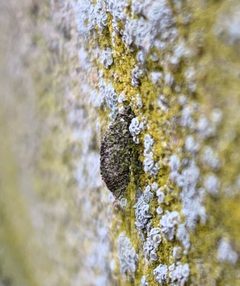
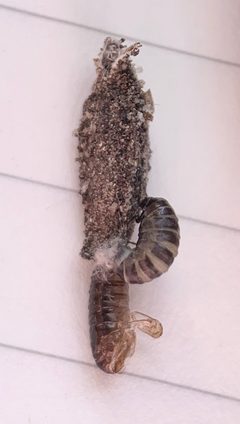
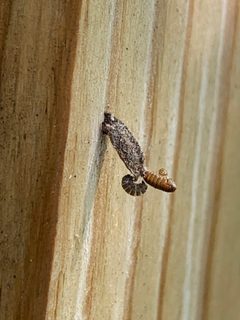
Larval case is diagnostic: small (4–6 mm), distinctly triangular in cross-section, flattened ventrally, tapered at both ends, and covered with debris including characteristic insect fragments. Cases are attached to tree trunks, posts, and walls at 1–2 m height. rarely seen; males can be distinguished from other small Psychidae by narrow wing shape and spotted pattern. The combination of tiny triangular case and lichen-feeding habit separates it from the larger, more conical evergreen bagworm (Thyridopteryx ephemeraeformis) and other Psychidae.
Images
Habitat
Deciduous and coniferous forests, shrublands, and rocky slopes. Sexual restricted to specific glacial refugia . Larval cases found attached to trunks, posts, and walls at typical heights of 1–2 meters.
Distribution
Europe: sexual in isolated relict areas including parts of the Alps, Swiss Jura, Reichswald near Nuremberg, Danube Valley between Passau and Linz, Adelegg, and high altitudes near Trieste. Parthenogenetic populations distributed from England eastward through Central and Eastern Europe to Russia, with isolated populations in Northern, Western, and Southern Europe. Introduced to North America.
Seasonality
In southern Germany, larval up tree trunks observed in early second half of February, followed by within the case; emerge after approximately three weeks. Both sexes have very short adult lifespan, often only a few hours.
Diet
Caterpillars preferentially feed on the lichen Lepraria incana.
Host Associations
- Lepraria incana - primary food sourcePreferred lichen for larvae
Life Cycle
Larva remains within protective case throughout development; pupates inside case. Male emerges from case and seeks out flightless female, who sits outside her sac tube, for mating. Parthenogenetic females begin laying shortly after hatching without mating. Case construction begins early in larval life and is carried throughout development.
Behavior
Larvae migrate up tree trunks with their cases prior to . Male actively seek females for the brief mating period. Parthenogenetic via thelytoky in widespread .
Ecological Role
Specialized lichen feeder; larval cases contribute to microhabitat structure on woody substrates. The represents a case study in parthenogenetic evolution and glacial relict .
Human Relevance
Sexual classified as geographically restricted and of conservation concern in Germany (Bavaria and Baden-Württemberg). Parthenogenetic form is common and not considered endangered. Occasionally noted in ecological studies of lichen and forest diversity.
Similar Taxa
- Thyridopteryx ephemeraeformisEvergreen bagworm is much larger with conical plant-covered bags; D. triquetrella has small triangular cases with insect fragments and lichen diet.
- Other PsychidaeMost bagworms have cylindrical or irregular cases; the distinctly triangular flattened case of D. triquetrella is unique among European .
More Details
Reproductive polymorphism
The exhibits both and tetraploid parthenogenetic forms in addition to sexual , making it a significant subject for studies on the evolution and maintenance of sex.
Glacial relict distribution
Sexual are restricted to areas that remained ice-free during the Riss and Würm glaciations, supporting the hypothesis that spread post-glacially while sexual populations persisted only in specific refugia.