
Thyridopteryx
Stephens, 1835
bagworm moths
Species Guides
2- Thyridopteryx ephemeraeformis(Evergreen Bagworm Moth)
- Thyridopteryx meadii(Creosote Bush Bagworm)
Thyridopteryx is a of bagworm moths (Psychidae) comprising five described . The genus is best known for T. ephemeraeformis, the evergreen bagworm or North American bagworm, a significant pest of ornamental and landscape plants. Larvae construct protective cases from silk and plant fragments, which they carry throughout their development. The genus exhibits unusual : males are winged and capable of , while females are wingless and remain within their cases for life.
Pronunciation
How to pronounce Thyridopteryx: /θaɪˌrɪdəpˈtɛrɪks/
These audio files are automatically generated. While they are not always 100% accurate, they are a good starting point.
Identification
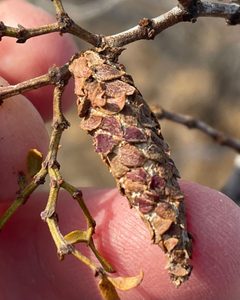
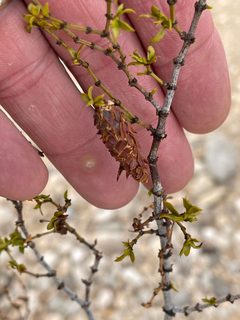
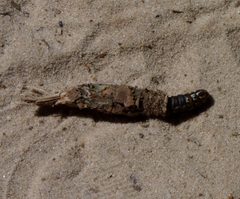
Members of Thyridopteryx are distinguished from other Psychidae by their larval case and associations. Larval cases are typically conical, constructed from silk interwoven with plant fragments oriented with ends directed downward. Cases of T. ephemeraeformis often resemble small pinecones, leading to misidentification as plant parts. males are small, dark with clear wings; females are maggot-like, wingless, and never leave their cases.
Images
Habitat
Larvae occur on woody plants in urban, residential, and natural landscapes. T. ephemeraeformis has been documented on over 50 of deciduous and evergreen trees and shrubs, with particular affinity for Juniperus and Thuja .
Distribution
Eastern North America, with T. ephemeraeformis extending from the northeastern United States through the southeastern states and into the Midwest. The has been introduced to other regions; T. ephemeraeformis has been recorded in Bangladesh and southern Australia.
Diet
Larvae are highly foliage feeders. T. ephemeraeformis has been documented feeding on over 125 of woody plants across 45 , including juniper, arborvitae, spruce, pine, Leyland cypress, maple, sycamore, and numerous ornamental species.
Host Associations
- Juniperus virginiana - primary eastern red cedar
- Thuja occidentalis - primary arborvitae
- ×Cupressocyparis leylandii - Leyland cypress
- Psidium guajava - guava (Bangladesh record)
- Thuja standishii - arborvitae/juniper (Bangladesh record)
- Ixora grandiflora - rangan/jungle geranium (Bangladesh record)
- Mussaenda philippica - mussaenda (Bangladesh record)
- Acalypha wilkesiana - copperleaf (Bangladesh record)
- Lawsonia inermis - henna (Bangladesh record)
- Mangifera indica - mango (Bangladesh record, no significant damage observed)
- Punica granatum - pomegranate (Bangladesh record, no significant damage observed)
- Areca catechu - betel nut (Bangladesh record, no significant damage observed)
Life Cycle
overwinter inside the maternal case. larvae emerge in late spring (mid-May in Kentucky), disperse by ballooning on silk threads, and construct individual cases from silk and plant material. Cases are enlarged as larvae grow through instars. occurs within the case in late summer. Males emerge as winged and fly to locate females; females remain in their cases, release to attract males, and mate without leaving the case. After mating, females lay 200–1000+ eggs within the case, then exit, fall to the ground, and die.
Behavior
larvae disperse by ballooning (silking) on wind currents. Approximately 75% of dispersing larvae construct cases before ballooning. Case-carrying larvae balloon primarily in the afternoon; caseless larvae balloon mainly in the morning. Larvae exhibit selection : they readily settle on arborvitae and juniper foliage but tend to disperse from maple and other deciduous hosts. Cases function as thermal modifiers, maintaining temperatures significantly above ambient in both sun and shade. Male and female larvae exhibit differential stratification on host trees: females gradually ascend the crown while males remain at lower heights.
Ecological Role
Larvae are significant defoliators of ornamental and landscape plants. Severe can kill evergreen in a single season. The serves as host for including Itoplectis conquisitor (primary parasitoid), Calliephialtes grapholithae, and other ichneumonid and chalcidoid parasitoids. Larval cases provide for associated fungi.
Human Relevance
T. ephemeraeformis is a major pest of urban and suburban landscaping, causing substantial economic damage to nurseries and residential plantings. Control methods include manual removal of cases (92% efficacy demonstrated), applications (Bacillus thuringiensis for small larvae, spinosad for larger larvae), and using synthetic (1-methylbutyl decanoate, which suppressed mating by 87% in field trials). The is monitored by the USA National Network Pheno Forecast system to optimize management timing.
Similar Taxa
- Dahlica triquetrellaBoth are Psychidae with case-bearing larvae, but Dahlica cases are much smaller, composed of detritus rather than oriented plant fragments, and often mistaken for dirt or wood particles.
- Chalcoela iphitalisLarvae occur in similar ( nests) and may be confused, but C. iphitalis is a crambid with predatory larvae that feed on wasp , not plant material.
Sources and further reading
- BugGuide
- Wikipedia
- GBIF taxonomy match
- iNaturalist taxon
- NCBI Taxonomy
- Catalogue of Life
- Snap to it and bag a bagworm! - Thyridopteryx ephemeraeformis — Bug of the Week
- Notodontidae | Beetles In The Bush
- Not quite adult | Beetles In The Bush
- Bug Eric: A Potential New Host Record for Calliephialtes grapholithae (Hymenoptera: Ichneumonidae) from a Paper Wasp nest (Hymenoptera: Vespidae: Polistes metricus)
- National Phenology Network Aids Pest Management With Insect Forecast Maps
- Catch a Glimpse of Caterpillars During National Moth Week
- Bagworm, Thyridopteryx ephemeraeformis Haworth (Insecta: Lepidoptera: Psychidae)
- AERIAL DISPERSAL BEHAVIOR OF LARVAL BAGWORMS, THYRIDOPTERYX EPHEMERAEFORMIS (LEPIDOPTERA: PSYCHIDAE)
- TEMPERATURE MODIFICATION BY BAGS OF THE BAGWORMTHYRIDOPTERYX EPHEMERAEFORMIS(LEPIDOPTERA: PSYCHIDAE)
- Distribution and Pathogenicity of Fungi Associated with the Bagworm, Thyridopteryx ephemeraeformis (Haworth) 12
- Observations on the Biology and Behavior of the Evergreen Bagworm Moth, Thyridopteryx ephemeraeformis (Lepidoptera: Psychidae)
- Efficacy and Costs Associated with the Manual Removal of Bagworms, Thyridopteryx ephemeraeformis, from Leyland Cypress
- Regularities in the Size and Orientation of Juniper Fragments Attached to the Cases of the Bagworm, Thyridopteryx ephemeraeformis (Haw.)
- FACTORS AFFECTING THE SURVIVAL OF LARVAL AND PUPAL STAGES OF THE BAGWORM, THYRIDOPTERYX EPHEMERAEFORMIS (LEPIDOPTERA: PSYCHIDAE)
- Aerial dispersal and host plant selection by neonate Thyridopteryx ephemeraeformis (Lepidoptera: Psychidae)
- Host range, damage extent and leaf consumptions by the bagworm, Thyridopteryx ephemeraeformis Haw. (Lepidoptera: Psychidae) in Bangladesh
- Differential stratification, movement and parasitism of sexes of the bagworm, Thyridopteryx ephemeraeformis on redcedar
- Studies of Ballooning and Resulting Patterns of Locally Contagious Distribution of the Bagworm Thyridopteryx ephemeraeformis (Haworth) (Lepidoptera: Psychidae)
- Suppression of female bagworm, Thyridopteryx ephemeraeformis reproduction potential with its sex pheromone, 1‐methylbutyl decanoate