
Itoplectis conquisitor
(Say, 1835)
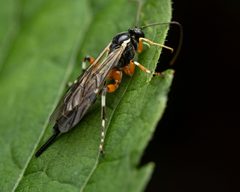
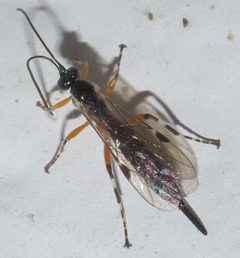
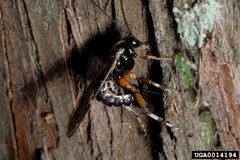
Itoplectis conquisitor is an ichneumonid endoparasitoid first described by Thomas Say in 1835. The is notable for its broad range and has been extensively studied for its potential in . can be maintained on artificial diets without host material, and the species was the first parasitic insect reared on an artificial host. Females exhibit associative learning capabilities and can be conditioned to host-associated cues.
Pronunciation
How to pronounce Itoplectis conquisitor: /ˌaɪtoʊˈplektɪs kənˈkwɪsɪtɔr/
These audio files are automatically generated. While they are not always 100% accurate, they are a good starting point.
Images
Distribution
Native to North America with records from the East Coast (Pennsylvania to Florida), West Coast (British Columbia to Central America and Ecuador), and north to Québec, Canada and Alaska. Sparse regional observations in Western North America. Introduced reported in Europe.
Host Associations
- Galleria mellonella - pupa (larval development, feeding)Blood used in natural food regimen for ; artificial diets can substitute
- Thymelicus lineola - No preimaginal conditioning observed when reared on this
- Thyridopteryx ephemeraeformis - Bagworm; accounted for 58% of parasitized individuals in Virginia study; inversely related to size, with ovipositor length insufficient to penetrate hosts >57 mm
- Rhyacionia buoliana - European pine shoot moth; abundance influenced by tree
- Celerio euphorbiae - used in oviposition induction studies
Life Cycle
Endoparasitoid development occurs within pupae. First successful rearing on artificial host achieved in 1978, producing males from encapsulated synthetic medium. Larval nutritional requirements have been established for chemically-defined synthetic diet rearing, with initial yields of approximately 17% adults in .
Behavior
Females exhibit associative learning: can be conditioned to associate color with presence, affecting searching but not attack distribution once hosts are located. Innate preference for blue over yellow demonstrated. Can be conditioned to attack tubes of particular lengths or diameters and tubes mounted on pins rather than plastic forms, suggesting recognition of host shelter characteristics. No preimaginal conditioning: no preference for natal host when exposed to alternative hosts.
Ecological Role
endoparasitoid of lepidopteran pupae. Potential selective agent for size at . Practices multiparasitism. Not considered a significant control agent of host due to size-dependent limitations.
Human Relevance
Studied extensively as a model organism for and artificial rearing techniques. Development of artificial diets and rearing methods facilitates mass production for potential applications. Research on associative learning and -searching informs biological control release strategies.
Sources and further reading
- BugGuide
- Wikipedia
- GBIF taxonomy match
- iNaturalist taxon
- NCBI Taxonomy
- Catalogue of Life
- Associative Learning in Itoplectis conquisitor (Say) (Hymenoptera: Ichneumonidae)
- Absence of Preimaginal Conditioning in Itoplectis conquisitor (Say) (Hymenoptera: Ichneumonidae)
- ARTIFICIAL DIETS FOR THE ADULT PARASITOID ITOPLECTIS CONQUISITOR (HYMENOPTERA: ICHNEUMONIDAE)
- The Change in Fatty Acid Pattern of Itoplectis conquisitor (Say) Reared on Different Hosts
- The Inconsistent phospolipid fatty acid composition in an insect parasitoid Itoplectis conquisitor (say) (Lepidoptera: pyralidae).
- HOST HEMOLYMPH CHEMICALS THAT INDUCE OVIPOSITION IN THE PARASITEITOPLECTIS CONQUISITOR(HYMENOPTERA: ICHNEUMONIDAE)
- A chemically defined synthetic diet and larval nutritional requirements of the endoparasitoid Itoplectis conquisitor (Hymenoptera)
- Influence of Food on Fecundity and Longevity of Adults of Itoplectis conquisitor (Say) (Hymenoptera: Ichneumonidae)
- AN HYMENOPTEROUS INSECT, THE PARASITOID ITOPLECTIS CONQUISITOR, REARED AXENICALLY ON A CHEMICALLY-DEFINED SYNTHETIC DIET
- A CHEMICALLY DEFINED, SYNTHETIC MEDIUM THAT INDUCES OVIPOSITION IN THE PARASITEITOPLECTIS CONQUISITOR(HYMENOPTERA: ICHNEUMONIDAE)
- The influence of host distribution, sex, and size on the level of parasitism by Itoplectis conquisitor (Hymenoptera: Ichneumonidae)
- INFLUENCE OF POSITION AND SIZE OF HOST SHELTER ON HOST-SEARCHING BY ITOPLECTIS CONQUISITOR (HYMENOPTERA: ICHNEUMONIDAE)
- AN ARTIFICIAL HOST: ENCAPSULATED SYNTHETIC MEDIUM FORIN VITROOVIPOSITION AND REARING THE ENDOPARASITOIDITOPLECTIS CONQUISITOR(HYMENOPTERA: ICHNEUMONIDAE)
- Influence of Host Tree on Abundance of Itoplectis conquisitor (Say) (Hymenoptera: Ichneumonidae), a Polyphagous Parasite of the European Pine Shoot Moth, Rhyacionia buoliana (Schiff.) (Lepidoptera: Olethreutidae)