
Itoplectis
Förster, 1869
Species Guides
2Itoplectis is a of in the Ichneumonidae, first described by Arnold Förster in 1869. The genus contains approximately 35 to 61 recognized with distribution. Members are solitary parasitoids that attack lepidopteran pupae and have been studied extensively for their potential as agents. Several species, particularly I. conquisitor and I. naranyae, serve as model organisms for research on parasitoid , learning, and chemical .
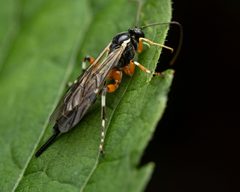
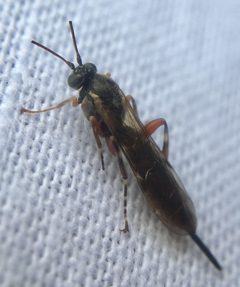
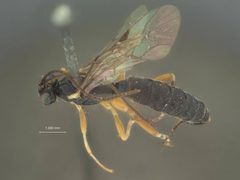
Pronunciation
How to pronounce Itoplectis: /ˌaɪtoʊˈplɛktɪs/
These audio files are automatically generated. While they are not always 100% accurate, they are a good starting point.
Images
Distribution
distribution. Documented occurrence records include Denmark, Norway, Sweden, and the United States (Vermont).
Host Associations
- Galleria mellonella - Used for rearing and as natural food source for ; pupa blood serves as natural food regimen
- Thymelicus lineola - Rearing ; no preimaginal conditioning observed
- Celerio euphorbiae - Source of chemicals inducing oviposition in I. conquisitor
- Coptocycla texana - for I. mexicanus (pupa)
Behavior
Females of I. conquisitor exhibit associative learning, capable of linking color cues with presence to improve searching ; this conditioning affects host searching but not attack distribution once hosts are located. The shows an innate preference for blue over yellow. I. conquisitor lacks preimaginal conditioning— show no preference for their natal host regardless of rearing experience. I. naranyae females emit volatile most strongly shortly after , attracting males; older males (30 days) are most responsive, and males with prior female experience respond more strongly than naïve males. Field tests confirm virgin females attract wild males, indicating chemically mediated mate finding operates at close to moderate ranges.
Ecological Role
solitary of lepidopteran pupae. Functions as a agent. Sex ratio in I. naranyae is adaptively controlled in response to size, with host-size dependent sex allocation documented in field .
Human Relevance
Studied as a agent for management of lepidopteran pests. Artificial diets (liquid and candied) have been developed for I. conquisitor that eliminate the need for material while maintaining equivalent to natural food regimens, facilitating mass rearing for biocontrol programs. traps show potential for monitoring and managing I. naranyae . Conditioning to specific host plant cues prior to release may improve establishment success against target pests.
More Details
Taxonomic History
The was first described by Arnold Förster in 1869. Kasparyan recognized approximately 35 , while GBIF includes 61 species. Notable described species include I. conquisitor (Say, 1836), I. maculator (Fabricius, 1775), I. melanocephala (Gravenhorst, 1829), and I. naranyae (Ashmead, 1906).
Oviposition Stimuli
In I. conquisitor, oviposition is induced by chemicals. The active fraction consists of hexoses and approximately 19 common ; hexoses may act as synergists. I. conquisitor oviposits in hemolymph of Lepidoptera, Hymenoptera, Coleoptera, and Trichoptera, but not in Hemiptera, Orthoptera, Neuroptera, Plecoptera, or Crustacea.
Host Shelter Recognition
I. conquisitor can be conditioned to attack tubes of particular lengths or diameters and to distinguish tubes mounted on pins versus plastic forms. However, females cannot distinguish between horizontal and vertical tubes of the same size and cannot be conditioned to prefer horizontal orientations.
Sources and further reading
- BugGuide
- Wikipedia
- GBIF taxonomy match
- iNaturalist taxon
- NCBI Taxonomy
- Catalogue of Life
- Associative Learning in Itoplectis conquisitor (Say) (Hymenoptera: Ichneumonidae)
- Absence of Preimaginal Conditioning in Itoplectis conquisitor (Say) (Hymenoptera: Ichneumonidae)
- ARTIFICIAL DIETS FOR THE ADULT PARASITOID ITOPLECTIS CONQUISITOR (HYMENOPTERA: ICHNEUMONIDAE)
- Adaptiveness of sex ratio control by the pupal parasitoid Itoplectis naranyae (Hymenoptera: Ichneumonidae) in response to host size
- Estimation of Host-Size Dependent Sex Ratio in the Polyphagous Parasitoid Itoplectis naranyae ASHMEAD (Hymenoptera: Ichneumonidae) in the Field
- Chemically Mediated Mate Finding of the Polyphagous Solitary Parasitoid Itoplectis naranyae (Hymenoptera: Ichneumonidae)
- The Change in Fatty Acid Pattern of Itoplectis conquisitor (Say) Reared on Different Hosts
- Relationship between Female Size and Host-feeding Behavior in the Parasitoid Wasp Itoplectis naranyae (Hymenoptera : Ichneumonidae)
- The Effects of Prior Host Experience and Egg Load on Host Acceptance Behavior of the Parasitoid Itoplectis naranyae (Hymenoptera : Ichneumonidae) on Empty Hosts
- Host Age Preference and Sex Allocation in the Pupal Parasitoid Itoplectis naranyae (Hymenoptera: Ichneumonidae)
- INFLUENCE OF POSITION AND SIZE OF HOST SHELTER ON HOST-SEARCHING BY ITOPLECTIS CONQUISITOR (HYMENOPTERA: ICHNEUMONIDAE)
- HOST HEMOLYMPH CHEMICALS THAT INDUCE OVIPOSITION IN THE PARASITEITOPLECTIS CONQUISITOR(HYMENOPTERA: ICHNEUMONIDAE)