
Thymelicus lineola
(Ochsenheimer, 1808)
Essex Skipper, European Skipper
Thymelicus lineola is a small native to Europe and introduced to North America prior to 1910. In Europe it is known as the Essex Skipper; in North America it is called the European Skipper. The has spread extensively across eastern Canada and the northern United States, with established as far west as British Columbia. It is with five larval instars. are active in summer and exhibit thermoregulatory basking . Males use perching and patrolling strategies to locate mates and release from androconial scent during courtship.
Pronunciation
How to pronounce Thymelicus lineola: /ˈθaɪ.mɛl.ɪ.kəs lɪˈneɪ.oʊ.lə/
These audio files are automatically generated. While they are not always 100% accurate, they are a good starting point.
Identification
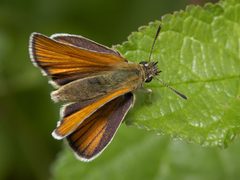
Distinguished from the similar Small Skipper (Thymelicus sylvestris) by the black tip of the club, which extends along the upper edge (T. sylvestris has an orange tip). The sex brand on the male forewing is a short, straight line rather than the longer, curved line found in T. sylvestris. Underside of hindwing is greenish-gray. Wingspan approximately 24–28 mm.
Images
Habitat
Grassy areas including meadows, pastures, roadsides, and hayfields. In Europe, agricultural practices have reduced its presence in hayfields. Larvae develop on various grasses. require sunny conditions for activity and avoid shaded areas for oviposition.
Distribution
Native to Europe and northern Asia. Introduced to North America prior to 1910, with established throughout southern Ontario, Quebec, Manitoba, and parts of the northern United States including Michigan, Ohio, New York, Pennsylvania, Maryland, New Jersey, and Connecticut. Range extends west to British Columbia.
Seasonality
. active from late June to August in North America, with peak activity varying by region and year. , larval, and pupal stages occur during remainder of year.
Diet
Larvae feed on grasses including timothy (Phleum pratense), orchard grass (Dactylis glomerata), and other Poaceae. feed on nectar from various flowers.
Life Cycle
Five larval instars. are laid on grass stems. Larvae feed within silken tubes on grasses, overwinter as partially grown larvae, and complete development in spring. occurs in silken cocoons among grass stems or debris. emerge in summer.
Behavior
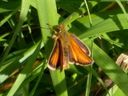
Males perch on grass stems and dart at passing objects to detect females. Courtship involves pursuit, hovering near perched females, and release of from androconial scent on forewings; osmophores break off during courtship to release pheromone. Females exercise mate choice and may reject males through evasive . Both sexes bask with wings held in characteristic posture to elevate thoracic temperature; basking occurs when black globe temperature exceeds 20°C. Males divide time equally between flying and feeding in warm weather; females spend majority of time feeding.
Ecological Role
Larval herbivore on grasses. may incidentally interfere with pollination of some orchids (e.g., Cypripedium reginae) by becoming trapped in flowers, potentially reducing seed development. Serves as for multiple in Europe including Stenichneumon scutellator, Rogas tristis, and Phryxe vulgaris.
Human Relevance
Considered a pest of timothy hay in North America, where larval feeding reduces forage quality. Subject to control efforts including cutting infested areas before or application of Bacillus thuringiensis. Transported unintentionally via contaminated timothy seed. Target of research involving introduction of European to North America. sequenced as part of Darwin Tree of Life project.
Similar Taxa
- Thymelicus sylvestrisSimilar size, , and appearance; distinguished by orange (not black) club tip and longer curved male sex brand
- Thymelicus acteonLarger size and more southerly distribution in Europe; male has more extensive sex brand
Sources and further reading
- BugGuide
- GBIF taxonomy match
- iNaturalist taxon
- NCBI Taxonomy
- Catalogue of Life
- Stalk-boring insect pests - AgriLife Extension Entomology
- Conservation Translocations: It’s Not Just Beavers - Buglife Blog - Buglife
- Bug Eric: Spider Sunday: Striped Lynx Spider
- Bug Eric: Wasp Wednesday: Anacrabro ocellatus
- Sulfoxaflor Found to Be Less Harmful to Beneficial Predators of Soybean Aphids
- Glyphosate and Acetamiprid Have Relatively Low Toxicity for Honey Bees
- Mate Location and Mating Behavior of Thymelicus lineola (Lepidoptera: Hesperiidae)
- THYMELICUS LINEOLA (LEPIDOPTERA: HESPERIIDAE) AND ITS PARASITES IN EUROPE
- SAFETY TESTS FOR THE BACULOVIRUS OF THYMELICUS LINEOLA (LEPIDOPTERA: HESPERIIDAE)
- European skipper butterfly (Thymelicus lineola) associated with reduced seed development of showy lady’s-slipper orchid (Cypripedium reginae)
- THE NUMBER OF LARVAL STAGES OF THYMELICUS LINEOLA (LEPIDOPTERA: HESPERIIDAE) IN EASTERN CANADA
- The Present Status of the Introduced Skipper, Thymelicus lineola (Ochs.) (Lepidoptera: Hesperiidae), in North America and Possible Methods of Control
- RANGE EXTENSION FOR THE EUROPEAN SKIPPER, THYMELICUS LINEOLA (OCHSENHEIMER), 1808 (LEPIDOPTERA: HESPERIIDAE), IN MANITOBA
- KNOWN DISTRIBUTION OF THE EUROPEAN SKIPPER, THYMELICUS LINEOLA (LEPIDOPTERA: HESPERIIDAE), IN QUEBEC
- TRANSPORT OF THE EUROPEAN SKIPPER, THYMELICUS LINEOLA (LEPIDOPTERA: HESPERIIDAE), ASSOCIATED WITH THE PRODUCTION OF CERTIFIED TIMOTHY SEED
- SEASONAL BIOLOGY IN QUEBEC AND PREDICTION OF PHENOLOGY OF THE EUROPEAN SKIPPER,THYMELICUS LINEOLA(LEPIDOPTERA: HESPERIIDAE)
- Diel patterns of activity of Thymelicus lineola adults (Lepidoptera: Hesperiidae) in relation to weather *
- Expanding Distribution and Evolutionary Potential of Thymelicus lineola (Lepidoptera: Hesperiidae), an Introduced Skipper, With Special Reference to its Appearance in British Columbia
- The role of the androconia in the mating behaviour of the European skipper, Thymelicus lineola, and evidence for a male sex pheromone
- European Skipper Butterfly (<i>Thymelicus lineola</i>) Associated with Reduced Seed Development of Showy Lady’s-slipper Orchid (<i>Cypripedium reginae</i>)
- The genome sequence of the Essex Skipper butterfly, Thymelicus lineola (Ochsenheimer, 1808).