
Thymelicus
Hübner, 1819
skippers
Species Guides
1- Thymelicus lineola(Essex Skipper)
Thymelicus is a Palearctic of (Hesperiidae) and the sole member of the tribe Thymelini. The genus includes approximately 12 described , several of which have been subjects of conservation and biological study. Two species—Thymelicus sylvestris (small skipper) and Thymelicus lineola (European skipper/Essex skipper)—have been introduced to North America, where T. lineola has become a notable agricultural pest. The genus has served as a model for studies in conservation , - relationships, and insect developmental .
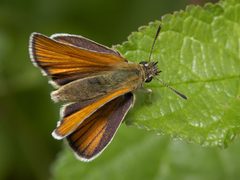
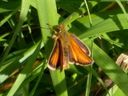
Pronunciation
How to pronounce Thymelicus: //θaɪˈmɛlɪkəs//
These audio files are automatically generated. While they are not always 100% accurate, they are a good starting point.
Images
Habitat
occupy grassland including unimproved calcareous grassland, meadows, and areas with tall grasses. Thymelicus acteon requires mature Brachypodium pinnatum plants for breeding. Thymelicus lineola is virtually absent from hay-fields in Europe due to agricultural practices, though it occupies undisturbed wild -plant .
Distribution
Native to the Palearctic region. In Europe, occurs from southern regions northward; Thymelicus acteon is present in Britain with localized . Thymelicus lineola has been introduced to North America and now occurs in Ontario, Québec, Manitoba, Prince Edward Island, and British Columbia, Canada, with spread continuing westward from initial establishment points.
Diet
Larvae feed on grasses (Poaceae). Thymelicus acteon specifically requires mature Brachypodium pinnatum. Thymelicus lineola has been associated with reduced seed development in Cypripedium reginae (showy lady's-slipper orchid), though the nature of this interaction requires further study.
Host Associations
- Brachypodium pinnatum - larval foodplantRequired by Thymelicus acteon; mature plants necessary for breeding
- Cypripedium reginae - associated with reduced seed developmentObserved for Thymelicus lineola; mechanism unclear
Life Cycle
Thymelicus lineola has five larval instars, as determined by Dyar's law in from Québec, Ontario, and Prince Edward Island, Canada. exists in capsule width and developmental time within the fifth instar. Previous reports of six instars for Ontario populations were erroneous, resulting from misinterpretation of sexual differences as separate instars.
Behavior
Thymelicus acteon forms closed with limited . exhibit localized movement patterns; the has spread locally within its historical range in Britain but has not extended its overall range boundaries. Thymelicus lineola exhibits mate location that has been subject to specific study.
Ecological Role
Serves as for diverse complexes. Thymelicus lineola in Europe hosts Phryxe vulgaris, Thecocarcelia incedens, Rogas tristis, Labrorychus delarvatus, Stenichneumon scutellator, and Brachymeria intermedia. These parasitoids in turn support hyperparasites including Mesochorus macrurus and Gelis cursitans. The has been subject to assisted efforts for climate research.
Human Relevance
Thymelicus lineola is an agricultural pest in North America, requiring control measures including cutting infested areas before or application of Thuricide 90T. A specific to T. lineola has been developed as a microbial control agent and shown safe to non-target organisms in preliminary testing. Stenichneumon scutellator has been investigated as a agent for introduction to Canada. Thymelicus sylvestris was used in assisted experiments in northern England to test climate-driven range expansion. The exemplifies successful conservation programs.
Sources and further reading
- BugGuide
- Wikipedia
- GBIF taxonomy match
- iNaturalist taxon
- NCBI Taxonomy
- Catalogue of Life
- Conservation Translocations: It’s Not Just Beavers - Buglife Blog - Buglife
- European skipper butterfly (Thymelicus lineola) associated with reduced seed development of showy lady’s-slipper orchid (Cypripedium reginae)
- THYMELICUS LINEOLA (LEPIDOPTERA: HESPERIIDAE) AND ITS PARASITES IN EUROPE
- THE NUMBER OF LARVAL STAGES OF THYMELICUS LINEOLA (LEPIDOPTERA: HESPERIIDAE) IN EASTERN CANADA
- The ecology and status of Thymelicus acteon (Lepidoptera: Hesperiidae) in Britain
- SAFETY TESTS FOR THE BACULOVIRUS OF THYMELICUS LINEOLA (LEPIDOPTERA: HESPERIIDAE)
- RANGE EXTENSION FOR THE EUROPEAN SKIPPER, THYMELICUS LINEOLA (OCHSENHEIMER), 1808 (LEPIDOPTERA: HESPERIIDAE), IN MANITOBA
- Mate Location and Mating Behavior of Thymelicus lineola (Lepidoptera: Hesperiidae)
- The Present Status of the Introduced Skipper, Thymelicus lineola (Ochs.) (Lepidoptera: Hesperiidae), in North America and Possible Methods of Control
- KNOWN DISTRIBUTION OF THE EUROPEAN SKIPPER, THYMELICUS LINEOLA (LEPIDOPTERA: HESPERIIDAE), IN QUEBEC
- The genome sequence of the Small Skipper, Thymelicus sylvestris (Poda, 1761).