
Calliephialtes grapholithae
(Cresson, 1890)
Calliephialtes grapholithae is an ichneumonid that primarily parasitizes concealed lepidopteran larvae. Its most extensively documented is Cydia caryana (Tortricidae), a key pest of pecan orchards in Mexico and the southern United States. The has been recorded from pecan-growing regions in Coahuila and Tamaulipas, Mexico, and from Kansas, USA. A potential additional host association involves Chalcoela iphitalis (Crambidae), a whose larvae prey on paper wasp larvae within nests; this relationship requires independent confirmation.
Pronunciation
How to pronounce Calliephialtes grapholithae: /kæl.iːˈfaɪ.æl.tiːz ˌɡræf.əˈlɪθ.i.aɪ/
These audio files are automatically generated. While they are not always 100% accurate, they are a good starting point.
Identification
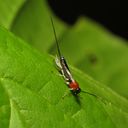
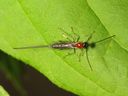
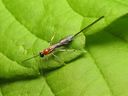
are ichneumonid wasps with typical characteristics: slender body, long , and a visible ovipositor in females. Males are smaller than females. Accurate identification to level requires examination of wing venation, propodeal structure, and other morphological details; consultation of keys for North American Ichneumonidae is necessary. Distinguished from other Calliephialtes species by genitalic and wing characteristics detailed in taxonomic revisions.
Images
Habitat
Associated with agroecosystems containing pecan (Carya illinoinensis) orchards in northern Mexico and the southern United States. In Mexico, shows higher abundance at medium-high altitudes (1,470–1,600 m) in localities such as Saltillo, General Cepeda, and Parras de la Fuente (Coahuila). Absent from lower elevation sites (1,110 m) with intensive use in adjacent crops. Also recorded from paper wasp (Polistes metricus) nests in Kansas, USA, though this association appears indirect via a lepidopteran intermediate .
Distribution
Mexico: Coahuila (Saltillo, General Cepeda, Parras de la Fuente, Torreón—absent), Tamaulipas (Jaumave). United States: Kansas (Leavenworth), Hawaii (presence recorded in GBIF). Native range corresponds to pecan distribution in northern Mexico and southern United States.
Seasonality
observed in mid-November in Kansas, USA. Activity in Mexican pecan orchards documented during 2019–2020 field seasons, with emergence from incubated pecan husks collected during the growing season.
Host Associations
- Cydia caryana - primary Larval ; emerged from damaged pecan husks (rueznos) in laboratory incubation. Confirmed by multiple rearing studies in Mexico.
- Chalcoela iphitalis - probable Proposed based on single rearing event from Polistes metricus nest in Kansas; larvae prey on larvae within nests. Requires independent confirmation before unequivocal acceptance.
- Acrobasis betulella - reported Previously recorded in literature; Pyralidae: Phycitinae.
- Acrobasis juglandis - reported Previously recorded in literature; Pyralidae: Phycitinae.
- Acrobasis rubrifasciella - reported Previously recorded in literature as A. nibrifasciella; Pyralidae: Phycitinae.
- Carmenta texana - reported Previously recorded in literature; Sesiidae: Sesiinae.
- Meskea dyspteraria - reported Previously recorded in literature; Thyrididae: Siculodinae.
- Periploca ceanothiella - reported Previously recorded in literature as Stagmatophora ceanothiella; Cosmopterigidae: Chrysopeleiinae.
- Thyridopteryx ephemeraeformis - reported Previously recorded in literature; Psychidae: Oiketicinae (bagworm moth).
- Megalopyge opercularis - reported Previously recorded in literature; Megalopygidae (evergreen bagworm).
Behavior
females locate concealed lepidopteran larvae within plant tissues or protective structures (pecan husks, bagworm cases) and oviposit using a long ovipositor. Laboratory rearing from pecan husks involves incubation of damaged fruits in controlled conditions to obtain adult . The mechanism by which females might access within defended paper wasp nests remains undescribed.
Ecological Role
agent of lepidopteran pests, particularly Cydia caryana in pecan agroecosystems. Contributes to natural enemy diversity in agricultural landscapes. Absence from sites with intensive use suggests sensitivity to chemical management practices, with implications for strategies.
Human Relevance
Of interest for of Cydia caryana, an economically significant pest of pecan production. Laboratory rearing protocols have been developed to maintain using artificial diets for the . Potential for in pecan orchards, particularly at higher elevations where chemical pressure is reduced.
Similar Taxa
- Phanerotoma fasciataCo-occurring braconid of Cydia caryana in Mexican pecan orchards; distinguished by -level characters (Ichneumonidae vs. Braconidae), including presence of areolet in forewing and different antennal structure.
- Eupelmus sp.Co-emergent from pecan husks in Tamaulipas; distinguished by characters (Eupelmidae: compact body, metallic coloration, reduced wing venation). Status as or hyperparasitoid of C. caryana unconfirmed.
More Details
Host specificity pattern
Known share ecological trait of 'concealed' larval stages—within pecan husks, bagworm cases, or nests. This pattern suggests specialized foraging for hosts in protected microhabitats rather than exposed foliage-feeding larvae.
Altitudinal distribution factors
Higher abundance at 1,470–1,600 m versus absence at 1,110 m in Coahuila correlates with reduced use in adjacent crops (cotton) at higher elevations, though direct causal link requires experimental verification.
Taxonomic note
Original description by Cresson (1890). Spelling variants in literature include 'Calliephiates' (erroneous) in some Mexican publications.
Sources and further reading
- BugGuide
- GBIF taxonomy match
- iNaturalist taxon
- Catalogue of Life
- Bug Eric: A Potential New Host Record for Calliephialtes grapholithae (Hymenoptera: Ichneumonidae) from a Paper Wasp nest (Hymenoptera: Vespidae: Polistes metricus)
- Incidencia del parasitoide Calliephialtes grapholithae Cresson (Hymenoptera: Ichneumonidae) en larvas de Cydia caryana Fitch (Lepidoptera: Tortricidae)
- EVALUACIÓN DE TRES DIETAS ARTIFICIALES PARA LA CRÍA DE Cydia caryana (FITCH, 1856) (LEPIDOPTERA: TORTRICIDAE) EN LABORATORIO DESTINADA PARA MANTENER POBLACIONES DEL PARASITOIDE Calliephialtes grapholithae CRESSON (HYMENOPTERA: ICHNEUMONIDAE). EVALUATION OF THREE ARTIFICIAL DIETS FOR THE REARING OF Cydia caryana (FITCH, 1856) (LEPIDOPTERA: TORTRICIDAE) IN LABORATORY CONDITIONS AIMED AT MAINTAINING PARASITOID Calliephialtes grapholithae CRESSON (HYMENOPTERA: ICHNEUMONIDAE).
- Abundancia relativa de los parasitoides Calliephiates grapholithae Cresson (Hymenoptera: Ichneumonidae) y Phanerotoma fasciata Provanche (Hymenoptera: Braconidae) sobre larvas del barrenador del ruezno Cydia caryana Fitch (Lepidoptera: Tortricidae) en seis localidades de Coahuila, México Relative abundance of the parasitoides Calliephiates grapholithae Cresson (Hymenoptera: Ichneumonidae) and Phanerotoma fasciata Provanche (Hymenoptera: Braconidae) on russet barrels Cydia caryana Fitch (Lepidoptera: Tortricidae) in six localities in Coahuila, Mexico