
Megalopyge opercularis
(J.E. Smith, 1797)
southern flannel moth, puss caterpillar, asp, Italian asp, fire caterpillar, woolly slug, opossum bug, puss moth, tree asp, asp caterpillar
Species Guides
1- Megalopyge opercularis bissesa(Southern Flannel Moth)
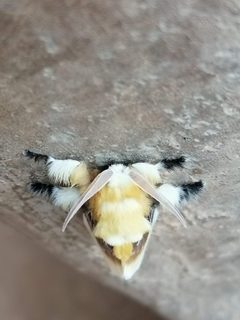
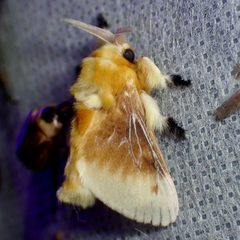
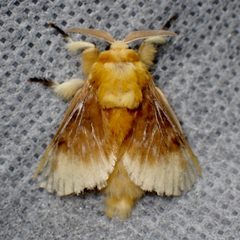
Megalopyge opercularis is a in the Megalopygidae, notable for its highly venomous larval stage and strikingly different form. The caterpillar, known as the puss caterpillar, is densely covered in hair-like setae that conceal venomous spines capable of delivering extremely painful stings. The adult, called the southern flannel moth, is covered in soft fur ranging from dull orange to lemon yellow. The has two annually in much of its range, with late-season larvae sometimes in cocoons.
Pronunciation
How to pronounce Megalopyge opercularis: /ˌmɛɡəˈlɒpɪdʒi oʊˈpɜːrkjələrɪs/
These audio files are automatically generated. While they are not always 100% accurate, they are a good starting point.
Identification
The puss caterpillar is distinguished from similar Megalopyge by its tail that extends well beyond the body, unlike M. crispata which lacks this distinctive tail. Among stinging caterpillars, it is uniquely recognized by its dense, soft, fur-like appearance concealing venomous spines—resembling a small mammal rather than a typical caterpillar. The southern flannel is identified by its compact, heavily furred body and small wings relative to body size. Color variation in larvae is extensive, making size and tail structure more reliable than coloration alone.
Images
Habitat
Found in wooded areas, forests, and suburban landscapes; larvae feed on foliage of various trees and shrubs including oak, elm, wild plum, apple, birch, hickory, pecan, persimmon, and rose; also occurs on garden plants such as roses and ivy.
Distribution
Eastern United States from extreme southeastern Virginia south to Florida; throughout the Southern United States; Mexico; parts of Central America; parts of South America.
Seasonality
Two annually: one in summer and one in fall; late-season larvae may remain in cocoons throughout winter, emerging as in late spring; adult activity peaks in spring and summer depending on geographic location.
Diet
Larvae feed on leaves of various woody plants including oak, elm, wild plum, apple, birch, hickory, pecan, persimmon, and rose; also reported on garden plants such as roses and ivy.
Host Associations
- Quercus spp. - larval food plantoak
- Ulmus spp. - larval food plantelm
- Prunus americana - larval food plantwild plum
- Malus spp. - larval food plantapple
- Betula spp. - larval food plantbirch
- Carya spp. - larval food planthickory
- Carya illinoinensis - larval food plantpecan
- Diospyros virginiana - larval food plantpersimmon
- Rosa spp. - larval food plantrose
- Hedera spp. - larval food plantivy
Life Cycle
Complete with four stages: , larva, pupa, . Larva passes through multiple instars; early instars have curly, cottony appearance, middle instars develop disheveled look without distinctive tail, final instar has pronounced tail extension. occurs in cocoon with hair pockets and . Two per year in most of range; late fall larvae may in cocoons over winter, emerging as adults the following spring.
Behavior
Larvae are slow-moving and feed solitarily on foliage; the dense hair-like setae serve as defensive concealment for venomous spines beneath. are and attracted to light. The caterpillar's appearance of a small, furry mammal is a form of protective mimicry that may deter some .
Ecological Role
Herbivore as larva, consuming foliage of various trees and shrubs; serves as prey for various and despite defenses; may contribute to pollination though specific role is not well documented.
Human Relevance
The puss caterpillar is considered one of the most venomous caterpillars in North America. Contact with the concealed spines causes immediate, severe pain described as comparable to broken bones or blunt-force trauma, with including burning, swelling, nausea, headache, abdominal distress, rashes, blisters, and in severe cases chest pain, numbness, or difficulty breathing. The condition is termed erucism or urticarial dermatitis; M. opercularis is the most commonly reported source of caterpillar stings in the United States. Medical attention is recommended for reactions. First aid involves removing embedded spines with cellophane tape; various remedies including ice packs, antihistamines, and topical treatments have been reported with varying success.
Similar Taxa
- Megalopyge crispataSimilar appearance and venomous spines; distinguished by lack of tail extension beyond body in M. crispata versus pronounced tail in M. opercularis
- Norape ovinaWhite flannel moth caterpillar with similar dense hair-like setae and venomous spines; distinguished by different coloration and plant preferences including black locust
- Automeris ioIo moth caterpillar with prominent venomous spines; distinguished by clusters of branched spines radiating from body segments rather than dense fur-like covering
- Hemileuca spp.Buck moth caterpillars with venomous spines; distinguished by prominent branched spines and preference for oak foliage without dense fur-like concealment
- Phobetron pitheciumHag moth or monkey slug caterpillar with unusual fleshy appendages; distinguished by bizarre lateral lobes rather than uniform furry covering
More Details
Venom mechanism
The urticating spines are hollow, barbed structures that break off upon contact and embed in skin, delivering venom through a gland at the spine base. The venom composition includes multiple bioactive compounds contributing to intense pain and inflammatory response.
Defensive mimicry
The caterpillar's resemblance to a small mammal (Persian cat) represents protective mimicry that may reduce by visual , while the concealed spines provide active chemical defense against tactile predators.
Parasitoid associations
The ichneumon Calliephialtes grapholithae has been reared from M. opercularis; this wasp typically attacks concealed and the caterpillar's cocoon likely provides such concealment.
Sources and further reading
- BugGuide
- Wikipedia
- GBIF taxonomy match
- iNaturalist taxon
- NCBI Taxonomy
- Catalogue of Life
- Bug Eric: A Potential New Host Record for Calliephialtes grapholithae (Hymenoptera: Ichneumonidae) from a Paper Wasp nest (Hymenoptera: Vespidae: Polistes metricus)
- Archive — Bug of the Week
- Look but do not touch: puss caterpillar, Megalopyge opercularis; White flannel moth, Norape ovina; Io moth, Automeris io; buck moth Hemileuca spp.; and hag moth, Phobetron pithecium — Bug of the Week
- Megalopygidae | Beetles In The Bush
- Bacterial Communities Associated with Megalopyge opercularis (Smith) (Lepidoptera: Megalopygidae): Exploring Poisonous Lepidopterans