
Phobetron pithecium
(Smith, 1797)
Hag Moth, Monkey Slug (larva)
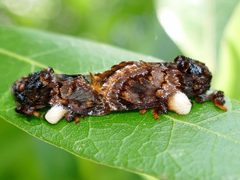
Phobetron pithecium, commonly known as the hag moth, is a of slug caterpillar in the Limacodidae. Its larva, called the monkey slug, is one of the most distinctive caterpillars in North America, bearing nine pairs of curly, hair-covered projections that give it an appearance resembling a shed spider skin or leaf debris. The species occurs across eastern North America from southern Canada to the Gulf Coast, with active primarily in summer. Both larva and adult exhibit notable defensive adaptations: the caterpillar's can detach without harm to the animal, and adults display with males having translucent wings while females are drab brown with yellow leg and reportedly mimic bees.

Pronunciation
How to pronounce Phobetron pithecium: //foʊˈbiːtrɒn pɪˈθiːsiəm//
These audio files are automatically generated. While they are not always 100% accurate, they are a good starting point.
Identification
Larva is unmistakable—no close analogues exist among North American caterpillars. The combination of flattened body, nine pairs of curly hair-covered of unequal length, and reduced legs distinguishes it from all other . May be mistaken for shed spider skin or leaf debris. male identified by translucent wings; female by drab brown-gray coloration with yellow leg and -like appearance in .
Images
Habitat
Deciduous forests and woodlands; commonly found in orchards. Larvae occur on undersides of leaves of trees and shrubs. attracted to ultraviolet and mercury-vapor lights in mesic lowland deciduous forest.
Distribution
Eastern North America from southern Canada (Vermont) to Gulf Coast; occurs throughout eastern United States.
Seasonality
One per year in northern range; two or more generations in southern United States. active in summer (July–August based on blacklighting records).
Diet
Larvae feed on leaves of various deciduous trees and shrubs including apple (Malus), ash (Fraxinus), birch (Betula), cherry (Prunus), chestnut (Castanea), dogwood (Cornus), hickory (Carya), oak (Quercus), persimmon (Diospyros), walnut (Juglans), and willow (Salix).
Host Associations
- Malus - larval food plantapple
- Fraxinus - larval food plantash
- Betula - larval food plantbirch
- Prunus - larval food plantcherry
- Castanea - larval food plantchestnut
- Cornus - larval food plantdogwood
- Carya - larval food planthickory
- Quercus - larval food plantoak
- Diospyros - larval food plantpersimmon
- Juglans - larval food plantwalnut
- Salix - larval food plantwillow
Life Cycle
Complete . One annually in north; two or more in southern United States. Larva solitary, feeds on leaf undersides. occurs in cup-shaped cocoon with circular escape hatch.
Behavior
Larva solitary, not a significant agricultural pest despite common occurrence in orchards. can detach without harming caterpillar, serving defensive function. at lights; female , reportedly mimics in .
Ecological Role
Herbivore in deciduous forest ; larval feeding on diverse woody plants contributes to nutrient cycling. Minor component of forest lepidopteran fauna; not economically significant pest.
Human Relevance
Caterpillar has been reported to cause irritation to humans— can produce skin reactions. Not a serious agricultural pest despite orchard presence. Occasionally encountered by naturalists and photographers due to larva's bizarre appearance.
Similar Taxa
- Megalopyge opercularisBoth are stinging slug caterpillars (Limacodidae) with dense hair covering; however, puss caterpillar has more uniformly hairy, elongated body without distinct paired
- Acharia stimuleaBoth are stinging limacodid caterpillars; saddleback caterpillar has prominent horn and contrasting green-brown color pattern, lacks multiple curly
- Automeris ioBoth are stinging caterpillars with urticating spines; Io moth caterpillar has prominent branched spines in rows, not flattened body with curly lateral
Misconceptions
Larva is sometimes mistaken for shed skin of hairy spider or leaf debris due to its unusual flattened form and hair-covered projections. Despite 'monkey slug,' it is not a slug (mollusk) but a caterpillar.
More Details
Defensive Adaptations
The larva's represent a remarkable defensive innovation—structures that can be sacrificed without harm to the animal, potentially distracting . The female's reported mimicry and male's mimicry suggest complex, though detailed behavioral studies are lacking.
Taxonomic History
Originally described as Phalaena pithecium by J.E. Smith in 1797, later transferred to Phobetron. The genus name derives from Greek 'phobetron' meaning 'frightful thing'; specific epithet 'pithecium' refers to ape-like appearance of larva.
Collection Records
Documented at ultraviolet/mercury-vapor light in mesic lowland deciduous forest in Missouri (Holly Ridge Natural Area, July 2022), indicating activity patterns typical of .
Sources and further reading
- BugGuide
- Wikipedia
- GBIF taxonomy match
- iNaturalist taxon
- NCBI Taxonomy
- Catalogue of Life
- Ascalaphidae | Beetles In The Bush
- August | 2022 | Beetles In The Bush
- Archive — Bug of the Week
- entomology | Beetles In The Bush | Page 5
- Look but do not touch: puss caterpillar, Megalopyge opercularis; White flannel moth, Norape ovina; Io moth, Automeris io; buck moth Hemileuca spp.; and hag moth, Phobetron pithecium — Bug of the Week