
Acharia stimulea
(Clemens, 1860)
Saddleback caterpillar, Saddleback moth
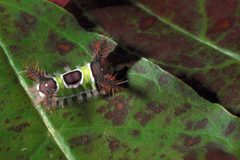
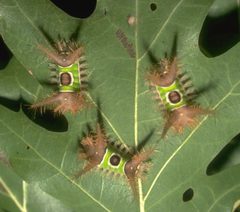
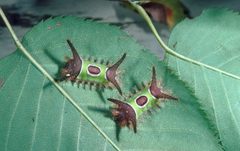
Acharia stimulea, commonly known as the saddleback caterpillar, is a North American in the Limacodidae. Its larva is notable for its striking appearance—a brown shield-like marking surrounded by white on its back, resembling a saddle, with prominent projections at both ends bearing venomous . Contact with these spines causes painful stings and potential skin reactions in humans. The has a broad plant range and is parasitized by braconid wasps in the Cotesia.
Pronunciation
How to pronounce Acharia stimulea: /əˈkɛəriə ˈstɪmjʊliə/
These audio files are automatically generated. While they are not always 100% accurate, they are a good starting point.
Identification
The saddleback caterpillar is immediately recognizable by its unique pattern: a brown shield-like marking encircled by white, resembling a saddle. The projections at both ends bearing branched, venomous spines are distinctive. No other North American caterpillar combines this specific color pattern with terminal projections. Can be confused with other Limacodidae larvae, but the precise saddle marking is diagnostic.
Images
Habitat
Found in forests, gardens, and suburban areas where plants grow. Larvae occur on foliage of trees, shrubs, and herbaceous plants including oaks, elms, lindens, apples, plums, corn, blueberries, grapes, and violets. likely inhabit wooded and semi-open areas but specific details are not documented.
Distribution
Eastern North America, with records from the United States and an introduced in Belgium (Flemish Region). Within North America, occurs from the mid-Atlantic region westward, with specific records from Maryland, Virginia, and surrounding areas.
Seasonality
Larvae active during summer months; specific not well documented. Multiple per year possible given broad range and geographic distribution.
Diet
Larva is a herbivore feeding on leaves of numerous woody and herbaceous plants including oaks (Quercus), elms (Ulmus), lindens (Tilia), apples (Malus), plums (Prunus), corn (Zea), blueberries (Vaccinium), grapes (Vitis), violets (Viola), redbud (Cercis), black locust (Robinia), greenbrier (Smilax), and hackberry (Celtis). diet not documented.
Host Associations
- Quercus - larval food plantoaks
- Ulmus - larval food plantelms
- Tilia - larval food plantlindens
- Malus - larval food plantapples
- Prunus - larval food plantplums
- Zea - larval food plantcorn
- Vaccinium - larval food plantblueberries
- Vitis - larval food plantgrapes
- Viola - larval food plantviolets
- Cercis - larval food plantredbud
- Robinia - larval food plantblack locust
- Smilax - larval food plantgreenbrier
- Celtis - larval food planthackberry
Life Cycle
Complete with , larva, pupa, and stages. Larvae are the most commonly observed stage. Female Cotesia parasitize larvae by laying eggs inside using an ovipositor; wasp larvae develop within the caterpillar, emerge through the skin, and spin white silk cocoons on the exterior surface. injected by the wasp disables the caterpillar's immune system, allowing wasp larval development.
Behavior
Larvae are solitary or found in small clusters on leaves. When disturbed, the release toxins causing immediate pain. No active defensive beyond the passive protection of stinging spines have been documented. Parasitized larvae become immobile as larvae emerge and pupate.
Ecological Role
Herbivore that consumes leaves of numerous plant ; serves as for parasitic braconid wasps (Cotesia spp.) which regulate its . The --caterpillar interaction represents a well-studied example of host- and immune system manipulation.
Human Relevance
Medical significance due to venomous that cause painful stings, burning sensations, and persistent rashes upon skin contact. Reactions range from mild to severe; blistering has been reported. Gardeners, hikers, and outdoor are at risk when brushing against foliage where larvae feed. Not an agricultural pest of major economic importance despite broad range. Educational value as an example of aposematic coloration and chemical defense.
Similar Taxa
- Automeris ioIo moth caterpillar also has branched urticating spines and causes similar stings, but lacks the distinctive saddle marking—instead has green body with red and white stripes
- Norape ovinaWhite flannel moth caterpillar has stinging hairs and similar limacodid body form, but is covered in dense white or yellowish setae rather than having a saddle pattern
- Euchaetes egleMilkweed tussock moth caterpillar has hairy tufts but these are not venomous; lacks saddle marking and has distinct black, white, and orange coloration
Misconceptions
Small white objects on the back of caterpillars are often mistaken for of ; these are actually cocoons of emerged parasitic wasp larvae. The caterpillar is not aggressive—stings occur through accidental contact, not deliberate attack.
More Details
Venom apparatus
are hollow spines connected to poison glands in the caterpillar's skin. Toxins are released upon mechanical contact with the spines.
Parasitoid biology
The interaction with Cotesia involves -mediated immune suppression, a sophisticated evolutionary that allows the wasp larvae to develop within the living caterpillar without being encapsulated by the 's immune system.
Taxonomic note
Formerly placed in Sibine; current classification places this in Acharia based on morphological and molecular evidence.
Sources and further reading
- BugGuide
- GBIF taxonomy match
- NCBI Taxonomy
- Catalogue of Life
- Insect FAQs | Entomology Research Museum
- Catch a Glimpse of Caterpillars During National Moth Week
- Archive — Bug of the Week
- Super Crop Challenge #5 | Beetles In The Bush
- Stinging caterpillars - White flannel moth, Norape ovina, and Saddleback caterpillar, Archaria stimulea — Bug of the Week
- To sting a stinger: Saddleback caterpillar, Acharia stimulae, and brachonid wasp, Cotesia — Bug of the Week