
Acharia
Thunberg, 1794
Saddleback Caterpillar Moths and Allies
Species Guides
2- Acharia extensa
- Acharia stimulea(Saddleback caterpillar)
Acharia is a of in the Limacodidae, commonly known as saddleback caterpillar moths. The genus is notable for larvae with urticating (stinging) hairs and distinctive saddleback patterning. Some , particularly Acharia stimulea, are well-known in North America for their painful stings. Other species such as Acharia fusca have become agricultural pests in oil palm plantations.
Pronunciation
How to pronounce Acharia: //əˈkɛəriə//
These audio files are automatically generated. While they are not always 100% accurate, they are a good starting point.
Identification
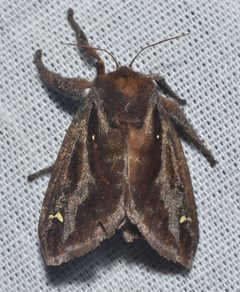
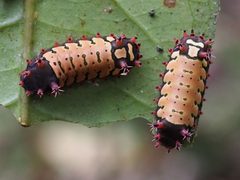
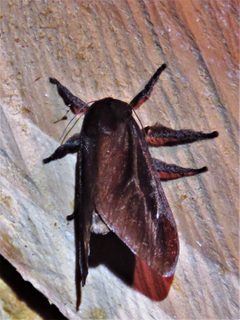
Larvae are immediately recognizable by the prominent saddle-like marking on the dorsum—a brown or purplish shield surrounded by a cream or white border. The body is slug-like with reduced , typical of Limacodidae. Four large, fleshy (scoli) bearing venomous spines project from the front and rear flanks. are relatively nondescript brown or gray with subtle patterning.
Images
Habitat
Found in forests, gardens, and agricultural settings. Larvae occur on foliage of diverse plants. Some thrive in disturbed and suburban gardens.
Distribution
Native to the Americas, with Acharia stimulea widespread in eastern North America. Acharia fusca has expanded as an pest in oil palm-growing regions of Southeast Asia and elsewhere.
Seasonality
active primarily in summer and autumn. Larvae present during growing seasons when plants are available.
Diet
Larvae feed on leaves of diverse plants including oaks, elms, lindens, apples, plums, corn, blueberries, grapes, and iris. Acharia fusca specializes on oil palm (Elaeis guineensis).
Life Cycle
Complete with , larval, pupal, and stages. Larvae are the most commonly encountered stage. Development time from egg to adult ranges from approximately 77 days at 35°C to 170 days at 15°C in Acharia fusca. occurs in a cocoon, with adults emerging to mate and lay eggs.
Behavior
Larvae exhibit defensive when disturbed, turning toward threats and engaging with urticating spines on their scoli. They are solitary feeders. When parasitized by braconid wasps (Cotesia), larvae become for larvae that emerge and spin external white silk cocoons.
Ecological Role
Larvae function as herbivores, consuming leaf tissue of various plants. They serve as for including Cotesia . Their stinging defenses represent aposematic (warning) coloration against vertebrate .
Human Relevance
Acharia stimulea is familiar to gardeners and outdoor in North America due to its painful sting, which causes burning sensations, rash, and in severe cases reactions. Acharia fusca is an economically significant pest of oil palm plantations, causing defoliation and yield loss.
Similar Taxa
- Limacodidae (other genera)Other slug caterpillar moths share the reduced , slug-like larval form, but Acharia is distinguished by the distinctive saddleback color pattern and specific arrangement of scoli.
- Saturniidae larvaeSome saturniid caterpillars also bear , but they possess more pairs of (five versus two in Limacodidae) and lack the saddleback marking.
Sources and further reading
- BugGuide
- Wikipedia
- iNaturalist taxon
- NCBI Taxonomy
- Catalogue of Life
- Insect FAQs | Entomology Research Museum
- To sting a stinger: Saddleback caterpillar, Acharia stimulae, and brachonid wasp, Cotesia — Bug of the Week
- Weeding can turn spicy when saddlebacks are around: Saddleback caterpillar, Acharia stimulae — Bug of the Week
- To sting a stinger: Saddleback caterpillar, Acharia stimulae, and brachonid wasp, Cotesia sp. — Bug of the Week
- Catch a Glimpse of Caterpillars During National Moth Week
- Super Crop Challenge #5 | Beetles In The Bush
- Life History Traits and Damage Potential of an Invasive Pest Acharia fusca (Lepidoptera: Limacodidae) on Oil Palm