
Automeris io
Fabricius, 1775
Io moth, peacock moth
Species Guides
1- Automeris io neomexicana(Io moth)
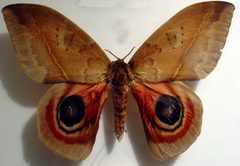
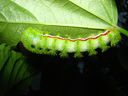
Automeris io is a colorful North American saturniid with in coloration: males are bright yellow, females reddish-brown to purple. Both sexes possess distinctive eyespots on the hindwings used in anti- displays. The caterpillars are gregarious, bright green with red and white lateral stripes, and possess venomous urticating spines that cause painful stings. Adults are , lack functional mouthparts, and live 1–2 weeks. have declined in parts of their range, particularly in New England, due to loss and by introduced agents.

Pronunciation
How to pronounce Automeris io: //ɔːˈtɒməˌrɪs ˈaɪ.oʊ//
These audio files are automatically generated. While they are not always 100% accurate, they are a good starting point.
Identification
distinguished from similar saturniids by the combination of in color (yellow males, reddish-brown to purple females) and the single large eyespot on each hindwing. Males identified by ; females by simpler antennae and darker coloration. Caterpillars identified by bright green color with red and white lateral stripes and prominent venomous spines—distinctive among North American saturniid larvae. Pupae can be sexed by the presence of a notch (female) versus (male) on the aspect.
Images
Appearance
have a wingspan of 63–88 mm. Sexually dimorphic: males have bright yellow forewings, body, and legs; females have reddish-brown to purple forewings, body, and legs. Males possess much larger (feathery) than females. Both sexes have one large black to bluish eyespot with some white in the center on each hindwing. Caterpillars reach 7 cm in length, with bright green bodies, two lateral stripes (upper bright red, lower white), and numerous urticating spines. Pupae are dark brown to black; female pupae have a notch on the aspect, while male pupae bear a pair of in this area with no notch.
Habitat
Occurs in diverse including deciduous and mixed forests, woodlands, and suburban areas with plants. Found from sea level to moderate elevations. Larvae feed on a broad range of woody plants; specific host associations vary regionally.
Distribution
Eastern North America from the southeast corner of Manitoba and southern extremes of Ontario, Quebec, New Brunswick, and Nova Scotia in Canada. In the United States, ranges from Montana, North Dakota, South Dakota, Nebraska, Colorado, New Mexico, Texas, and Utah eastward across the eastern states to southern Florida.
Seasonality
emerge from cocoons in late morning or early afternoon, typically from June to July. Adults are strictly , flying during peak night hours. Females extend at nightfall to release . Single brooded in northern portions of range; may have partial second in southern areas.
Diet
Caterpillars are herbivorous and gregarious, feeding on leaves of numerous woody plants. Documented plants include: Morus alba (white mulberry), Prunus pensylvanica (pin cherry), Salix spp. (willow), Abies balsamea (balsam fir), Acer rubrum (red maple), Amorpha fruticosa (bastard indigo), Baptisia tinctoria (wild indigo), Carpinus caroliniana (American hornbeam), Celtis laevigata (sugarberry), Cephalanthus occidentalis (buttonbush), Cercis canadensis (eastern redbud), Chamaecrista fasciculata (showy partridge pea), Comptonia peregrina (sweetfern), Cornus florida (flowering dogwood), Corylus avellana (common hazel), Erythrina herbacea (coral bean), Fagus spp. (beech), Fraxinus spp. (ash), Liquidambar styraciflua (American sweetgum), Lythrum salicaria (purple loosestrife), Quercus spp. (oak), Paeonia spp. (peony), and Phoenix roebelenii (pygmy date palm). have mouthparts and do not feed.
Host Associations
- Morus alba - larval food plantwhite mulberry
- Prunus pensylvanica - larval food plantpin cherry
- Salix spp. - larval food plantwillow
- Abies balsamea - larval food plantbalsam fir
- Acer rubrum - larval food plantred maple
- Amorpha fruticosa - larval food plantbastard indigo
- Baptisia tinctoria - larval food plantwild indigo
- Carpinus caroliniana - larval food plantAmerican hornbeam
- Celtis laevigata - larval food plantsugarberry
- Cephalanthus occidentalis - larval food plantbuttonbush
- Cercis canadensis - larval food planteastern redbud
- Chamaecrista fasciculata - larval food plantshowy partridge pea
- Comptonia peregrina - larval food plantsweetfern
- Cornus florida - larval food plantflowering dogwood
- Corylus avellana - larval food plantcommon hazel
- Erythrina herbacea - larval food plantcoral bean
- Fagus spp. - larval food plantbeech
- Fraxinus spp. - larval food plantash
- Liquidambar styraciflua - larval food plantAmerican sweetgum
- Lythrum salicaria - larval food plantpurple loosestrife, introduced
- Quercus spp. - larval food plantoak
- Paeonia spp. - larval food plantpeony
- Phoenix roebelenii - larval food plantpygmy date palm
Life Cycle
are laid in clusters of more than twenty on plant leaves, with large rosettes that turn black as embryos develop. Eggs hatch in 8–11 days. Larvae emerge orange, consuming their egg shells, and proceed through five instars. Early instars are gregarious and travel in single-file processions. Later instars turn bright green and develop urticating spines. Caterpillars spin flimsy, valveless cocoons of dark coarse silk—some at the base of trees among leaf litter, others wrapped in living leaves that brown and fall with the cocoon. Pupae overwinter in cocoons. emerge in late morning or early afternoon, requiring approximately 20 minutes to inflate wings with . Adult lifespan is 1–2 weeks. Females die after egg-laying.
Behavior
Caterpillars are gregarious throughout all instars, forming single-file processions on plants. are strictly , with females releasing from extended abdominal at nightfall to attract males. Males use enlarged to detect female pheromones. Both sexes employ a deimatic anti- display: when disturbed in -down position or touched, they shake and expose the large hindwing eyespots to startle predators.
Ecological Role
Caterpillars function as herbivores, consuming foliage of diverse woody plants. serve as prey for bats, birds, small mammals, and spiders. Subject to by tachinid flies (Compsilura concinnata, Lespesia spp., Chetogena claripennis, Carcelia formosa, Sisyropa eudryae, Nilea dimmocki) and ichneumonid and braconid wasps (Hyposoter fugitivus, Enicospilus americanus, Cotesia electrae, Cotesia hemileucae). The introduced Compsilura concinnata has been implicated in declines.
Human Relevance
Caterpillar stings cause painful, irritating erucism (acute dermatitis) due to venomous spines; not life-threatening but can cause significant discomfort and allergic reactions in sensitive individuals. are non-threatening and do not feed. Subject of scientific interest for anti- adaptations and phylogenetic relationships. declining in eastern North America due to loss and agents.
Similar Taxa
- Automeris metzliSimilar with urticating caterpillars and eyespot defenses; distinguished by geographic range (Mexico to Ecuador, Trinidad) and specific associations including Erythrina and coconut
- Antheraea polyphemusAnother North American saturniid with hindwing eyespots; distinguished by larger size, tan to brown coloration without in yellow/purple tones, and eyespots with central clear windows rather than solid black/bluish with white center
- Eacles imperialisImperial moth overlaps in range and has colorful larvae; distinguished by lack of eyespots on hindwings and different larval coloration (green, brown, or orange with spines but without red and white lateral stripes)
Sources and further reading
- BugGuide
- Wikipedia
- GBIF taxonomy match
- iNaturalist taxon
- NCBI Taxonomy
- Catalogue of Life
- A rainforest beauty better for observing rather than touching: Silkmoth caterpillar, Automeris spp. — Bug of the Week
- Bug Eric: Scientific Illustration
- How Beekeepers Can Foster Propolis Production for Better Hive Health
- Platystomatidae | Beetles In The Bush
- From the mailbag: Fig-eating Kudzu bugs come to college, Megacopta cribraria — Bug of the Week
- Bug Eric: February 2010
- Phylogeny and divergence time estimation of Io moths and relatives (Lepidoptera: Saturniidae: Automeris)
- Phylogeny and divergence time estimation of Io moths and relatives (Lepidoptera: Saturniidae: Automeris )
- Larvas urticantes Automeris (Lepidoptera: Saturniidae) en Cajanus cajan: riesgo para la salud de productores panameños Automeris (Lepidoptera: Saturniidae) stinging larvae in Cajanus cajan: a health risk for Panamanian farmers Larvas de picada de Automeris Hübner, 1819 (Lepidoptera: Saturniidae) em Cajanus cajan (L.): um risco sanitário para os produtores do Panamá
- An Analysis of Behaviour Sequences in Automeris Aurantiaca Weym (Lepidoptera)