
Eacles imperialis
Drury, 1773
Imperial Moth
Species Guides
3- Eacles imperialis imperialis(Imperial moth)
- Eacles imperialis nobilis(Texas Imperial Moth)
- Eacles imperialis pini(Imperial moth (pini subspecies))
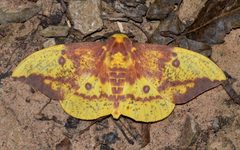
Eacles imperialis is a large saturniid with the widest geographic range in its , extending from southern Canada to Argentina. display substantial color variation, with yellow base coloration and variable red, brown, and purple markings. The has experienced regional decline in the northeastern United States, with some New England extirpated, while remaining common in the Mid-Atlantic, Appalachia, and Deep South.
Pronunciation
How to pronounce Eacles imperialis: /ˈiːæklɛs ˌɪmpəˈrialis/
These audio files are automatically generated. While they are not always 100% accurate, they are a good starting point.
Identification
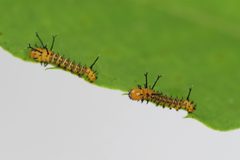
Distinguished from other large yellow Saturniidae by combination of: yellow ground color with red-brown-purple blotches (not eyespots like Antheraea polyphemus or tails like Actias luna); lack of transparent wing windows; variable but never fully dark wings like some Citheronia . Males distinguished from females by broader pectinate and abdominal purple spot. Larvae distinguished from other large spiny Saturniidae by orange first instar with black bands, and fifth instar color with distinctive patch coloration.
Images
Habitat
Associated with forested including deciduous and mixed woodlands, rural and suburban areas with trees. E. i. pini occurs in coniferous and transition zone woodlands. in the northeast appear associated with specific habitats such as coastal or montane pine barrens; the Martha's Vineyard population occupies frost-bottom oak/pine habitat.
Distribution
Widest-ranging in Eacles. Range extends from southern Canada (historically New England, southern Ontario) through eastern United States to Florida Keys, west to Nebraska and Rocky Mountains, south through Mexico and Central America to Argentina. E. i. pini occurs in northern New England, Great Lakes region, and Canada. Subspecies E. i. magnifica in Brazil and surrounding regions. E. i. oslari replaces it in southwestern North America.
Seasonality
(one per year). In northern range, emerge mid-summer (June–August). In southern range, more variable (April–October), with some spring/early summer emergence in Florida but most in late summer. Males emerge days earlier than females within .
Host Associations
- Pinus - larval primary for E. i. pini ; P. rigida on Martha's Vineyard
- Quercus - larval commonly reported across range
- Acer - larval commonly reported across range
- Liquidambar styraciflua - larval sweet gum
- Sassafras albidum - larval sassafras
- Eucalyptus - larval recorded
- Acer negundo - larval box elder
- Picea abies - larval Norway spruce
- Pinus strobus - larval E. i. pini
- Pinus resinosa - larval E. i. pini
- Picea glauca - larval limited records for E. i. pini
Life Cycle
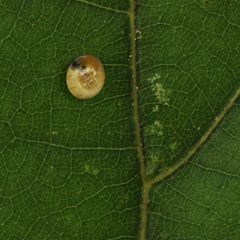
Complete with five larval instars. laid singly or in groups of 2–5 on plant leaves at dusk; hatch in 10–14 days. First instar larvae eat egg shell after . Larvae feed for several weeks; at end of each instar, spin silk on leaf , attach with anal claspers and , and . Sometimes consume old for protein. Fifth instar larvae burrow into soil to pupate in earthen chamber. emerge from soil at sunrise; do not feed due to mouthparts.
Behavior
emerge from soil pupal chambers at sunrise. Males use large pectinate to detect female . Females fly to tree at night to release for mate attraction. Mating occurs during night hours following . Mated pairs remain coupled and vulnerable to . Females oviposit at dusk. Larvae descend from tree canopies in late summer and autumn to burrow into soil, sometimes traversing open ground and human-made structures.
Ecological Role
Larvae function as herbivores on diverse woody plants. serve as prey for including foraging mammals and birds. Pupae in soil may serve as food source for soil-dwelling predators. declines in New England suggest sensitivity to fragmentation and anthropogenic disturbance.
Human Relevance
Subject of conservation concern in northeastern United States due to regional declines; Martha's Vineyard has been focus of scientific study and local political activity for preservation. Popular among entomologists and naturalists due to large size and coloration. Larvae occasionally encountered by public when crossing roads seeking sites. Potential for forest health and impacts of use, light pollution, and programs.
Similar Taxa
- Eacles oslariReplaces E. imperialis in southwestern North America; closely related requiring careful examination of genitalia for definitive identification
- Antheraea polyphemusLarge yellow-brown saturniid with eyespot on hindwing; E. imperialis lacks eyespots and has more extensive purple-red blotching
- Actias lunaLarge green saturniid with long hindwing tails and eyespots; E. imperialis lacks tails, has yellow ground color, and different pattern elements
- Citheronia regalisLarge saturniid with orange-yellow coloration and more regular pattern; E. imperialis has more irregular blotching and different wing shape
More Details
Conservation Status
Regional decline documented in northeastern US, with extirpation from Connecticut and absence from Massachusetts except Martha's Vineyard. Proposed causes include: and herbicide use in commercial farming, metal halide street lamps disrupting , and introduction of for spongy moth (Lymantria dispar) that non-target E. imperialis. Northern may require specific types vulnerable to fragmentation.
Subspecies Diversity
Eleven described show geographic variation in coloration and use. E. i. pini exhibits ecological specialization on pine hosts and restricted distribution in northern coniferous forests. E. i. imperialis on Martha's Vineyard shows dietary specialization on pitch pine (Pinus rigida) despite nature of elsewhere.
Sources and further reading
- BugGuide
- Wikipedia
- GBIF taxonomy match
- iNaturalist taxon
- NCBI Taxonomy
- Catalogue of Life
- Giant silk moth larvae prepare for winter: Imperial moth, Eacles imperialis — Bug of the Week
- Life history of the imperial moth Eacles imperialis (Drury) (Saturniidae: Ceratocampinae) in New England, USA: distribution, decline, and nutritional ecology of a relictual islandic population