
Citheronia
Hübner, 1819
Species Guides
3- Citheronia regalis(Regal Moth)
- Citheronia sepulcralis(pine-devil moth)
- Citheronia splendens(Splendid Royal Moth)
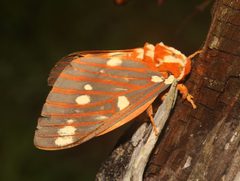
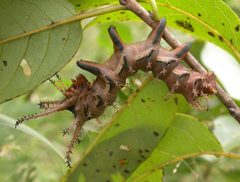
Citheronia is a of giant silk moths (Saturniidae) established by Jacob Hübner in 1819. The genus comprises approximately 20 distributed across the Americas, from the United States through Mexico, Central America, and into South America as far as Argentina. The genus is notable for its large, striking caterpillars—such as the famous "hickory horned devil" of C. regalis—which bear prominent horn-like projections and undergo dramatic morphological changes between instars. are characterized by reduced or non-functional mouthparts and short adult lifespans devoted primarily to .
Pronunciation
How to pronounce Citheronia: //sɪθəˈroʊniə//
These audio files are automatically generated. While they are not always 100% accurate, they are a good starting point.
Identification
are distinguished from other Saturniidae by their large size, feathery , and characteristic resting posture with wings spread flat or slightly tented. The is placed in Ceratocampinae based on larval and . Larvae are unmistakable due to their enormous size and prominent horn-like ; however, early instars with club-tipped spines may be confused with nymphalid larvae. -level identification of larvae is challenging and often requires geographic context and rearing to adulthood.
Images
Habitat
Deciduous forests and woodlands, particularly those containing trees in the walnut (Juglandaceae). Larvae are found on foliage of host plants; pupae occur in soil or leaf litter beneath host trees. Some inhabit montane regions in the tropics.
Distribution
Americas: United States (eastern and central regions), Mexico, Guatemala, and throughout South America including Ecuador, Brazil, Uruguay, and Argentina. The is considered an , pre-tertiary American fauna group with no Old World representatives.
Seasonality
In temperate regions (e.g., C. regalis, C. sepulcralis), are active during summer months, typically June through August. Southern of some may produce two annually; northern populations are . Tropical species likely have extended or year-round activity periods.
Host Associations
- Juglandaceae - larval food plantPrimary include walnut (Juglans), hickory (Carya), and butternut. C. regalis strongly associated with these .
- Fraxinus - larval food plantAsh recorded as secondary for C. regalis.
- Fagus - larval food plantBeech recorded as occasional for C. regalis.
- Syringa - larval food plantLilac recorded as occasional for C. regalis.
- Diospyros - larval food plantPersimmon recorded as occasional for C. regalis.
- Rhus - larval food plantSumac recorded as occasional for C. regalis.
- Liquidambar - larval food plantSweet gum recorded as occasional for C. regalis.
Life Cycle
are laid on plant leaves and hatch in approximately one week. Larvae pass through multiple instars (typically 5–6), with early instars bearing distinctive club-tipped spines that are lost in later instars. Fully grown larvae descend to the ground and burrow into soil or leaf litter to form a pupal . Pupae overwinter in temperate regions; emerge the following spring or summer. Adults lack functional mouthparts and live only a few days, during which they mate and females deposit eggs. In southern portions of the range, some may complete two annually; northern are .
Behavior
females release from elevated structures such as tree trunks to attract mates, typically on the night following . Adults are and strongly attracted to light. Larvae are solitary feeders. When threatened, caterpillars may rear up and thrash, but the prominent horns are defensive in appearance only and do not deliver venom or cause injury.
Ecological Role
Human Relevance
The hickory horned devil (C. regalis larva) is widely recognized among North American naturalists for its impressive size and striking appearance, despite being harmless to humans. The is sometimes featured in educational programs and nature centers. Larvae may cause minor defoliation of ornamental walnut and hickory trees but are rarely considered pests. do not feed and cause no damage.
Similar Taxa
- AnisotaAlso in Ceratocampinae with similar large, horned caterpillars and in soil; distinguished by wing patterns and larval horn arrangement.
- EaclesLarge Saturniidae with similarly impressive caterpillars; distinguished by different horn and geographic distribution primarily in more southern regions.
- HyalophoraLarge Saturniidae with reduced mouthparts and similar ; caterpillars lack the prominent thoracic horns characteristic of Citheronia.
Misconceptions
The hickory horned devil caterpillar is frequently perceived as dangerous due to its formidable appearance, including large orange and black thoracic horns and spiny . The "devil" reinforces this misconception. In fact, the caterpillar is entirely harmless to humans and lacks venomous spines or stinging hairs. The horns are purely defensive in appearance.
More Details
Early instar morphology
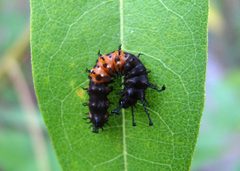
First and second instar larvae of multiple Citheronia bear distinctive club-tipped or "fly-swatter" spines that are dramatically different from the smooth, horned appearance of later instars. This ontogenetic change has caused confusion in larval identification, with early instars sometimes misidentified as nymphalid larvae.
Phylogenetic significance
The has been considered an ancient, pre-tertiary American lineage. Larval stages and peculiar have drawn historical comparisons to hawk moths (Sphingidae), though the two groups are not closely related.
Sources and further reading
- BugGuide
- Wikipedia
- GBIF taxonomy match
- iNaturalist taxon
- NCBI Taxonomy
- Catalogue of Life
- Of Lady Beetles and Green Fruit Beetle Larvae | Bug Squad
- Silkmoth Season, Part 2: A royal welcome – Royal Walnut Moth, Citheronia regalis — Bug of the Week
- Devils and hummingbirds - Hickory horned devil, Citheronia regalis and hummingbird clearwing moth, Hemaris thysbe — Bug of the Week
- Devilish times for hickory: Hickory horned devils and royal walnut moths, Citheronia regalis — Bug of the Week
- Brazil Bugs #16 – Royal Moth Larva | Beetles In The Bush
- Super Crop Challenge #6 | Beetles In The Bush
- ON THE GEOGRAPHICAL DISTRIBUTION OF CITHERONIA
- Hickory Horned Devil (Larva), Regal Moth or Royal Walnut Moth (Adult), Citheronia regalis (Fabricius) (Insecta: Lepidoptera: Saturniidae: Ceratocampinae)
- Updated Distributional Data forCitheronia sepulcralisGrote & Robinson, 1865 (Saturniidae: Ceratocampinae), with a New Host Plant Record
- A new species of Cotesia Cameron (Hymenoptera, Braconidae, Microgastrinae) reared from the hickory horned devil, Citheronia regalis, and luna moth, Actias luna, in east Texas
- A new species of Cotesia Cameron (Hymenoptera, Braconidae, Microgastrinae) reared from the hickory horned devil, Citheronia regalis, and luna moth, Actias luna, in east Texas