
Citheronia sepulcralis
Grote & Robinson, 1865
pine-devil moth
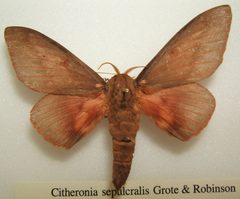
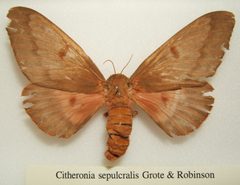
Citheronia sepulcralis, commonly known as the pine-devil , is a giant silk moth in the Saturniidae. are blackish-brown in color and lack functional mouthparts. The occurs across the eastern and southeastern United States, with larvae feeding exclusively on pine species. Multiple occur in southern regions, while northern are .
Pronunciation
How to pronounce Citheronia sepulcralis: //ˌsɪθəˈroʊniə ˌsɛpəlˈkreɪlɪs//
These audio files are automatically generated. While they are not always 100% accurate, they are a good starting point.
Identification
can be distinguished from other Citheronia by their blackish-brown coloration (Citheronia regalis, the royal walnut , has more orange and cream patterning). The species is also distinguished by its exclusive association with pine , whereas C. regalis feeds on walnut, hickory, and other hardwoods. Larvae are black or brown with black markings, lacking the prominent orange and black horns characteristic of C. regalis caterpillars (hickory horned devils).
Images
Habitat
Associated with pine forests and woodlands. Larvae feed on pine needles.
Distribution
United States: Georgia, Kentucky, Massachusetts, North Carolina, South Carolina, Pennsylvania, Louisiana, Florida, and Maine. Most common in Florida and Louisiana.
Seasonality
Northern US (June–July). Southern states (April–June). Florida: multiple possible from March through October.
Diet
Larvae feed on Pinus (pine). do not feed.
Host Associations
- Pinus - larval food plantexclusive ; larvae feed on pine needles
Life Cycle
hatch after 7–10 days. Larvae feed on pine needles and develop through several instars. When ready to pupate, caterpillars burrow underground. typically emerge in late morning.
Behavior
emerge in the morning and mate on the same night. Females lay in groups of 1–3 on pine needles the following night.
Ecological Role
Larval herbivore on pine . serve as prey for birds and other during their brief adult lifespan.
Similar Taxa
- Citheronia regalisSimilar size and (Ceratocampinae), but distinguished by coloration (orange and cream patterning vs. blackish-brown in C. sepulcralis), larval appearance (green with prominent orange and black horns vs. black/brown with black markings), and plants (walnut, hickory, and other hardwoods vs. exclusive pine association).
Sources and further reading
- BugGuide
- Wikipedia
- GBIF taxonomy match
- iNaturalist taxon
- NCBI Taxonomy
- Catalogue of Life
- Of Lady Beetles and Green Fruit Beetle Larvae | Bug Squad
- Silkmoth Season, Part 2: A royal welcome – Royal Walnut Moth, Citheronia regalis — Bug of the Week
- Devils and hummingbirds - Hickory horned devil, Citheronia regalis and hummingbird clearwing moth, Hemaris thysbe — Bug of the Week
- Devilish times for hickory: Hickory horned devils and royal walnut moths, Citheronia regalis — Bug of the Week
- Brazil Bugs #16 – Royal Moth Larva | Beetles In The Bush
- Super Crop Challenge #6 | Beetles In The Bush
- Updated Distributional Data forCitheronia sepulcralisGrote & Robinson, 1865 (Saturniidae: Ceratocampinae), with a New Host Plant Record