
Citheronia regalis
Fabricius, 1793
Regal Moth, Royal Walnut Moth
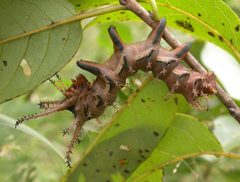
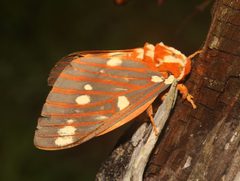
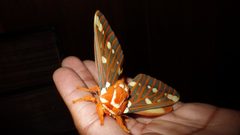
Citheronia regalis is a large North American saturniid known as the regal moth or royal walnut moth. Its larval stage, the hickory horned devil, is one of the largest caterpillars in North America north of Mexico and is notable for its striking appearance with prominent red and black horns. have mouthparts and do not feed, living only about a week to mate and lay . The has a single per year throughout most of its range.
Pronunciation
How to pronounce Citheronia regalis: /sɪˈθɛɹoʊniə rɪˈɡælɪs/
These audio files are automatically generated. While they are not always 100% accurate, they are a good starting point.
Identification
are distinguished from other large saturniids by the combination of orange-red thoracic coloration, gray wings with orange-yellow bands, and large size. The hickory horned devil caterpillar is unmistakable in final instar: no other North American caterpillar combines the large green body with prominent red and black thoracic horns. Earlier instars with clubbed spines may be confused with other Citheronia but are rarely encountered. The pupa's large size and earthen chamber (not cocoon) distinguish it from most other saturniids.
Images
Habitat
Deciduous forests, particularly those containing walnut (Juglans) and hickory (Carya) trees. In the southern part of its range, also found in forests with sweet gum (Liquidambar styraciflua), persimmon (Diospyros virginiana), and sumac (Rhus). The requires mature hardwood trees for larval development and open understory or edge where females can access tree foliage for oviposition.
Distribution
Eastern and central United States. Core range extends from the Deep South (Texas to central Florida) north through the Ohio Valley and southern Appalachia to southern Pennsylvania, New Jersey, and the mid-Atlantic states. Historical records from New England, but declined in the Atlantic Northeast during the mid-20th century; now considered extirpated in Connecticut and rare in New York. Western limit at the edge of the Great Plains in Missouri and eastern Texas.
Seasonality
Single per year () throughout range. fly from late June through August, with peak synchronized with the onset of humid summer weather. Larvae are present from July through October, with fifth instars peaking August to October. In the Deep South, adults may be recorded across a longer growing season due to extended favorable conditions.
Diet
Larvae feed on leaves of walnut (Juglans), hickory (Carya), and related Juglandaceae. Regional use includes sweet gum (Liquidambar styraciflua) and persimmon (Diospyros virginiana) in the South, and sumac (Rhus) where primary hosts are unavailable. do not feed due to mouthparts.
Host Associations
- Juglans cinerea - larval Butternut
- Carya illinoensis - larval Pecan and other Carya
- Liquidambar styraciflua - larval Sweet gum, primarily in southern range
- Diospyros virginiana - larval Persimmon, southern range
- Rhus - larval Sumac, secondary
- Cotesia nuellorum - Gregarious braconid of early instar larvae
Life Cycle
are yellowish, oval, 2 mm in diameter, laid singly or in groups of up to four on upper leaf surfaces of plants. Incubation 7–10 days. Larvae pass through five instars over 37–42 days; early instars are solitary nighttime feeders that rest curled in a J-shape by day, while later instars feed during the day. Final instar larvae expel gut contents, turn turquoise, then burrow 5–6 inches into soil to pupate in an earthen chamber. Some pupae overwinter for two seasons. eclose, pump wings with , and live approximately one week without feeding.
Behavior
Early instar larvae are solitary and cryptic, resting in J-shaped postures that resemble bird droppings. Later instars are more conspicuous and active during daylight hours. The formidable appearance of fifth instar larvae with prominent horns is a defensive display; the spines are prickly but do not sting and the caterpillar is easily handled. females release from elevated surfaces such as tree trunks to attract males, which may fly miles to locate females. Males may mate multiple times; females devote remaining life primarily to oviposition.
Ecological Role
Herbivore that consumes leaves of hardwood trees; individual larvae can defoliate several branches but rarely occur in densities sufficient to cause significant tree damage. Serves as for including Cotesia nuellorum. are prey for birds and other during their brief adult stage. The contributes to nutrient cycling through herbivory and serves as a food source for higher .
Human Relevance
Larvae are frequently encountered by the public due to their large size and striking appearance, generating considerable interest and sometimes alarm due to their 'devil' and horned appearance. Often featured in educational programs and nature centers; the hickory horned devil is a crowd-pleaser at insect fairs and university open houses. Not an agricultural or forestry pest. Historical decline in parts of range has prompted conservation concern; listed as of special concern in Connecticut.
Similar Taxa
- Citheronia splendensSimilar early instar larvae with clubbed spines; distinguished by geographic range (southwestern US) and coloration
- Citheronia lobesisSimilar early instar ; occurs in Central America, not sympatric with C. regalis
- Anisota senatoriaAnother large green saturniid caterpillar with thoracic horns, but horns are yellow-orange not red and black, and body has distinct striping not seen in C. regalis
- Actias luna luna moth is large and green but has long hindwing tails and lacks orange-red thoracic coloration; caterpillar is green with sparse , not horns
Misconceptions
The hickory horned devil's name and appearance lead many to assume it is dangerous or venomous; it is entirely harmless and among the more easily handled saturniid caterpillars. The prominent horns and spines are purely defensive display structures. Some pupae for two seasons was historically interpreted as individual to adverse conditions, but may function to maintain genetic diversity across .
More Details
Parasitoid specificity
The braconid Cotesia nuellorum parasitizes only early instar larvae (2nd–3rd instar); fourth and fifth instar larvae appear immune, suggesting instar-specific defensive or physiological barriers.
Mass and size records
, larvae, and pupae are all the largest by mass among north of Mexico in their respective life stages.
Historical range contraction
Well-documented in New England historical records but suffered marked decline in Atlantic Northeast during mid-20th century; causes uncertain but likely include forest fragmentation, use, and loss of mature trees.
Sources and further reading
- BugGuide
- Wikipedia
- GBIF taxonomy match
- iNaturalist taxon
- NCBI Taxonomy
- Catalogue of Life
- Of Lady Beetles and Green Fruit Beetle Larvae | Bug Squad
- What's a Picnic Without Bugs? | Bug Squad
- Silkmoth Season, Part 2: A royal welcome – Royal Walnut Moth, Citheronia regalis — Bug of the Week
- Brazil Bugs #16 – Royal Moth Larva | Beetles In The Bush
- Super Crop Challenge #6 | Beetles In The Bush
- Super Crop Challenge | Beetles In The Bush | Page 3
- Hickory Horned Devil (Larva), Regal Moth or Royal Walnut Moth (Adult), Citheronia regalis (Fabricius) (Insecta: Lepidoptera: Saturniidae: Ceratocampinae)
- A new species of Cotesia Cameron (Hymenoptera, Braconidae, Microgastrinae) reared from the hickory horned devil, Citheronia regalis, and luna moth, Actias luna, in east Texas
- A new species of Cotesia Cameron (Hymenoptera, Braconidae, Microgastrinae) reared from the hickory horned devil, Citheronia regalis, and luna moth, Actias luna, in east Texas