
Antheraea polyphemus
Cramer, 1775
Polyphemus moth, Polyphemus silk moth
A large North American silk with tan to brown coloration and distinctive purplish eyespots on the hindwings, named after the cyclops Polyphemus from Greek mythology. have mouthparts and do not feed, living less than one week. The produces silk cocoons and has been used in hybridization experiments with other silk moths. Two typically emerge annually across most of its range.

Pronunciation
How to pronounce Antheraea polyphemus: /ænˈθɪəriə pɒˈlɪfɪməs/
These audio files are automatically generated. While they are not always 100% accurate, they are a good starting point.
Identification
The large purplish eyespots on the hindwings are diagnostic and immediately distinguish this from other North American giant silk moths. Males are identified by their conspicuously feathery compared to females. The Polyphemus can be separated from the Luna moth (Actias luna) by its brown coloration versus pale green, and from the Cecropia moth (Hyalophora cecropia) by the presence of single large eyespots rather than multiple smaller eyespots and more complex wing patterning. The Promethea moth (Callosamia promethea) has more elongated hindwing tails and lacks the prominent eyespots. in antennae is pronounced and useful for sex identification.
Images
Appearance
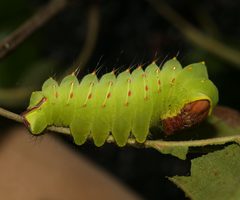
are tan to dark brown with variable coloration ranging from reddish cinnamon to dark brown. The most distinctive feature is the large purplish eyespot on each hindwing, surrounded by yellow, blue, and black rings. Forewings lack eyespots. Wingspan ranges from 10–15 cm (4–6 inches). Wing margins have black and white stripes. Males have highly (feathery) ; females have moderately less bushy antennae and a slightly larger . Caterpillars are bright green with silver spots on the sides in the final instar, reaching 7.5–10 cm (3–4 inches) in length. Earlier instars are yellow and change coloration with each .
Habitat
Deciduous hardwood forests, orchards, urban areas with appropriate trees, and wetlands. Requires presence of host trees for larval development. are attracted to light sources at night.
Distribution
Widespread across continental North America from southern Canada to Mexico. Present throughout subarctic Canada and all contiguous United States except Arizona and Nevada. Two occur in most regions; single brood in northern parts of range.
Seasonality
Two annually throughout most of range: one in early spring and one in late summer. emerge in afternoon, with males typically emerging several days before females from the same brood. Adults are , active at dusk and throughout the night.
Diet
have mouthparts and do not feed. Larvae are , feeding on leaves of numerous deciduous trees including American elm (Ulmus americana), birch (Betula), willow (Salix), oak (Quercus), maple (Acer), hickory (Carya), beech (Fagus), honey locust (Gleditsia triacanthos), walnut (Juglans), pear (Pyrus), plum and cherry (Prunus), sassafras, and citrus.
Host Associations
- Ulmus americana - preferred American elm is a preferred for -laying and larval development
- Betula - preferred Birch are preferred
- Salix - preferred Willow are preferred
- Quercus - secondary Oak are secondary used less frequently
- Acer - secondary Maple are secondary
- Carya - secondary Hickory are secondary
- Fagus - secondary Beech are secondary
- Gleditsia triacanthos - secondary Honey locust is a secondary
- Juglans - secondary Walnut are secondary
- Pyrus - secondary Pear is a secondary
- Prunus - secondary Plum, peach, apricot, and cherry are secondary
- Sassafras - secondary Sassafras is a secondary
- Citrus - secondary Citrus is a secondary , used more rarely
Life Cycle
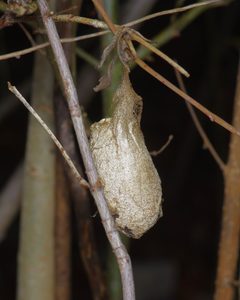
are flat, light brown, and laid singly or in groups of 2–3 on undersides of tree leaves. Larvae hatch and proceed through five instars, molting progressively; final instar caterpillars are bright green with silver spots. Caterpillars spin brown silk cocoons wrapped in host leaves for protection and camouflage. The pupa is secured by a to a silk pad at the cocoon's end. eclose by splitting the pupal case and pushing upward. Two per year in most regions; single brood in northern areas. Development from egg to adult can occur in less than two months under favorable conditions.
Behavior
are strictly , becoming active at dusk. Females emit sex-attractant beginning the evening of , with maximal male attraction during the last two hours before sunrise; males detect pheromones using specialized trichoid on their and may fly miles to locate females. Mating occurs the same day adults emerge and can last from under one hour to many hours. If unmated, females cease calling after 2–3 days and release unfertilized . Adults do not feed due to mouthparts. In captivity, males and females tend to ignore each other unless plant material is present. Caterpillars produce clicking sounds (50–55 clicks per minute, lasting over a minute) by rubbing serrated together when disturbed, followed by regurgitation of defensive fluids.
Ecological Role
Larvae serve as herbivores on deciduous trees, contributing to nutrient cycling. function as prey for including bats and owls; the eyespot distraction display may deflect predator attacks to wing margins, reducing fatal damage. Pupae are preyed upon by squirrels. and tachinid flies (particularly the introduced Compsilura concinnata) are significant mortality factors. The is part of the supporting parasitoid and predator in deciduous forest .
Human Relevance
Used historically in hybridization experiments with other silk (Antheraea yamamai from Japan, Antheraea mylitta from India) to produce intergeneric hybrids for scientific study. Cocoons produce silk, though not commercially harvested like domesticated . Popular among amateur entomologists and educators for rearing and observation; frequently displayed at museum events and educational programs. Light pollution poses a documented threat to . Spongy moth can trigger chemical defenses in quaking aspen that render them unsuitable as trees, indirectly affecting Polyphemus moth populations.
Similar Taxa
- Hyalophora cecropiaSimilar large size and brown coloration, but has multiple smaller eyespots on each wing and more complex patterning rather than single large hindwing eyespots; also has red and white color elements on wings
- Actias lunaSimilar large size and hindwing eyespots, but pale green rather than brown, with elongated hindwing tails that Polyphemus lacks
- Callosamia prometheaSimilar size and brown coloration, but has more elongated hindwing tails and lacks the prominent eyespots; males are darker than females (reverse of typical saturniid pattern)
- Antheraea pernyiAsian used in tussah silk production; similar overall appearance but not naturally sympatric with A. polyphemus
More Details
Defense mechanisms
use eyespots as distraction displays to confuse , potentially mimicking the of a great horned owl (Bubo virginianus). This often results in wing damage that does not impair . Caterpillars combine acoustic signaling ( clicking) with chemical defense (regurgitation of distasteful fluids) when threatened.
Rearing difficulties
Considered more difficult to breed in captivity than other North American saturniids such as Hyalophora cecropia, Callosamia promethea, or Actias luna; males and females often ignore each other in cages unless plant material is present.
Light pollution sensitivity
Documented sensitivity to artificial light; streetlamps cause disorientation and disrupt mating, -laying, and . The 'vacuum cleaner effect' describes how electric lamps can reduce insect through attraction and subsequent or exhaustion.
Hybridization history
Reclassified from Telea polyphemus to Antheraea polyphemus following successful hybridization experiments in the late 1950s by Gary Botting, who transferred -producing scent sacs between to produce viable intergeneric hybrids.
Sources and further reading
- BugGuide
- Wikipedia
- GBIF taxonomy match
- iNaturalist taxon
- NCBI Taxonomy
- A Moth's Nighttime Visit Turns Into Remembrances of Alice--and an Educational Video | Bug Squad
- Silk Textile Displays Grab Attention at Bohart Museum's Moth Night | Bug Squad
- Don't Miss Bohart Museum Open House on Moths! | Bug Squad
- Silkworm Moths, Blacklighting, Hot Chocolate, Cookies and More | Bug Squad
- Native Bees to Share Spotlight at Bohart Museum Open House | Bug Squad
- Turbo Testudine | Beetles In The Bush
- The electrical circuitry of an olfactory sensillum in Antheraea polyphemus
- A reinvestigation of the role of (E)-2-hexenal in female calling behaviour of the polyphemus moth (Antheraea polyphemus)
- DISTRIBUTION AND METABOLISM OF α-ECDYSONE IN PUPAE OF THE SILKWORMANTHERAEA POLYPHEMUS