
Antheraea
Hübner, 1819
tussar moths
Species Guides
2- Antheraea oculea(Western Polyphemus Moth)
- Antheraea polyphemus(Polyphemus moth)
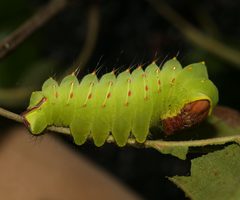
Antheraea is a of giant silk moths in the Saturniidae, established by Jacob Hübner in 1819. in this genus are notable for producing wild silk of commercial importance, commonly known as "tussar silk" or "tussah silk." The genus includes species distributed across Asia, North America, and other regions, with several species cultivated for . Caterpillars of Antheraea species feed on diverse plants including oaks and other woody trees.

Pronunciation
How to pronounce Antheraea: /æn.ˈθɪə.ri.ə/
These audio files are automatically generated. While they are not always 100% accurate, they are a good starting point.
Images
Distribution
of Antheraea occur across Asia, North America, and Africa. Specific distribution varies by species: Antheraea polyphemus ranges from southern Canada through Mexico and most of the continental United States; Antheraea pernyi occurs in China; Antheraea paphia and Antheraea mylitta are found in India; Antheraea yamamai is native to Japan; Antheraea compta is to the Tibetan Sub-Himalayas.
Diet
Caterpillars of Antheraea are , feeding on leaves of various woody plants. Documented plants include oaks (Quercus species), including Quercus yunnanensis for Antheraea compta, as well as elm, walnut, hickory, maple, and other trees. Specific host associations vary by species and geographic region.
Host Associations
- Quercus - larval plantMultiple oak including Quercus yunnanensis for A. compta; Valley oak for A. polyphemus
- Carya - larval plantHickory documented for A. polyphemus
- Juglans - larval plantWalnut documented for A. polyphemus
- Ulmus - larval plantElm documented for A. polyphemus
- Acer - larval plantMaple documented for A. polyphemus
Life Cycle
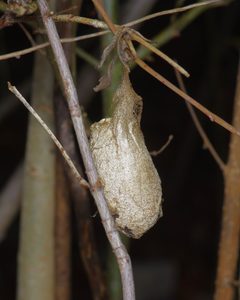
Antheraea undergo complete with four developmental stages: , larva (caterpillar), pupa (within cocoon), and . Larvae typically pass through multiple instars (five to six instars documented in several species). Caterpillars spin cocoons of leaves and silk for . In Antheraea polyphemus, the entire cycle from egg to adult has been observed to complete in less than two months under favorable conditions. Voltinism varies by species and ecorace, with some and others multivoltine.
Behavior
Antheraea are and attracted to light sources. Caterpillars of Antheraea polyphemus exhibit defensive including rearing the body in a 'sphinx' pose when threatened, and producing clicking sounds with the that may precede defensive regurgitation of distasteful fluids. Defensive behaviors have also been documented in other including Antheraea compta.
Ecological Role
As larvae, Antheraea function as herbivores consuming leaves of woody plants. As , they may contribute to pollination though this role is not well documented. The silk cocoons provide material for nest construction by other animals. Larvae serve as prey for various including birds, , and other insects.
Human Relevance
Antheraea are economically significant for wild silk production. Tussah silk (from Antheraea pernyi, A. paphia, and related species) is harvested from cocoons and woven into textiles. Antheraea mylitta, the tropical tasar , is commercially cultivated in India with multiple ecoraces maintained for . The has been subject to hybridization experiments for silk improvement, including artificial hybrids such as Antheraea × proylei. Antheraea polyphemus is frequently used in educational settings and public outreach due to its large size and striking appearance.
Similar Taxa
- SamiaAlso in Saturniidae and produces wild silk (eri silk), but belongs to different (Saturniinae: Attacini vs. Saturniini for Antheraea) and has different geographic distribution and plant associations
- BombyxProduces commercial silk (mulberry silk) but belongs to , not Saturniidae; domesticated with different and silk characteristics
- HyalophoraNorth American giant silk in Saturniidae with similar size and appearance to Antheraea polyphemus, but distinguished by different wing patterns and eyespot arrangements
More Details
Sericulture and Silk Types
Tussah silk produced by Antheraea differs from mulberry silk (Bombyx mori) in being wild-harvested rather than domestically reared, resulting in coarser, more textured fiber. The silk is termed 'wild silk' or 'raw silk' and has been produced for at least 5,000 years. Multiple Antheraea species contribute to global tussah silk production including A. pernyi (Chinese oak silkmoth), A. paphia (India), A. mylitta (tropical tasar), and A. yamamai (Japanese oak silkmoth).
Conservation Status of Ecoraces
Antheraea mylitta exists as 44 distinct ecoraces across India, with significant variation in phenotypic traits including , voltinism, cocoon weight, and silk ratio. Some ecoraces such as the Andhra local ecorace are threatened with extinction due to weaknesses in , hatching, and low yield, prompting conservation efforts and genetic studies to preserve valuable genes for hybridization programs.
Hybridization
Artificial hybrids have been created between Antheraea , including Antheraea × proylei (A. pernyi male × A. roylei female) and experimental crosses involving A. polyphemus with A. paphia and A. yamamai using transfer techniques developed in 1959-1960.
Sources and further reading
- BugGuide
- Wikipedia
- GBIF taxonomy match
- iNaturalist taxon
- NCBI Taxonomy
- Catalogue of Life
- A Moth's Nighttime Visit Turns Into Remembrances of Alice--and an Educational Video | Bug Squad
- Silk Textile Displays Grab Attention at Bohart Museum's Moth Night | Bug Squad
- Don't Miss Bohart Museum Open House on Moths! | Bug Squad
- Silkworm Moths, Blacklighting, Hot Chocolate, Cookies and More | Bug Squad
- Scary eyes - Polyphemus moth, Antheraea polyphemus — Bug of the Week
- Scary eyes in the DMV – Giant Polyphemus silk moth, Antheraea polyphemus — Bug of the Week
- Studies on the transmission and tissue distribution of Antheraea pernyi iflavirus in the Chinese oak silkmoth Antheraea pernyi
- Supplementary material 1 from: Liu Z (2023) An “American” silkmoth endemic to Himalayas, part I: life history and natural distribution of Antheraea compta Rothschild, 1899 (Lepidoptera, Saturniidae). Deutsche Entomologische Zeitschrift 70(2): 261-282. https://doi.org/10.3897/dez.70.102952
- Supplementary material 3 from: Liu Z (2023) An “American” silkmoth endemic to Himalayas, part I: life history and natural distribution of Antheraea compta Rothschild, 1899 (Lepidoptera, Saturniidae). Deutsche Entomologische Zeitschrift 70(2): 261-282. https://doi.org/10.3897/dez.70.102952
- Next-Generation Sequencing (NGS) in populations of Indian Tropical Tasar Silkworm, Antheraea mylitta
- Figure 2 from: Liu Z (2023) An “American” silkmoth endemic to Himalayas, part I: life history and natural distribution of Antheraea compta Rothschild, 1899 (Lepidoptera, Saturniidae). Deutsche Entomologische Zeitschrift 70(2): 261-282. https://doi.org/10.3897/dez.70.102952