
Eacles imperialis pini
Michener, 1950
Imperial moth (pini subspecies), pine-feeding Imperial moth
Eacles imperialis pini is a of the Imperial moth, a giant silk in the Saturniidae. This subspecies is notable for its association with pine and other coniferous trees as larval , distinguishing it from nominate that feed primarily on deciduous trees. are large, visually striking moths with yellow and purple-brown patterning. The subspecies occurs in North America, with documented populations on Martha's Vineyard, Massachusetts, where it has persisted while other Imperial moth populations in New England have declined or been extirpated.
Pronunciation
How to pronounce Eacles imperialis pini: /ˈeɪ.kliːz ɪmˌpɪə.riˈælɪs ˈpɪ.naɪ/
These audio files are automatically generated. While they are not always 100% accurate, they are a good starting point.
Identification
Distinguished from other giant silk moths by the combination of large size, yellow and purple-brown wing pattern, and absence of eyespots or translucent patches on wings (unlike Antheraea polyphemus or Actias luna). Differs from nominate Eacles imperialis imperialis primarily by larval association with conifers including pine, spruce, hemlock, cedar, cypress, and juniper, though is similar. Specimens from Martha's Vineyard showing this pine-feeding have been specifically associated with the E. i. pini.
Images
Appearance
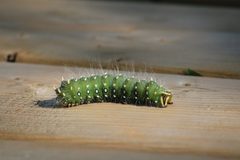
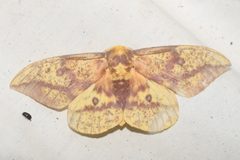
are large with wingspans typically 80–175 mm. Forewings display variable yellow ground color with scattered dark purple-brown to black spots and blotches. Hindwings are similarly patterned but often with more extensive dark areas. Body is robust and densely hairy, colored yellow with purple-brown markings. are feathery, especially in males. Larvae are large, cylindrical caterpillars reaching 75–100 mm at maturity, green to brown in color with yellow spiracular lines, and bearing fleshy, unbranched .
Habitat
Associated with coniferous and mixed forests where larval trees occur. On Martha's Vineyard, persists in pine-dominated woodlands and areas with pitch pine and other conifers. are often found resting on tree trunks during daylight hours.
Distribution
North America. Documented from Martha's Vineyard, Massachusetts, where a relictual persists. Broader distribution of the includes areas where pine-feeding populations occur, potentially extending through eastern North America where coniferous are available. GBIF records indicate presence in North America generally and specifically Vermont, USA.
Seasonality
emerge from soil pupal chambers in late spring to summer with return of warm weather and foliage. In Massachusetts, period primarily June to August. Larvae feed through summer and early autumn, descending from tree in late summer and early fall to burrow underground and pupate.
Diet
Larvae feed on leaves of coniferous trees including pine (Pinus), spruce (Picea), hemlock (Tsuga), cedar (Thuja), cypress, and juniper (Juniperus). have mouthparts and do not feed.
Host Associations
- Pinus - larval pitch pine and other
- Picea - larval spruce
- Tsuga - larval hemlock
- Thuja - larval cedar
- Juniperus - larval juniper
Life Cycle
deposited singly or in groups of 2–5 on leaves. Larvae hatch in approximately two weeks and feed for several weeks. Full-grown larvae descend from tree in late summer or early autumn, cross ground-level terrain, and burrow into soil to form earthen pupal chambers. Pupae overwinter underground. emerge following year with warm weather, mate, and oviposit. No cocoon is spun—unlike many Saturniidae, this pupates in a subterranean earthen chamber.
Behavior
are and strongly attracted to artificial light sources, which disrupts navigation and may lead to , failed mating, or mortality. Females release at night in tree to attract males. Adults frequently rest on tree trunks during daylight, where cryptic coloration provides camouflage. Larvae are solitary feeders in tree canopies.
Ecological Role
Larvae function as herbivores, consuming substantial quantities of coniferous foliage. serve as prey for bats and other , particularly when aggregated at artificial lights. The represents a genetically distinct adapted to coniferous , contributing to local biodiversity on Martha's Vineyard where it has persisted while other regional populations declined.
Human Relevance
Subject of conservation concern due to regional extirpations and declines in New England. Serves as for impacts of artificial light pollution, destruction, , and introduced agents. on Martha's Vineyard support local ecotourism and natural history interest. Artificial light attraction makes vulnerable to human-caused mortality in developed areas.
Similar Taxa
- Eacles imperialis imperialisNominate ; primarily associated with deciduous (oak, hickory, maple, sweet gum, etc.) rather than conifers. similar; distinction based on larval and geography.
- Antheraea polyphemusAnother large Saturniid with yellow-brown coloration, but distinguished by prominent eyespot on each hindwing and more uniform tan to brown ground color without purple tones.
- Actias lunaLarge green Saturniid with long hindwing tails and eyespots; readily distinguished by color and wing shape.
- Citheronia regalisRoyal Walnut moth; similar large size but with orange-brown to olive coloration and more irregular wing patterning; larvae bear branched unlike unbranched tubercles of Eacles.
More Details
Conservation status in New England
The Martha's Vineyard of E. i. pini has persisted while Imperial moth populations in much of New England, including Connecticut, have been extirpated. This persistence is attributed to the island's relative isolation from introduced flies (Compsilura concinnata), applications targeting gypsy moth, and possibly reduced light pollution in some areas. The exemplifies how localized ecological factors can maintain populations that have disappeared from broader regions.
Light pollution vulnerability
are highly susceptible to artificial light attraction, which disrupts celestial navigation systems evolved for moon and star orientation. spiral toward near light sources, leading to energy depletion, failed mate location, disrupted oviposition, and increased by bats and other . This vulnerability has been documented as a significant factor in regional declines and is particularly acute for this in developed areas of its limited range.