
Lespesia
Robineau-Desvoidy, 1863
Species Guides
2- Lespesia archippivora(Caterpillar Destroyer)
- Lespesia samiae
Lespesia is a of tachinid flies (Diptera: Tachinidae) distributed from Canada to Chile, with approximately 37 in the Neotropical Region. Species are endoparasitoids of Lepidoptera caterpillars, with some records from larvae. The genus includes economically significant species such as L. archippivora, a major of monarch butterfly larvae documented through extensive citizen science monitoring.
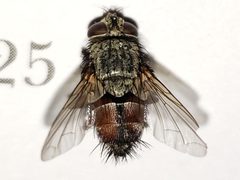
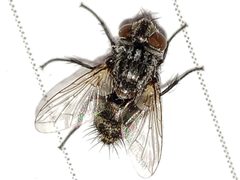
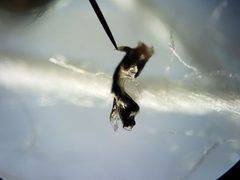
Pronunciation
How to pronounce Lespesia: /lɛsˈpeːzi.a/
These audio files are automatically generated. While they are not always 100% accurate, they are a good starting point.
Images
Habitat
Associated with caterpillar including agricultural crops, ornamental plants, and natural vegetation. L. melloi was collected at 1,010 m elevation in southeastern Brazil.
Distribution
ranges from Canada to Chile, with 37 recorded in the Neotropical Region. Specific locality records include Vermont (USA), Puerto Rico, southeastern Brazil (Nova Friburgo, Rio de Janeiro), and Chiapas (Mexico).
Host Associations
- Danaus plexippus - endoparasitoidL. archippivora; major , 75% of tachinid specimens from monarch monitoring
- Xanthopastis timais - endoparasitoidL. melloi; caterpillars and pupae feed on Amaryllidaceae
- Spodoptera frugiperda - endoparasitoidL. postica and Lespesia spp.; on Zea mays in Puerto Rico and Chiapas
- Spodoptera exigua - endoparasitoidL. archippivora
- Monoctenus sanchezi - endoparasitoidL. postica; first record for this association
- Thagona tibialis - endoparasitoidL. melloi; hyperparasitoid Brachymeria koehleri recorded from pupae
- Lepidoptera (general) - endoparasitoidMultiple ; laboratory studies confirm broad ranges for some species
Life Cycle
Endoparasitoid larvae develop internally within caterpillars. In L. melloi, larvae emerged from hosts June 2-5, pupated within hours, and emerged June 29-July 1 (approximately 3-4 weeks after ).
Behavior
Female flies deposit into or on caterpillar . L. archippivora exhibits progeny allocation strategies when exploiting hosts. Multiparasitism (multiple tachinid emerging from single host) has been observed in monarchs.
Ecological Role
agent of lepidopteran pests. L. archippivora is the most abundant (75% of specimens) in monarch butterfly , with 9.8% overall rate increasing to 17% in fifth-instar larvae. L. melloi is a potential biocontrol agent for Spanish moth on amaryllis.
Human Relevance
Used in biological pest control programs. L. archippivora has been monitored extensively through citizen science (Monarch Larva Monitoring Project) since 1999, with over 20,000 monarch specimens reared and more than 1,100 flies collected by volunteers. L. postica and L. melloi show potential for controlling agricultural pests on maize and ornamental plants.
Sources and further reading
- BugGuide
- Wikipedia
- GBIF taxonomy match
- iNaturalist taxon
- NCBI Taxonomy
- Catalogue of Life
- A Fly -- Oh, My! | Bug Squad
- Lespesia-melloi - Entomology Today
- Lespesia archippivora Archives - Entomology Today
- Citizen Science Delivers "Unprecedented View" of Monarch Butterfly Parasitoids
- Newly Discovered Fly Species Parasitizes Moths in Brazil
- Journal of Insect Science Archives - Page 16 of 16 - Entomology Today
- Laboratory Studies of Lespesia archippivora in Four Lepidopterous Hosts12
- First Records of Lespesia postica and Vibrissina mexicana (Tachinidae) as Parasitoids of Monoctenus sanchezi (Diprionidae)
- Lespesia melloi sp. nov. (Diptera: Tachinidae) from Brazil, a parasitoid of Xanthopastis timais(Lepidoptera: Noctuidae)
- Lespesia archippivora (Diptera: Tachinidae) Survival and Sex Ratios within Monarch Butterfly (Lepidoptera: Nymphalidae) Hosts
- Biology and Development of Lespesia aletiae (Diptera: Tachinidae) in Two Lepidopteran Species in the Laboratory
- Progeny Allocation by the Parasitoid Lespesia archippivora (Diptera: Tachinidae) in Larvae of Spodoptera exigua (Lepidoptera: Noctuidae)
- Lespesia melloisp. nov. (Diptera: Tachinidae) from Brazil, a Parasitoid ofXanthopastis timais(Lepidoptera: Noctuidae)
- ARCHYTAS MARMORATUS (TOWNSEND) AND LESPESIA SPP. (DIPTERA: TACHINIDAE) PARASITOIDS OF SPODOPTERA FRUGIPERDA (J.E. SMITH) (LEPIDOPTERA: NOCTUIDAE) ON ZEA MAYS L. IN SOUTHERN PUERTO RICO
- Lespesia postica: A New Report as a Parasitoid ofSpodoptera frugiperdaat Chiapas, México
- Brachymeria koehleri(Hymenoptera: Chalcididae) as a Hyperparasitoid ofLespesia melloi(Diptera: Tachinidae) Pupae inThagona tibialis(Lepidoptera: Lymantriidae) Caterpillars in Brazil