
Lespesia archippivora
(Riley, 1871)
Caterpillar Destroyer
Lespesia archippivora is a tachinid fly that develops internally within caterpillars, eventually killing its . It is a parasitoid known to infect at least 25 lepidopteran and one hymenopteran species. The species is particularly notable for its impact on monarch butterfly , with studies estimating 6.2% of wild monarchs are killed by this fly. It has been widely used as a agent against agricultural pests including armyworms, cutworms, and . First introduced to Hawaii in 1898 for pest control, it is now established across North America and several Pacific islands.
Pronunciation
How to pronounce Lespesia archippivora: //lɛˈspiːʒə ˌɑːrˌkɪpɪˈvɔːrə//
These audio files are automatically generated. While they are not always 100% accurate, they are a good starting point.
Identification
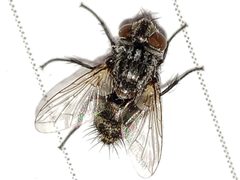
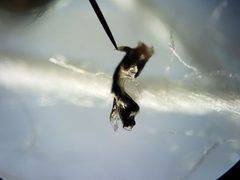
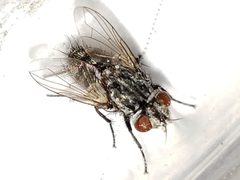
Distinguished from other tachinid flies by its association with specific and geographic range. are covered in thick, dark bristles on the . Accurate identification to level requires examination of morphological characters by a ; general field identification is difficult without host association data or specimen examination.
Images
Appearance
flies are approximately the size of a house fly. The is covered with thick, dark bristles—a distinctive feature of tachinid flies. Adults possess the typical dipteran body plan with one pair of functional wings.
Habitat
Occurs in agricultural fields, gardens, and natural areas where caterpillars are present. The requires supporting its diverse lepidopteran host range, including crop fields, meadows, and areas with milkweed and other host plants.
Distribution
Native to North America; established in Canada, United States, and Mexico. Introduced to Hawaii in 1898 and subsequently to Fiji, Guam, and Marshall Islands. Present in agricultural and natural landscapes across its range.
Seasonality
One study suggests the is (two per year). Activity coincides with availability of caterpillars, with rates increasing through larval stages of host development.
Host Associations
- Danaus plexippus - Monarch butterfly; causes 6.2% mortality in wild
- Mythimna unipuncta - ; used in
- Helicoverpa zea - Corn earworm; used in
- Agrotis ipsilon - Black cutworm; used in
- Peridroma saucia - Variegated cutworm; used in
- Spodoptera frugiperda - Fall armyworm; laboratory confirmed
- Spodoptera exigua - Beet armyworm; progeny allocation studied
- Omiodes accepta - Sugarcane leaf roller; used in
- Perilampus hyalinus - hyperparasitoid that parasitizes L. archippivora larvae
Life Cycle
Females mate within one day of , then locate caterpillars. are oviposited at the end of the host; eggs are relatively large compared to other tachinids. Maggots hatch and burrow through the host surface, moving freely within the host body. After three days, the larva positions itself near a host . The maggot undergoes three larval instars, consuming internal host contents. It exits the host as a late-stage larva and pupates in soil substrate. emergence occurs 10-14 days after . Total size typically ranges from 1-10 maggots per host. Females lay 15-204 eggs in their lifetime.
Behavior
Females act quickly when locating , ovipositing rapidly at the end of caterpillars. Exhibits progeny allocation , distributing offspring among available host larvae rather than concentrating in single hosts. Maggots move freely within the host body before positioning near .
Ecological Role
Acts as a regulating of lepidopteran herbivores. Serves as a for hyperparasitoids including the Perilampus hyalinus. Contributes to natural mortality factors affecting both pest and non-target butterflies including monarchs.
Human Relevance
Widely employed as a agent against agricultural pests since 1898, including the Hawaii introduction by Albert Koebele. Used to manage armyworms, cutworms, and in crop protection. A concern for monarch butterfly conservation due to documented mortality in wild and reared ; researchers debate whether high densities regulate monarch populations or affect fall to Mexico.
Similar Taxa
- Compsilura concinnataAnother tachinid fly of lepidopteran ; distinguished by introduction history (20th century introduction to North America for gypsy moth control) and different host range patterns
- Other Lespesia speciesCongeneric such as L. melloi are of different species (e.g., Spanish moth); require morphological examination for definitive identification
More Details
Hyperparasitism
Lespesia archippivora can itself be parasitized by hyperparasitoids. The Perilampus hyalinus has been documented infecting L. archippivora larvae.
Research Significance
Citizen science data from the Monarch Larva Monitoring Project (1999-present) has provided unprecedented documentation of this ' impact on , with over 20,000 specimens monitored and more than 1,100 specimens collected for identification.
Taxonomic Uncertainty
Researchers suspect L. archippivora may represent a 'complex' of multiple closely related , with one potentially specializing on . This remains a focus of ongoing research.
Sources and further reading
- BugGuide
- Wikipedia
- GBIF taxonomy match
- iNaturalist taxon
- NCBI Taxonomy
- Catalogue of Life
- A Fly -- Oh, My! | Bug Squad
- Citizen Science Delivers "Unprecedented View" of Monarch Butterfly Parasitoids
- Lespesia archippivora Archives - Entomology Today
- Lespesia-melloi - Entomology Today
- Newly Discovered Fly Species Parasitizes Moths in Brazil
- Journal of Insect Science Archives - Page 16 of 16 - Entomology Today
- Laboratory Studies of Lespesia archippivora in Four Lepidopterous Hosts12
- Lespesia archippivora (Diptera: Tachinidae) Survival and Sex Ratios within Monarch Butterfly (Lepidoptera: Nymphalidae) Hosts
- Progeny Allocation by the Parasitoid Lespesia archippivora (Diptera: Tachinidae) in Larvae of Spodoptera exigua (Lepidoptera: Noctuidae)