
Perilampus hyalinus
Say, 1829
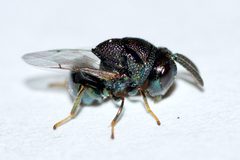
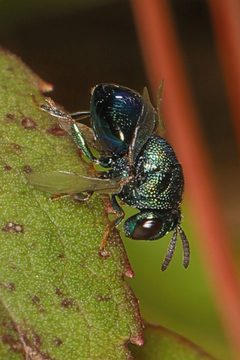
A Nearctic in the Perilampidae, part of a historically confused under this name for over 100 years. Recent integrative taxonomic revision (2024) clarified its status through neotype designation with COI sequence, establishing it as either a hyperparasitoid of dipteran parasitoids of Orthoptera or a parasitoid of dipteran kleptoparasites of Crabronidae and Sphecidae that provision nests with Orthoptera. Distinguished from eight newly described congeneric through , COI, ITS2, and data.
Pronunciation
How to pronounce Perilampus hyalinus: //ˌpɛrɪˈlæmpəs haɪˈeɪlɪnəs//
These audio files are automatically generated. While they are not always 100% accurate, they are a good starting point.
Identification
Distinguished from congeneric in the P. hyalinus complex through integrative taxonomic analysis combining , COI and ITS2 , and association data. The neotype designation provides a molecular reference for accurate identification.
Images
Distribution
Nearctic region: recorded from Alabama, Alberta, Arizona, Arkansas, British Columbia.
Host Associations
- dipteran parasitoids of Orthoptera - hyperparasitoidprimary mode established via neotype
- dipteran kleptoparasites of Crabronidae - provisioning nests with Orthoptera
- dipteran kleptoparasites of Sphecidae - provisioning nests with Orthoptera
Life Cycle
larvae hatch from broadcast on vegetation and attach to moving . To avoid , larvae embed in internal organs (brain, cord ganglia, malpighian tubes, silk glands) rather than remaining in the haemocoel. Upon host development resumption, planidia emerge and feed as . Second instar larvae suspend feeding to search for and destroy competitor within the host.
Behavior
Female broadcasts large numbers of (up to 500) on leaves, buds, bark cracks, and lichens. larvae actively avoid immune by embedding in specific internal organs. Second instar larvae exhibit competitor-seeking , suspending feeding to locate and eliminate other larvae in the host. Does not exhibit hyperparasitism when other parasites are present.
Ecological Role
Hyperparasitoid or in involving Orthoptera, Crabronidae, and Sphecidae. Acts as agent for . Engages in intra- competition with other parasitoids, actively eliminating competitors.
Similar Taxa
- Perilampus neodiprioniNewly described congeneric in the P. hyalinus complex; develops as both primary of Diprionidae and hyperparasitoid, strictly associated with Neodiprion
- Perilampus monocteniNewly described congeneric in the P. hyalinus complex; develops as both primary of Diprionidae and hyperparasitoid, associated with Monoctenus
- Perilampus sirsirisHyperparasitoid in the same complex, parasitizing hymenopteran and dipteran of Lepidoptera
- Chrysididae (cuckoo wasps)Similar small size, metallic coloration, and occurrence around colonies; distinguished by oval or rounded without sharp corners, versus triangular or inverted pyramid-shaped abdomen in Perilampidae
More Details
Taxonomic history
Historically confused with a wide range of associations and differing modes of across what is now recognized as a ten-. The 2024 revision by Yoo & Darling resolved 100 years of confusion through neotype designation and integrative .
Encapsulation avoidance
In Neodiprion lecontei , 87% of recovered were embedded in the brain and cord ganglia, with remainder in malpighian tubes and silk glands. Planidia in the haemocoel were typically encapsulated and did not survive.
Sources and further reading
- BugGuide
- GBIF taxonomy match
- iNaturalist taxon
- NCBI Taxonomy
- Catalogue of Life
- Encyrtid Holdings | Entomology Research Museum
- Bug Eric: Wasp Wednesday: Perilampid Wasps
- Bug Eric: Wasp Wednesday: Clitemnestra bipunctata
- New Host Records for Perilampus hyalinus (Hymenoptera: Perilampidae) and Phasmophaga antennalis (Diptera: Tachinidae)
- Integrative taxonomic revision of the Nearctic Perilampus hyalinus species complex (Hymenoptera, Chalcidoidea, Perilampidae) resolves 100 years of confusion about the host associations of P. hyalinus Say
- OBSERVATIONS ON LARVAL BEHAVIOUR AND AVOIDANCE OF ENCAPSULATION OF PERILAMPUS HYALINUS (HYMENOPTERA: PERILAMPIDAE) PARASITIC IN NEODIPRION LECONTEI (HYMENOPTERA: DIPRIONIDAE)
- Supplementary material 6 from: Yoo JJ, Darling DC (2024) Integrative taxonomic revision of the Nearctic Perilampus hyalinus species complex (Hymenoptera, Chalcidoidea, Perilampidae) resolves 100 years of confusion about the host associations of P. hyalinus Say. Journal of Hymenoptera Research 97: 1301-1383. https://doi.org/10.3897/jhr.97.133255
- Supplementary material 4 from: Yoo JJ, Darling DC (2024) Integrative taxonomic revision of the Nearctic Perilampus hyalinus species complex (Hymenoptera, Chalcidoidea, Perilampidae) resolves 100 years of confusion about the host associations of P. hyalinus Say. Journal of Hymenoptera Research 97: 1301-1383. https://doi.org/10.3897/jhr.97.133255
- Supplementary material 3 from: Yoo JJ, Darling DC (2024) Integrative taxonomic revision of the Nearctic Perilampus hyalinus species complex (Hymenoptera, Chalcidoidea, Perilampidae) resolves 100 years of confusion about the host associations of P. hyalinus Say. Journal of Hymenoptera Research 97: 1301-1383. https://doi.org/10.3897/jhr.97.133255
- Supplementary material 5 from: Yoo JJ, Darling DC (2024) Integrative taxonomic revision of the Nearctic Perilampus hyalinus species complex (Hymenoptera, Chalcidoidea, Perilampidae) resolves 100 years of confusion about the host associations of P. hyalinus Say. Journal of Hymenoptera Research 97: 1301-1383. https://doi.org/10.3897/jhr.97.133255
- Supplementary material 1 from: Yoo JJ, Darling DC (2024) Integrative taxonomic revision of the Nearctic Perilampus hyalinus species complex (Hymenoptera, Chalcidoidea, Perilampidae) resolves 100 years of confusion about the host associations of P. hyalinus Say. Journal of Hymenoptera Research 97: 1301-1383. https://doi.org/10.3897/jhr.97.133255
- Figure 25 from: Yoo JJ, Darling DC (2024) Integrative taxonomic revision of the Nearctic Perilampus hyalinus species complex (Hymenoptera, Chalcidoidea, Perilampidae) resolves 100 years of confusion about the host associations of P. hyalinus Say. Journal of Hymenoptera Research 97: 1301-1383. https://doi.org/10.3897/jhr.97.133255
- Figure 1 from: Yoo JJ, Darling DC (2024) Integrative taxonomic revision of the Nearctic Perilampus hyalinus species complex (Hymenoptera, Chalcidoidea, Perilampidae) resolves 100 years of confusion about the host associations of P. hyalinus Say. Journal of Hymenoptera Research 97: 1301-1383. https://doi.org/10.3897/jhr.97.133255
- Supplementary material 2 from: Yoo JJ, Darling DC (2024) Integrative taxonomic revision of the Nearctic Perilampus hyalinus species complex (Hymenoptera, Chalcidoidea, Perilampidae) resolves 100 years of confusion about the host associations of P. hyalinus Say. Journal of Hymenoptera Research 97: 1301-1383. https://doi.org/10.3897/jhr.97.133255
- Figure 5 from: Yoo JJ, Darling DC (2024) Integrative taxonomic revision of the Nearctic Perilampus hyalinus species complex (Hymenoptera, Chalcidoidea, Perilampidae) resolves 100 years of confusion about the host associations of P. hyalinus Say. Journal of Hymenoptera Research 97: 1301-1383. https://doi.org/10.3897/jhr.97.133255
- Figure 2 from: Yoo JJ, Darling DC (2024) Integrative taxonomic revision of the Nearctic Perilampus hyalinus species complex (Hymenoptera, Chalcidoidea, Perilampidae) resolves 100 years of confusion about the host associations of P. hyalinus Say. Journal of Hymenoptera Research 97: 1301-1383. https://doi.org/10.3897/jhr.97.133255
- Figure 24 from: Yoo JJ, Darling DC (2024) Integrative taxonomic revision of the Nearctic Perilampus hyalinus species complex (Hymenoptera, Chalcidoidea, Perilampidae) resolves 100 years of confusion about the host associations of P. hyalinus Say. Journal of Hymenoptera Research 97: 1301-1383. https://doi.org/10.3897/jhr.97.133255
- Supplementary material 7 from: Yoo JJ, Darling DC (2024) Integrative taxonomic revision of the Nearctic Perilampus hyalinus species complex (Hymenoptera, Chalcidoidea, Perilampidae) resolves 100 years of confusion about the host associations of P. hyalinus Say. Journal of Hymenoptera Research 97: 1301-1383. https://doi.org/10.3897/jhr.97.133255