
Neodiprion
Rohwer, 1918
Species Guides
16- Neodiprion abbotii
- Neodiprion abietis(balsam fir sawfly)
- Neodiprion compar(redheaded pine sawfly)
- Neodiprion edulicolus(Pinyon Sawfly)
- Neodiprion excitans(Black-headed Pine Sawfly)
- Neodiprion fabricii(Fabricius's Sawfly)
- Neodiprion hetricki
- Neodiprion lecontei(red-headed pine sawfly)
- Neodiprion mundus
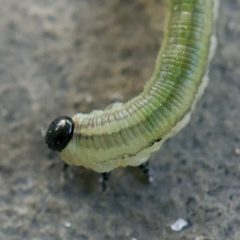
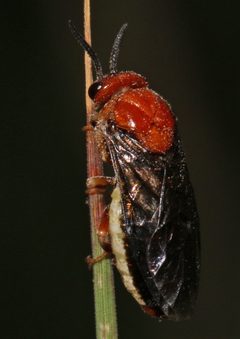
Neodiprion is a of conifer sawflies in the Diprionidae, containing approximately 25 native to North America. Larvae are specialized folivores of pine needles, with most species exhibiting strong associations with particular Pinus species. Several species, including N. lecontei and N. sertifer, are significant forest pests capable of causing extensive defoliation during years. The genus is distinguished from related by morphological and ecological traits associated with conifer specialization.
Pronunciation
How to pronounce Neodiprion: /ˌniː.oʊˈdɪpri.ən/
These audio files are automatically generated. While they are not always 100% accurate, they are a good starting point.
Identification
-level identification relies on and larval characteristic of the Diprionidae: adults have feathery or serrate (especially males), and a saw-like ovipositor used to insert into pine needles. Larvae resemble caterpillars but possess six or more pairs of (vs. five or fewer in Lepidoptera), and lack the (hooked structures) found on lepidopteran prolegs. -level identification of larvae requires examination of color patterns, capsule coloration, and body markings; adults require examination of genitalia and antennal structure.
Images
Habitat
Pine-dominated forests, plantations, and urban plantings. are associated with their specific pine species across a range of forest types from to temperate zones.
Distribution
Native to North America; individual ranges span from Canada through the eastern and central United States. Some species have been introduced to other regions (e.g., N. sertifer in Europe and Asia).
Seasonality
Most produce one to two per year, with larval activity typically occurring in spring through summer depending on latitude and species. occurs as in cocoons in soil or duff.
Diet
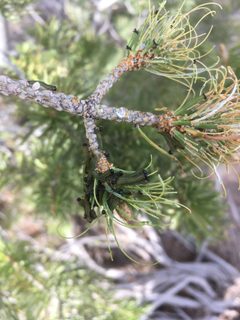
Specialized folivores of pine needles (Pinus spp.). Feeding habits vary by and larval age: young larvae typically feed gregariously on older needles, often consuming only the outer tissue and leaving needle slivers; older larvae consume entire needles. Some species exhibit preferences for specific needle age classes—N. rugifrons and N. swainei feed only on mature foliage of jack pine, avoiding foliage due to chemical deterrents.
Host Associations
- Pinus - primary -level association; individual Neodiprion show varying degrees of specificity
- Pinus resinosa - Documented for N. lecontei
- Pinus sylvestris - Preferred for N. sertifer; also used by other
- Pinus nigra subsp. pallasiana - Crimean pine; increasingly utilized by N. sertifer where planted in southern Russia
- Pinus banksiana - Jack pine; for N. rugifrons and N. swainei
- Pinus virginiana - Virginia pine; for N. pratti
- Pinus taeda - Loblolly pine; for N. taedae
- Pinus rigida - Pitch pine; for N. pinirigidae
Life Cycle
Holometabolous with complete . are inserted into pine needles using the saw-like ovipositor. Larvae pass through multiple instars (typically 5-6), feeding gregariously in early stages. Mature larvae drop to the ground and spin cocoons in soil or duff, where they pupate. Most have one per year, though some produce two generations. occurs as in cocoon.
Behavior
Larvae are gregarious, feeding in groups throughout most of the larval stage; this cooperative feeding may facilitate access to tough pine needle tissue. When disturbed, larvae of at least some (e.g., N. lecontei) arch their backs and regurgitate sticky, aromatic pine resin stored in specialized esophageal pouches as a chemical defense against . are short-lived and do not feed.
Ecological Role
Human Relevance
Several are significant forest pests, including N. lecontei (redheaded pine sawfly), N. sertifer (European pine in North America; introduced pest elsewhere), and N. pinetum. can defoliate thousands of acres of pine forest, causing growth loss, tree mortality in severe cases, and reduced seed production. Management options include manual removal of larvae, high-pressure water sprays for small- , and chemical applications for large outbreaks in managed forests.
Similar Taxa
- DiprionAlso in Diprionidae; distinguished by morphological differences in and larval characteristics. Neodiprion generally have more specialized associations with hard pines.
- GilpiniaEuropean ; not native to North America. Distinguished by distribution and associations with spruce (Picea) rather than pine.
More Details
Chemical ecology
specialization in some Neodiprion is mediated by plant chemistry. N. rugifrons and N. swainei avoid jack pine foliage due to the presence of 13-keto-8(14)-podocarpen-18-oic acid, a feeding deterrent that decreases as needles mature. This represents a highly specific chemical basis for host-herbivore interaction.
Defensive adaptations
The regurgitation defense involving sequestered pine resins was documented by Thomas Eisner and colleagues. This represents an unusual case of insects using plant-derived chemicals for defense without in specialized tissues throughout the body.
Sources and further reading
- BugGuide
- Wikipedia
- GBIF taxonomy match
- iNaturalist taxon
- NCBI Taxonomy
- Catalogue of Life
- Crazy redheads - Redheaded pine sawfly, Neodiprion lecontei(MISSING VIDEO AND LINKS) — Bug of the Week
- What's Eating Your Pine Needles? Sawflies, Probably
- Conifer sawfly larva - Entomology Today
- Neodiprion sertifer . [Distribution map].
- Red pine sawfly (Neodiprion sertifer) on the Crimean pine
- Mortality of Reproduction Defoliated by the Red-headed Pine Sawfly (Neodiprion lecontei Fitch)
- Chemical Basis for Feeding Adaptation of Pine Sawflies Neodiprion rugifrons and Neodiprion swainei
- Studies on the life history of the Virginia pine sawfly (Neodiprion pratti Dyar) /
- Life History Studies of Neodiprion americanum (Leach).1
- Life History Studies of Five Species of Neodiprion Sawflies
- Notes on the Biology of Neodiprion excitans in North Carolina1
- Ecological Niche Modelling to Assessment of Potential Distribution of Neodiprion Abietis (Harris, 1841) (Insecta, Hymenoptera, Diprionidae) in Eurasia