
Neodiprion pinetum
(Norton, 1869)
White Pine Sawfly
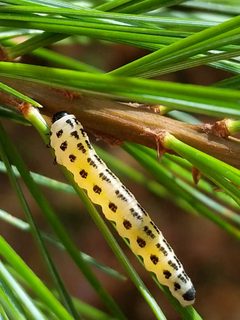
Neodiprion pinetum is a conifer-feeding native to eastern North America. are broad-bodied, stingless with females bearing a saw-like ovipositor used to insert into pine needles. Larvae are creamy-yellow with black and four longitudinal rows of black spots, resembling caterpillars but possessing more . The is frequently monophagous on eastern white pine (Pinus strobus), though larvae have been documented on several other pine species. Localized occur regularly and can kill small stands of trees, though natural enemies including egg and larval typically provide substantial .
Pronunciation
How to pronounce Neodiprion pinetum: /niːoʊdɪˈpraɪən pɪˈniːtəm/
These audio files are automatically generated. While they are not always 100% accurate, they are a good starting point.
Identification
distinguished from other Neodiprion by genitalia and internal ; the larval key in Davis et al. (2023) uses color pattern and spot arrangement to separate N. pinetum from including N. lecontei, N. compar, N. maurus, and N. fabricii. Larvae differ from caterpillars (Lepidoptera) by having on all abdominal segments rather than restricted to segments 3-6 and 10.
Images
Habitat
Stands of eastern white pine (Pinus strobus); also occurs on pitch pine, shortleaf pine, red pine, and Swiss mountain pine where these overlap with white pine range.
Distribution
Eastern North America, extending through the eastern United States to southeastern Canada. Documented in Wisconsin (Crawford County, Grant County), and distribution records from Canada include New Brunswick, Newfoundland, Ontario, and Quebec.
Seasonality
appear in late spring. Larvae feed through summer. overwinter in cocoons among leaf litter, completing the following spring.
Diet
Larvae feed on pine needles. First instars are gregarious and consume only the surface layer of needles; later instars spread through foliage and consume entire needles.
Host Associations
- Pinus strobus - primary eastern white pine; main throughout range
- Pinus rigida - secondary pitch pine
- Pinus echinata - secondary shortleaf pine
- Pinus resinosa - secondary red pine
- Pinus mugo - secondary Swiss mountain pine
- Closterocerus cinctipennis - eulophid ; achieved 90% parasitization in Wisconsin
- Olesicampe lophyri - ichneumonid larval
- Perilampus hyalinus - perilampid larval
- Spathimeigenia erecta - tachinid larval
Life Cycle
Holometabolous. Female lays approximately 100 over several months, inserting them into slits cut along pine needle edges. Mated females produce both male and female offspring; unmated females produce only male offspring via . Eggs hatch into gregarious first instar larvae that feed on needle surfaces. Later instars become solitary and consume entire needles. Mature larvae descend to ground and spin cocoons in leaf litter, as . occurs in spring, with emerging several weeks later.
Behavior
Larvae exhibit gregarious feeding in early instars, dispersing to feed solitarily in later stages. Heavy can completely defoliate trees. are short-lived and do not feed.
Ecological Role
Herbivore of white pine; serves as prey for birds and for diverse . can cause localized tree mortality, contributing to stand dynamics in white pine forests.
Human Relevance
Occasional pest of white pine in managed landscapes and natural forests. can kill ornamental trees and small forest stands. by native often mitigates surges without intervention.
Similar Taxa
- Diprion similisAlso called 'white pine sawfly' and shares ; larvae feed on white pine needles but belong to different
- Neodiprion lecontei with similar larval ; distinguished by spot pattern and coloration in Davis et al. (2023) larval key
- Neodiprion compar with similar ; requires larval color pattern or genitalia for separation
- Neodiprion maurus with similar associations; distinguished by larval spot arrangement
- Neodiprion fabricii with similar ; separated by larval color characters
Misconceptions
The 'white pine sawfly' is also applied to Diprion similis, causing confusion between two distinct in different .
Sources and further reading
- BugGuide
- Wikipedia
- GBIF taxonomy match
- iNaturalist taxon
- NCBI Taxonomy
- What's Eating Your Pine Needles? Sawflies, Probably
- The joys of ecological restoration | Beetles In The Bush
- Hymenoptera | Beetles In The Bush | Page 8
- Tettigoniidae | Beetles In The Bush | Page 2
- Orthoptera | Beetles In The Bush | Page 6
- jtrager | Beetles In The Bush
- The Biology of the White Pine Sawfly, Neodiprion Pinetum (Hymenoptera: Diprionidae) in Wisconsin