
Diprion similis
(Hartig, 1834)
Introduced Pine Sawfly, Imported Pine Sawfly, White Pine Sawfly
Diprion similis is a conifer-feeding native to central and northern Europe and Asia that has become in North America following its accidental introduction around 1914. The is notable for its arrhenotokous , where unfertilized develop into male offspring, facilitating rapid establishment. Larvae are gregarious defoliators of pine needles, with a strong preference for white pine (Pinus strobus) in North America. The species exhibits two per year in many regions, with second-generation larvae as in cocoons. Its invasive success has been attributed to parthenogenetic capabilities, lack of natural enemies in introduced ranges, and specialized communication involving the (2S,3R,7R)-propionate isomer of 3,7-dimethylpentadecan-2-ol.
Pronunciation
How to pronounce Diprion similis: /dɪˈpraɪ.ɒn ˈsɪmɪ.lɪs/
These audio files are automatically generated. While they are not always 100% accurate, they are a good starting point.
Identification
distinguished from other Diprionidae by structure (bipectinate in males, serrate in females) and color pattern. The can be separated from the native North American Neodiprion pinetum (also called 'white pine sawfly') by chemistry: D. similis uses the (2S,3R,7R)-propionate isomer, while N. pinetum uses the (2S,3S,7S)-acetate isomer. Larvae identified by black capsule, gregarious feeding , and characteristic longitudinal striping in later instars; the larval key in Davis et al. (2023) provides field identification tools.
Images
Appearance
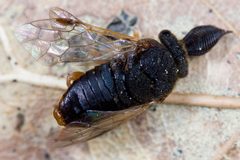
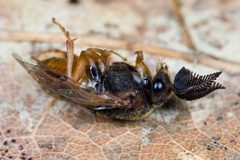
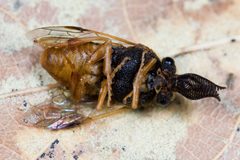
males measure 7–9 mm in length, entirely black with yellow legs except for brownish-black and femoral bases; are black and bipectinate (feather-like). Adult females are slightly larger at 7.5–10 mm, with black and and variable abdominal coloration ranging from yellow and black to entirely dark; antennae are black and serrate (saw-like). Larvae possess black heads and caterpillar-like bodies: early instars are yellowish-green, while later instars develop black longitudinal stripes with yellow and white patches on a bluish-black background. Females have six larval instars, males have five.
Habitat
Coniferous forests and plantations, particularly those containing Pinus strobus (white pine). In North America, occurs in mature white pine plantations and forest edges. Native range includes and temperate pine forests of Europe and Asia.
Distribution
Native to central and northern Europe (including Fennoscandia), Russian Siberia (to Lake Baikal), and China. Introduced to North America: first detected in Connecticut in 1914, now established throughout eastern United States and Canada wherever Pinus strobus occurs.
Seasonality
Two per year in most of range. emerge in spring and remain active through summer; peak male in early June in Ontario. First-generation larvae present in early summer, with cocoons formed in July and adult in August. Second-generation larvae appear in late summer, overwinter as in cocoons from autumn through spring, with some individuals entering extended lasting up to three years.
Diet
Larvae feed exclusively on pine needles (folivory). In native range: Pinus sylvestris, P. mugo, P. cembra, P. sibirica, and introduced P. strobus and P. contorta. In North America: primarily Pinus strobus, also P. resinosa, P. banksiana, and P. sylvestris. Young larvae feed on needle edges, consuming partial tissue; older larvae consume entire needles.
Host Associations
- Pinus strobus - primary Strong preference in North America; traps baited with placed in white pine plantations
- Pinus sylvestris - Native range and secondary host in North America
- Pinus resinosa - North American
- Pinus banksiana - North American
- Pinus mugo - Native range
- Pinus cembra - Native range
- Pinus sibirica - Native range
- Pinus contorta - Introduced in native range
Life Cycle
Holometabolous with two annually. laid in slits cut into pine needles by female's saw-like ovipositor, approximately 10 eggs per needle. Larvae pass through five (males) or six (females) instars, with early instars gregarious and later instars solitary. First-generation larvae pupate in silken cocoons on tree, emerging as in approximately one month. Second-generation larvae descend to ground, spin cocoons, and overwinter as ; occurs in spring. Some individuals remain in extended prepupal for up to three years. Adults are short-lived and do not feed.
Behavior
Newly hatched larvae exhibit gregarious feeding, forming groups on foliage; later instars become solitary. Larvae are feeders. employ -mediated mate location: females release (propanoate ester of (2S,3R,7R)-3,7-dimethylpentadecan-2-ol) to attract males. Unmated females can produce viable male offspring through arrhenotokous . Males are attracted to synthetic pheromone lures in field trapping; threo four-isomer blends are equally attractive as pure main component at matched release rates.
Ecological Role
Larvae function as herbivores and defoliators of pine . In native range, are regulated by natural enemies including and . In introduced North American range, populations have expanded with limited top-down control, leading to localized capable of reducing tree growth rates and causing mortality. Serves as prey for birds and supports parasitoid where established.
Human Relevance
Significant forest pest in North America, particularly in white pine plantations and ornamental plantings. Economic impacts include reduced timber growth, tree mortality, and costs of monitoring and management. -based monitoring systems have been developed using the identified (2S,3R,7R)-propionate compound. Management options include manual removal of larvae, high-pressure water sprays for small , and targeted applications for large ; natural enemy conservation is generally preferred.
Similar Taxa
- Neodiprion pinetumAlso feeds on white pine and shares 'white pine sawfly'; distinguished by chemistry (uses (2S,3S,7S)-acetate isomer), native to North America, and different larval coloration patterns
- Diprion piniEuropean with overlapping native range; uses different component (propanoate of 3,7-dimethyltridecan-2-ol) that is not attractive to D. similis males
- Dermacentor similisUnrelated described from western North America that shares the same specific epithet; no biological relationship but potential for nomenclatural confusion
Misconceptions
The 'white pine sawfly' is ambiguous and confusing because it is applied to both D. similis (introduced, ) and Neodiprion pinetum (native North American ). The two species are not closely related and differ in chemistry, distribution, and management needs.
Sources and further reading
- BugGuide
- Wikipedia
- GBIF taxonomy match
- iNaturalist taxon
- NCBI Taxonomy
- Encyrtid Holdings | Entomology Research Museum
- Bug Eric: A Jumping Spider, Tutelina similis
- Study Shows American Dog Ticks in Western U.S. Are a Separate Species
- What's Eating Your Pine Needles? Sawflies, Probably
- Pensoft Editorial Team | Blog - Part 7
- Bug Eric: Wasp Wednesday: Perilampid Wasps
- Sex Pheromone of the Introduced Pine Sawfly, Diprion similis, Revisited to Define a Useful Monitoring Lure: Deviating Chiral Composition and Behavioural Responses Compared to Earlier Reports.