
Diprion
Schrank, 1802
conifer sawflies, pine sawflies
Species Guides
1- Diprion similis(Introduced Pine Sawfly)
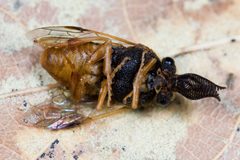
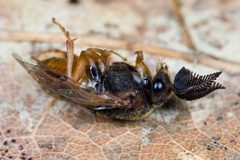
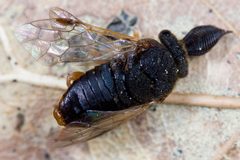
Diprion is a of conifer sawflies in the Diprionidae, containing at least 12 described . Species in this genus are significant defoliators of pine forests, with larvae feeding gregariously on pine needles. can cause substantial ecological and economic damage by defoliating thousands of forested acres. are stingless with a saw-like ovipositor used to insert into conifer foliage. The genus includes both native and , with Diprion similis introduced to North America in 1914.
Pronunciation
How to pronounce Diprion: //dɪˈpraɪ.ən//
These audio files are automatically generated. While they are not always 100% accurate, they are a good starting point.
Identification
Larvae resemble caterpillars but possess seven pairs of (caterpillars have five or fewer). Young larvae feed on needles by consuming them partially from the side like an ear of corn, leaving dry sliver remnants. Older larvae consume entire needles like a carrot, leaving only stubs. lack the narrow " waist" characteristic of many Hymenoptera; the attaches broadly to the . Females possess a saw-like ovipositor for inserting into plant tissue.
Images
Habitat
Pine forests and conifer-dominated landscapes. Associated with Scots pine (Pinus sylvestris), eastern white pine (Pinus strobus), and other Pinus .
Distribution
Europe, Asia, and North America. Native to the Palearctic; at least one (D. similis) introduced to North America. Records from Denmark, Norway, Sweden, and the northeastern United States (Vermont).
Diet
Larvae feed on pine needles (foliage of Pinus ). may consume pollen and nectar.
Host Associations
- Pinus sylvestris - primary main for D. pini
- Pinus strobus - for introduced D. similis in North America
- Pinus nigra - secondary attacked after develop on Scots pine
- Pinus radiata - occasional introduced , occasional observation
- Pinus contorta - occasional introduced , occasional observation
Life Cycle
Females use a saw-like ovipositor to insert into conifer foliage. Larvae hatch and feed gregariously on needles, passing through multiple instars. spin cocoons in soil or litter; some exhibit prolonged . occurs within the cocoon.
Behavior
Larvae are gregarious, feeding together in groups during most of their larval stage. can develop rapidly, leading to extensive defoliation. Some show fidelity to native pines but may shift to secondary hosts during outbreak conditions.
Ecological Role
Herbivore and defoliator of conifer forests. Serves as food for birds and supports diverse natural enemies including . are typically moderated by natural enemies, with representing periodic ecological disturbances.
Human Relevance
Significant forest pest capable of causing economic damage to timber resources and ornamental plantings. Management may involve manual removal, water spray, or applications in high-value settings. Subject of research including introduction of .
Similar Taxa
- NeodiprionAlso in Diprioninae with conifer-feeding larvae; distinguished by morphological features of and larvae requiring detailed examination
- Tenthredo in Tenthredinidae; lack narrow waist but larvae feed on deciduous plants rather than conifers
- Gilpinia in Diprionidae; similar larval habits but distinguished by
Sources and further reading
- BugGuide
- GBIF taxonomy match
- iNaturalist taxon
- NCBI Taxonomy
- Catalogue of Life
- Diprioninae Archives - Entomology Today
- What's Eating Your Pine Needles? Sawflies, Probably
- Bug Eric: Wasp Wednesday: Perilampid Wasps
- Bug Eric: Wasp Wednesday: Tenthredo
- Conifer sawfly larva - Entomology Today
- The Role of Resin Acids in the Relationship Between Scots Pine and the Sawfly, Diprion Pini (Hymenoptera: Diprionidae). II.—Correlations with the Biology of Diprion pini
- A near chromosome-scale genome assembly of the Common pine sawfly ( Diprion pini , Linnaeus, 1758)
- Characteristics of the Outbreak Area of Diprion hani (Hymenoptera: Diprionidae) and a Report of its Torymid Parasitoid
- Two Chalcidoid Egg-Parasites of Diprion sertifer, Geoffr.
- Whole-genome resequencing data support a single introduction of the invasive white pine sawfly, Diprion similis
- Empty Cocoons of the Introduced Pine Sawfly, Diprion similis, as Habitat Niches for Arthropods1
- Natural Control of Diprion similis, Htg., in Poland during 1936