
Tenthredo
Linnaeus, 1758
Common Sawflies
Species Guides
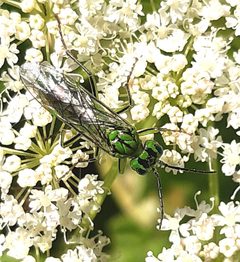
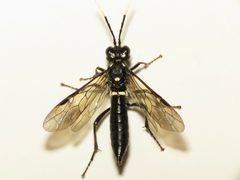
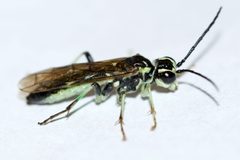
23Tenthredo is a large of comprising over 700 with Holarctic distribution. exhibit -mimicry with long and lack the narrow petiole ('wasp waist') characteristic of true wasps. Larvae are herbivorous and feed on diverse plants, with most species showing host specificity. Adults are predatory or , feeding on smaller insects as well as pollen and nectar at flowers. The genus is notable for its complex wing venation and soft-bodied, delicate adults.
Pronunciation
How to pronounce Tenthredo: //tɛnˈθriːdoʊ//
These audio files are automatically generated. While they are not always 100% accurate, they are a good starting point.
Identification
Distinguished from true (Vespidae, Sphecidae) by the broad connection between and —no narrow 'wasp waist.' Forewing with characteristic lance-shaped and straight cross-nervure distinguishes from other . Triangular with bulging separates from many other Tenthredinidae. Larvae distinguished from lepidopteran caterpillars by seven pairs of versus five or fewer. -level identification is problematic due to high species count (>700) and extensive variation in color patterns.
Images
Habitat
Associated with diverse including montane meadows, semi-open forests, and edges of deciduous forests. Tenthredo maxima specifically occurs in montane zone habitats of the Rockies, Cascades, and Sierra Nevada.
Distribution
Holarctic distribution. Approximately 118 in the United States and Canada. Documented in Europe including Austria, and across North America from Vermont to the southwestern United States (Arizona).
Seasonality
active primarily in late summer and early autumn, though some appear in spring. Tenthredo maxima larvae observed in August–September.
Diet
are predatory and : they prey on flies and other small insects, and consume pollen and nectar at flowers. Larvae are herbivorous, feeding on foliage of plants.
Life Cycle
are inserted into plant tissues using the saw-like ovipositor. Larvae develop on plants, feeding externally on foliage. Larvae of some nearly full-grown by August–September. occurs in soil or plant litter; specific details vary by species.
Behavior
frequently observed on flowers. Females do not sting despite -mimicry; the ovipositor is modified for sawing plant tissue, not defense. Some appear susceptible to yellow pan traps. Larvae often feed in groups on leaves.
Ecological Role
Larvae function as herbivores, with some documented feeding on plant rarely used by (e.g., Gentianaceae). serve as of small insects and as potential when feeding on nectar and pollen.
Human Relevance
No significant direct economic impact. may be encountered by naturalists and photographers due to conspicuous -mimicry. Larvae may cause minor defoliation of ornamental or native plants but are not considered major pests.
Similar Taxa
- Vespidae (true wasps)Constricted petiole (' waist') present; Tenthredo lacks this constriction with broad - attachment.
- Diprionidae (conifer sawflies)Larvae superficially similar but associations differ; Diprionidae specialize on conifers while Tenthredo use broad-leaved plants.
- Other Tenthredinidae generaDistinguished by forewing venation (lance-shaped with straight cross-nervure) and triangular with bulging .
Sources and further reading
- BugGuide
- Wikipedia
- GBIF taxonomy match
- iNaturalist taxon
- NCBI Taxonomy
- Catalogue of Life
- Bug Eric: Wasp Wednesday: Tenthredo
- Figures 3-7 from: Liston A, Altenhofer E, Netzberger R, Prous M (2020) Biology of two European Tenthredo species (Hymenoptera, Tenthredinidae) feeding on Gentiana. Deutsche Entomologische Zeitschrift 67(1): 13-18. https://doi.org/10.3897/dez.67.49741
- Figures 1- 2 from: Liston A, Altenhofer E, Netzberger R, Prous M (2020) Biology of two European Tenthredo species (Hymenoptera, Tenthredinidae) feeding on Gentiana. Deutsche Entomologische Zeitschrift 67(1): 13-18. https://doi.org/10.3897/dez.67.49741
- Life history and larva of Tenthredo (Elinora) koehleri (Klug, 1809) (Hymenoptera, Tenthredinidae).
- TAXONOMY, VARIATION, AND ZOOGEOGRAPHY OF TENTHREDO MAXIMA (NORTON) (HYMENOPTERA: TENTHREDINIDAE)
- The genome sequence of Tenthredo amoena Gravenhorst, 1807.
- The genome sequence of the Figwort Sawfly Tenthredo scrophulariae Linnaeus, 1758.