
Tenthredo grandis
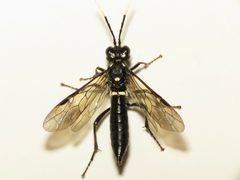
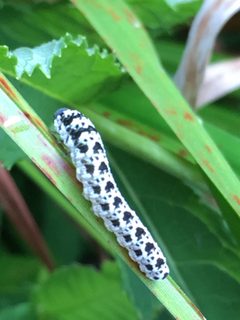
Tenthredo grandis is a in the Tenthredinidae. Unlike typical , sawflies lack a narrow "wasp waist," with the broadly attached to the . The larvae are herbivorous rather than , feeding on turtlehead plants (Chelone spp.) during midsummer. are often observed on flowers and consume smaller insects as well as pollen and nectar. The species exhibits mimicry of stinging wasps despite females lacking a functional stinger.
Pronunciation
How to pronounce Tenthredo grandis: /tɛnˈθɾeːdoʊ ˈɡɾændɪs/
These audio files are automatically generated. While they are not always 100% accurate, they are a good starting point.
Identification
Tenthredo grandis belongs to the Tenthredo, which includes approximately 118 in the U.S. and Canada. in this genus are characterized by triangular with slightly bulging and complex wing venation giving wings a reticulated appearance. Females possess an ovipositor modified into a saw-like blade for inserting into plant tissues. Specific diagnostic features for T. grandis are not documented in available sources.
Images
Habitat
Associated with deciduous forest edges and areas where plant turtlehead (Chelone spp.) occurs. The Tenthredo generally appears in late summer and early autumn, though specific preferences for T. grandis beyond host plant presence are not documented.
Distribution
North America. Specific range boundaries for T. grandis are not documented in available sources.
Seasonality
Larvae active in midsummer. of the Tenthredo tend to appear later than other , in late summer and early autumn.
Diet
Herbivorous; larvae feed on turtlehead (Chelone spp.). consume smaller insects, pollen, and nectar.
Host Associations
- Chelone spp. - larval food plantturtlehead
Life Cycle
Larval stage occurs in midsummer. Complete details including , pupal, and timing are not documented in available sources.
Behavior
Larvae defoliate plants during midsummer. This feeding activity reduces host plant reproductive output and creates competitive interactions with checkerspot caterpillars (Euphydryas phaeton), forcing prediapause larvae to wander in search of alternative food plants. are frequently seen on flowers.
Ecological Role
Herbivore that reduces plant reproductive output through defoliation. Indirectly affects checkerspot caterpillar by depleting shared food resources and causing competitor displacement.
Similar Taxa
- Tenthredo spp.Other members of the share the broad waist connection between and , triangular , and reticulated wing venation typical of Tenthredinidae. Differentiation requires examination of specific morphological characters not documented for T. grandis in available sources.
- Euphydryas phaeton (Baltimore checkerspot caterpillar)Shares plant (Chelone spp.) and occurs in same ; competitive interaction through resource depletion. Checkerspot caterpillars have 5 or fewer pairs of , while larvae have 7 pairs of prolegs.
More Details
Competitive Interaction
Defoliation by T. grandis larvae has been documented to force competing Baltimore checkerspot caterpillars (Euphydryas phaeton) to abandon plants and wander in search of alternative food sources, indirectly affecting their survival and .
Sources and further reading
- BugGuide
- iNaturalist taxon
- Guest Blog Post: Researchers split the birdcatcher trees (genus Pisonia) into three | Blog
- Bug Eric: January 2011
- Bug Eric: Wasp Wednesday: Western Cicada Killer
- Nomenclatural changes in Phymatodes | Beetles In The Bush
- Effect of defoliation by checkerspot caterpillars (Euphydryas phaeton) and sawfly larvae (Macrophya nigra and Tenthredo grandis) on their host plants (Chelone spp.)