
Gilpinia
Benson, 1939
conifer sawflies
Species Guides
2- Gilpinia frutetorum(Nursery Pine Sawfly)
- Gilpinia hercyniae(European Spruce Sawfly)
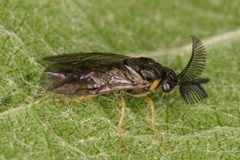
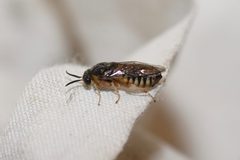
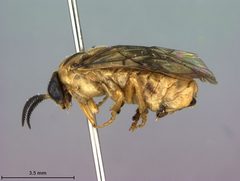
Gilpinia is a of conifer sawflies in the Diprionidae, comprising approximately 20 described distributed across Europe, Asia, and North America. Several species are significant forest pests, notably G. hercyniae (European spruce ) and G. polytoma, which feed on spruce (Picea) species. The genus exhibits complex strategies including facultative and variable voltinism (one to three annually) depending on geographic location and climate. Species identification relies heavily on morphological examination of the ovipositor, male genitalia, and wing coloration.
Pronunciation
How to pronounce Gilpinia: /ɡɪlˈpɪniə/
These audio files are automatically generated. While they are not always 100% accurate, they are a good starting point.
Identification
-level identification requires examination of ovipositor , male genitalia structure, and wing coloration patterns. The G. socia species group includes several morphologically similar (G. hakonensis, G. amamiana, G. socia, G. frutetorum, G. laricis, G. variegata) distinguished by subtle differences in ovipositor serration patterns and lancet structure. G. infuscalae is distinguished from the similar G. nigra by strongly infuscate wings, simple inner spur of hind tibia, and unique lancet morphology.
Images
Habitat
Conifer forests, primarily associated with spruce (Picea) and pine (Pinus) stands.
Distribution
Europe (including Britain, Czechoslovakia, Finland, Germany, Italy, Romania, Sweden, Poland, Bulgaria), Asia (Japan, Korea, China, Russia), and North America (Canada, United States).
Seasonality
Activity period varies by and latitude; G. polytoma exhibits one to three annually depending on bioclimatic zone, with as cocoons.
Diet
Larvae feed on conifer needles. Specific associations include Picea spp. for G. hercyniae and G. polytoma; Pinus densiflora for G. hakonensis; Pinus massoniana for G. infuscalae.
Host Associations
- Picea - larval primary for G. hercyniae and G. polytoma
- Pinus densiflora - larval for G. hakonensis
- Pinus massoniana - larval for G. infuscalae
- Picea abies - larval for G. polytoma
Life Cycle
Development includes , larval, prepupal, and pupal stages within a cocoon. Intracocoon development duration varies with temperature and moisture; can occur at the pronymphal stage. Voltinism ranges from to trivoltine depending on geographic location and genetic .
Behavior
Females deposit into conifer needles using a serrated ovipositor; ovipositor is -specific and taxonomically diagnostic.
Ecological Role
Defoliating herbivore of conifers; can cause significant forest damage. Serves as for flies (Bessa selecta, Tachinidae) and hymenopterous .
Human Relevance
Several are economically important forest pests. G. hercyniae (European spruce ) and G. polytoma have caused substantial damage to spruce plantations in North America and Europe. G. verticalis has been recorded damaging Scots pine in Sweden.
Similar Taxa
- DiprionSimilar in Diprionidae; distinguished by taxonomic revision and morphological characters including wing venation and genitalia structure
- PristiphoraSympatric including P. erichsoni (larch sawfly), which shares (Bessa selecta) with Gilpinia but feeds on Larix rather than Picea or Pinus
Sources and further reading
- BugGuide
- Wikipedia
- GBIF taxonomy match
- iNaturalist taxon
- NCBI Taxonomy
- Catalogue of Life
- Gilpinia hakonensis and similar species in Japan and ovipositors of five European Gilpinia species (Hymenoptera, Diprionidae)
- Gilpinia polytoma . [Distribution map].
- Gilpinia hercyniae . [Distribution map].
- Gilpinia infuscalae Wang & Wei, sp. nov. and a key to the Chinese Gilpinia species (Hymenoptera: Diprionidae)
- Östliche Kiefern-Buschhornblattwespe (Gilpinia verticalis Guss.), ein für Schweden neuer Forstschädling
- The Geographical Distribution of Gilpinia hercyniae Hymenoptera: Diprionidae in the United Kingdom
- Distribution of Gilpinia hercyniae (Hymenoptera Diprionidae) Eggs within Sitka Spruce Trees
- <i>Gilpinia fennica</i> (Forsius, 1911) new to Poland (Hymenoptera, Symphyta: Diprionidae), and a review of the species
- THE DIAPAUSE AND RELATED PHENOMENA IN GILPINIA POLYTOMA (HARTIG): I. FACTORS INFLUENCING THE INCEPTION OF DIAPAUSE
- BESSA SELECTA (MEIGEN) (DIPTERA: TACHINIDAE) AS A PARASITE OF GILPINIA HERCYNIAE (HARTIG) (HYMENOPTERA: DIPRIONIDAE)
- THE DIAPAUSE AND RELATED PHENOMENA IN GILPINIA POLYTOMA (HARTIG): III. BIOCLIMATIC RELATIONS
- THE DIAPAUSE AND RELATED PHENOMENA IN GILPINIA POLYTOMA (HARTIG): V. DIAPAUSE IN RELATION TO EPIDEMIOLOGY