
Neodiprion lecontei
(Fitch, 1858)
red-headed pine sawfly, Leconte's sawfly
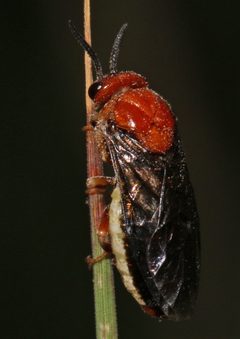
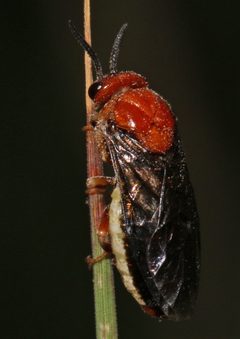
Neodiprion lecontei is a pine-feeding native to eastern North America, commonly known as the red-headed pine sawfly. are small (5–8.5 mm), sexually dimorphic, and active in spring and summer. Larvae are gregarious defoliators of pine needles, capable of stripping entire branches and causing significant damage to young trees and plantations. The exhibits complex with one to three per year depending on latitude, and has been extensively studied as a model for -associated differentiation, decoupling across life stages, and .
Pronunciation
How to pronounce Neodiprion lecontei: //ˌniːoʊdɪˈpraɪən lɛˈkɒntaɪ//
These audio files are automatically generated. While they are not always 100% accurate, they are a good starting point.
Identification
distinguished from other Neodiprion by reddish-brown and in females (entirely black in males), serrated versus feathery between sexes, and body size 5–8.5 mm. Larvae identified by yellowish-green coloration with up to eight longitudinal rows of black spots, brown head, and gregarious feeding habit on pine needles; young larvae leave characteristic straw-like central needle sections uneaten, while older larvae consume entire needles. Distinguished from caterpillars by greater number of (6–7 pairs versus 5 or fewer in Lepidoptera) and absence of on prolegs.
Images
Appearance
have membranous wings and a broad waist. Females are robust with reddish-brown and , mainly black sometimes with white lateral markings, and serrated with nineteen segments. Males are entirely black, more slender, smaller than females, and have feathery antennae. Larvae resemble lepidopteran caterpillars: young larvae are whitish with brown heads; older larvae are yellowish-green with up to eight longitudinal rows of black spots and brown heads. Larvae possess three pairs of true legs anteriorly and six to seven pairs of posteriorly.
Habitat
Pine forests and plantations, particularly stands with trees under 5 m in height. Occupies native pine woodlands and managed forestry plantations across eastern North America.
Distribution
Eastern North America, ranging from southeastern Canada westward to the Great Plains and southward to Texas and Florida. Specific records from Ontario, Quebec, New Brunswick, Vermont, and throughout the eastern United States.
Seasonality
emerge in spring ( completes in spring after winter as in cocoons). In northern portions of range, one per year; in southern portions, two to three overlapping generations. Larval activity primarily mid- to late summer; some individuals may remain in extended diapause, emerging one or more years later.
Diet
Larvae feed on foliage of native and introduced pines (Pinaceae). In northern range, primarily jack pine (Pinus banksiana) and red pine (Pinus resinosa); in southern range, loblolly pine (Pinus taeda), shortleaf pine (Pinus echinata), slash pine (Pinus elliottii), and longleaf pine (Pinus palustris). Also feeds on Virginia pine (Pinus virginiana), eastern white pine (Pinus strobus), Scots pine (Pinus sylvestris), and when preferred unavailable, Norway spruce (Picea abies), deodar cedar (Cedrus deodara), and larch (Larix spp.).
Host Associations
- Pinus banksiana - primary (northern range)
- Pinus resinosa - primary (northern range)
- Pinus taeda - primary (southern range)
- Pinus echinata - primary (southern range)
- Pinus elliottii - primary (southern range)
- Pinus palustris - primary (southern range)
- Pinus virginiana - secondary
- Pinus strobus - secondary
- Pinus sylvestris - secondary
- Picea abies - occasional when preferred unavailable
- Cedrus deodara - occasional when preferred unavailable
- Larix spp. - occasional when preferred unavailable
Life Cycle
Complete with hypermetamorphic larval development. Female deposits single in slits cut into pine needles with saw-like ovipositor; eggs appear pale and create banded needle appearance. Eggs hatch after approximately four weeks. Three ecologically and morphologically distinct larval stages (instars) separated by . Young larvae feed gregariously on needle sides, leaving central section uneaten; older larvae consume entire needles. When development complete, larvae drop to ground and spin cocoons in needle litter or soil. Overwinter as , pupate in spring, and bite through cocoon end to emerge. Some individuals exhibit extended , remaining in prepupal stage for one or more additional years.
Behavior
Larvae are highly gregarious, feeding in groups and capable of stripping whole branches or trees of needles. When a tree is completely defoliated, larvae move as a group to neighboring trees or may chew soft bark of twigs. Trail-following facilitates group cohesion during foraging. exhibit fidelity and mate preference patterns consistent with isolation-by-environment mechanisms.
Ecological Role
Primary consumer and significant defoliator of pine forests. can cause extensive tree mortality, particularly in young plantations established during the 1930s. Serves as for including Perilampus hyalinus (Perilampidae), whose larvae embed in host brain and cord ganglia to avoid , and tachinid flies (Spathimeigenia sp.). Subject to (Neodiprion lecontei , NeleNPV) that has been developed as potential agent.
Human Relevance
Major forest pest capable of causing economic damage to pine plantations and natural stands. Young trees under 5 m height frequently attacked and killed by severe defoliation. Management includes manual removal of larvae, high-pressure water spraying for small , and applications for large in managed forests. Natural enemies typically moderate , reducing need for chemical intervention. sequenced as part of N. lecontei group studies; species serves as model organism for research on adaptive decoupling, -associated differentiation, and evolution.
Similar Taxa
- Neodiprion sertiferEuropean pine sawfly with similar larval appearance and feeding habit; distinguished by geographic range (introduced to North America) and
- Neodiprion swaineiJack pine sawfly with overlapping and range; distinguished by -laying patterns and larval coloration details
- Neodiprion compar, N. maurus, N. pinetum, N. fabriciiCongeneric with similar larval ; distinguished by specific associations, geographic distribution, and detailed larval color pattern differences per Davis et al. (2023) identification key
- Diprion similisIntroduced pine sawfly with similar ; distinguished by and larval spotting patterns
More Details
Genomic significance
Member of the N. lecontei group, a clade of approximately twenty closely related intensively studied species. size approximately 330 MB arranged on seven . Subject of transcriptome studies supporting the adaptive decoupling hypothesis for metamorphic and sexually dimorphic patterns.
Viral pathology
to Neodiprion lecontei (NeleNPV), the first fully sequenced hymenopteran (81,755 , 89 ORFs, 33.3% GC content). NeleNPV has smallest published baculovirus genome and lacks several conserved lepidopteran baculovirus genes, suggesting potential need for separate .
Isolation-by-environment
Exhibits -associated differentiation driven by multiple mechanisms including against immigrants, against immigrants, selection against hybrids, biased , and environment-based phenological differences across different pine host .
Sources and further reading
- BugGuide
- Wikipedia
- GBIF taxonomy match
- iNaturalist taxon
- NCBI Taxonomy
- What's Eating Your Pine Needles? Sawflies, Probably
- Cicindela scutellaris lecontei x scutellaris unicolor intergrades in southeast Missouri | Beetles In The Bush
- Super Crop Challenge | Beetles In The Bush
- Sequence and Organization of the Neodiprion lecontei Nucleopolyhedrovirus Genome
- Oviposition of the Red-Headed Pine Sawfly, Neodiprion lecontei (Fitch)
- Mortality of Reproduction Defoliated by the Red-headed Pine Sawfly (Neodiprion lecontei Fitch)
- Multiple mechanisms contribute to isolation-by-environment in the redheaded pine sawfly, Neodiprion lecontei
- Multiple mechanisms contribute to isolation-by-environment in the redheaded pine sawfly, Neodiprion lecontei
- Support for the Adaptive Decoupling Hypothesis from Whole-Transcriptome Profiles of a Hypermetamorphic and Sexually Dimorphic Insect, Neodiprion lecontei
- THE NEUROENDOCRINE ORGANS OF LARVAE OF NEODIPRION LECONTEI, N. SWAINEI, AND DIPRION HERCYNIAE (HYMENOPTERA: DIPRIONIDAE)
- OBSERVATIONS ON LARVAL BEHAVIOUR AND AVOIDANCE OF ENCAPSULATION OF PERILAMPUS HYALINUS (HYMENOPTERA: PERILAMPIDAE) PARASITIC IN NEODIPRION LECONTEI (HYMENOPTERA: DIPRIONIDAE)
- Some Laboratory Investigations of the Light Reactions of the Larvae of Neodiprion americanus banksianae Roh. and N. lecontei (Fitch) (Hymenoptera: Diprionidae)
- Group Foraging and Trail Following Behavior of theRed-headed Pine Sawfly <I>Neodiprion lecontei</I> (Fitch) (Hymenoptera: Symphyta: Diprionidae)
- Support for the adaptive decoupling hypothesis from whole‐transcriptome profiles of a hypermetamorphic and sexually dimorphic insect, Neodiprion lecontei
- Influence of elevated CO2, nitrogen, and Pinus elliottii genotypes on performance of the redheaded pine sawfly, Neodiprion lecontei