
Neodiprion sertifer
(Geoffroy, 1785)
European pine sawfly, red pine sawfly, redheaded pine sawfly
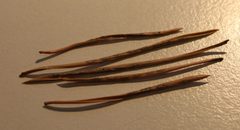
Neodiprion sertifer is a native to Europe that was accidentally introduced to North America in 1925, where it has become an established forest pest. emerge in late summer or early autumn and females lay in pine needles using a saw-like ovipositor. Larvae feed gregariously on pine needles and possess a chemical defense mechanism: they store pine resins in specialized gut pouches and regurgitate them when threatened. The overwinters in the egg stage rather than as cocoons, distinguishing it from many .
Pronunciation
How to pronounce Neodiprion sertifer: //ˌniː.oʊˈdɪp.ri.ɒn ˈsɜr.tɪ.fɜr//
These audio files are automatically generated. While they are not always 100% accurate, they are a good starting point.
Identification
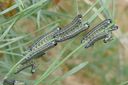
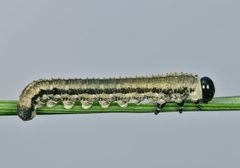
Larvae have creamy white bodies with rows of black spots and red or scarlet . are -like and stingless. The can be distinguished from similar Neodiprion species by larval coloration and by its with -stage . A larval identification key for eastern North American conifer sawflies is available in Davis et al. (2023).
Images
Habitat
Coniferous forests and plantations, particularly those containing Scots pine (Pinus sylvestris), red pine, Jack pine, Japanese pines, and Crimean pine (Pinus nigra subsp. pallasiana). Found in both natural forests and managed landscapes including urban and suburban areas with ornamental plantings.
Distribution
Native to Europe (Austria, Belgium, Britain, Czechoslovakia, Denmark, Finland, France, Germany, Hungary, Italy, Netherlands, Norway, Poland, Portugal, Romania, Spain, Sweden, Switzerland, Yugoslavia); also recorded in Japan, Korea, Turkey, and Russia. Introduced to North America in 1925; established in Canada (Ontario) and the United States.
Seasonality
emerge from cocoons in late summer or early autumn (September–October). are laid in autumn and overwinter. Larvae hatch from early April to late May. Cocoon stage occurs in summer, with adult timed to autumn regardless of when larval feeding concluded.
Diet
Larvae feed on pine needles (folivory). Young larvae feed on needles from the edge inward, consuming approximately half the needle and leaving a dry sliver; older larvae consume entire needles. pines include Scots pine, red pine, Jack pine, Japanese pines, and Crimean pine.
Life Cycle
with one per year. overwinter in pine needles. Larvae hatch in spring (April–May), feed gregariously, then spin cocoons in summer. emerge from cocoons in autumn (September–October) to mate and oviposit. Unlike such as N. lecontei and N. swainei, this does not overwinter in the cocoon stage.
Behavior
Larvae are gregarious, feeding in groups throughout most of their development. Group feeding may facilitate access to tender needle tissue once one larva breaches the tough needle surface. When disturbed, larvae arch their backs and regurgitate a droplet of sticky, odorous pine resin from specialized gut pouches as an anti- defense. This secretion deters spiders, ants, and birds.
Ecological Role
Herbivore and folivore on conifers; serves as prey for birds and for multiple including Lophyroplectus luteator (Ichneumonidae) and Bracon hebetor (Braconidae). Natural enemies typically help moderate .
Human Relevance
Significant forest pest in North America following its 1925 introduction. can defoliate thousands of acres, though trees rarely die from defoliation alone; growth stunting is the primary damage. Managed through (natural ), manual removal of clusters, or application during the larval stage. Spinosad, , and bassiana have shown efficacy in control studies.
Similar Taxa
- Neodiprion leconteiRedheaded pine sawfly; larvae have similar red but is multivoltine with 2+ per year and overwinters in cocoons rather than
- Neodiprion swaineiOverwinters in cocoon stage rather than ; different seasonal
- Diprion piniEuropean pine ; distinguished by oviposition and response to larval oral secretions (D. pini is deterred by N. sertifer secretions, while N. sertifer is not)
Sources and further reading
- BugGuide
- Wikipedia
- GBIF taxonomy match
- iNaturalist taxon
- NCBI Taxonomy
- Crazy redheads - Redheaded pine sawfly, Neodiprion lecontei(MISSING VIDEO AND LINKS) — Bug of the Week
- What's Eating Your Pine Needles? Sawflies, Probably
- Conifer sawfly larva - Entomology Today
- Neodiprion sertifer . [Distribution map].
- Red pine sawfly (Neodiprion sertifer) on the Crimean pine
- Acidic precipitation increases egg survival in Neodiprion sertifer
- New approaches to the control of Neodiprion sertifer (Geoffroy, 1785) (Hymenoptera: Diprionidae)
- Observations on the Development ofNeodiprion sertifer(Geoff.) within the Cocoon (Hymenoptera: Diprionidae)
- Interspecific competition between the principal larval parasitoids of the pine sawfly, Neodiprion sertifer (Geoff.) (Hym.: Diprionidae)
- Oviposition pattern and behaviour of the pine sawfly Neodiprion sertifer (Hymenoptera: Diprionidae)
- THE DISPERSAL OF LOPHYROPLECTUS LUTEATOR (HYMENOPTERA: ICHNEUMONIDAE) ON NEODIPRION SERTIFER (HYMENOPTERA: DIPRIONIDAE) IN SOUTHERN ONTARIO
- Effect of Mating Disruption on Reproductive Behavior in the European Pine Sawfly, Neodiprion sertifer (Hymenoptera: Diprionidae)