
Neodiprion abbotii
(Leach, 1817)
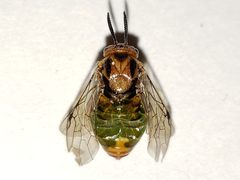
Neodiprion abbotii is a in the Diprionidae. As a member of the Diprioninae , it belongs to a group of primitive Hymenoptera that are among the few folivores capable of feeding on conifer needles. are small, stingless with a saw-like ovipositor used to insert into conifer foliage. Larvae are caterpillar-like but possess more pairs of than Lepidoptera larvae and lack .
Pronunciation
How to pronounce Neodiprion abbotii: /ˌniːoʊˈdaɪpriːən ˈæbətiː/
These audio files are automatically generated. While they are not always 100% accurate, they are a good starting point.
Identification
Larvae are distinguished from Lepidoptera caterpillars by having more than 5 pairs of and lacking . Within the Neodiprion, N. abbotii is differentiated from such as N. lecontei, N. compar, N. maurus, N. pinetum, and N. fabricii by larval coloration and other field characteristics detailed in the larval identification key provided by Davis et al. 2023. are distinguished by genitalia and other morphological features typically requiring microscopic examination.
Images
Habitat
Associated with conifer forests and landscapes containing pine . Found in natural forests, managed forests, and ornamental plantings where suitable host conifers occur.
Distribution
Eastern North America. Specific range boundaries within this region are not well documented in available sources.
Diet
Larvae feed on conifer foliage, specifically pine needles. pine associations for N. abbotii specifically are not documented in available sources, though feed on various pine species including black pine, Scots pine, and Mugo pine.
Host Associations
- Pinus - Specific pine associations for N. abbotii are not documented in available sources.
Life Cycle
undergo complete with , larval, pupal, and stages. Females use their saw-like ovipositor to insert eggs into conifer needles. Larvae feed gregariously on needles. Mature larvae descend to the ground and spin tough silk cocoons in the duff or soil beneath trees to pupate. Some Neodiprion produce multiple per season, though specific generation timing for N. abbotii is not documented.
Behavior
Larvae are gregarious, feeding together in groups throughout most of their development. When disturbed, larvae of related have been observed to arch their backs and regurgitate sticky, odorous pine resin stored in specialized esophageal pouches as a chemical defense against .
Ecological Role
Herbivore that consumes conifer foliage. Serves as prey for birds and various natural enemies. are typically moderated by natural enemies and rarely reach levels that cause significant forest impact.
Human Relevance
Occasional pest of ornamental and forest pines. Large can defoliate trees, though chemical treatments are rarely necessary as natural enemies typically control . Management options include physical removal of larvae or water spraying for small ; applications are reserved for high populations in managed forests.
Similar Taxa
- Neodiprion lecontei with similar larval form and ; distinguished by larval color pattern (red in N. lecontei versus different coloration in N. abbotii per Davis et al. 2023 key).
- Neodiprion compar with similar ; distinguished by larval coloration and field characteristics per Davis et al. 2023 identification key.
- Neodiprion maurus with similar associations; differentiated by larval per Davis et al. 2023.
- Neodiprion pinetum with overlapping range; distinguished by larval characteristics per Davis et al. 2023 key.
- Neodiprion fabricii with similar ; separated by larval coloration and other field characteristics per Davis et al. 2023.
- Lepidoptera larvaeSuperficially similar caterpillar-like form; distinguished by larvae having more than 5 pairs of without , plus different capsule structure.
More Details
Research Status
Despite being one of 25 in eastern U.S. forests, N. abbotii has received limited specific research attention. Most detailed knowledge comes from broader studies of the Neodiprion and Diprioninae. The 2023 review by Davis et al. in Journal of provides the first in-color larval identification key for eastern North American conifer sawflies, including this species.