
Neodiprion abietis
(Harris, 1841)
balsam fir sawfly
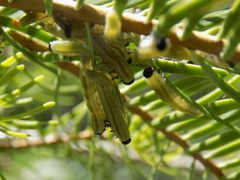
Neodiprion abietis, the balsam fir , is a conifer-feeding sawfly native to North America. Larvae are gregarious defoliators that feed preferentially on balsam fir (Abies balsamea) needles, with capable of causing significant tree mortality in eastern Canadian forests. The exhibits in development, with females typically undergoing six instars over 35 days and males five instars over 30 days. are strongly regulated by a -specific (NeabNPV), which has been developed as a registered biological (Abietiv™) for outbreak management.
Pronunciation
How to pronounce Neodiprion abietis: /ˌniː.oʊˈdaɪ.pri.ən əˈbaɪ.ɪ.tɪs/
These audio files are automatically generated. While they are not always 100% accurate, they are a good starting point.
Identification
Larvae distinguished from other Neodiprion by association with balsam fir and characteristic longitudinal stripe patterns: absence in early instars, three dark stripe pairs in later instars. Fourth and fifth instar stripes are similar, complicating differentiation. identified by antennal segment counts (male 21–23, female 18–20) and association with Abies balsamea. For field identification, consult larval color keys in Davis et al. 2023 (Journal of ), which provide the first in-color larval identification resource for eastern North American conifer sawflies.
Images
Habitat
Mature and balsam fir (Abies balsamea) forests; precommercially thinned stands show increased intensity. Oviposition occurs in current-year or one-year-old foliage. Larval development optimized on mixed-age foliage.
Distribution
North America: Canada (Newfoundland and Labrador, New Brunswick, Alberta, British Columbia, Manitoba), United States (range extends to northern Mexico per some sources, though primary documentation centers on Canadian Maritimes and eastern forests).
Seasonality
with extended : eggs laid September–October, overwinter in foliage; hatch late June to mid-July; larval development July–August; August; late August–early September. Some individuals may enter extended diapause resulting in 2-year .
Diet
feeder on conifer needles, with strong preference for balsam fir (Abies balsamea). Acceptable include white spruce (Picea glauca), black spruce (Picea mariana), and tamarack (Larix laricina), though oviposition preference tests show 98% of laid on balsam fir when choice available. Larvae prefer 2–3 year-old foliage, rarely feeding on current-year growth.
Host Associations
- Abies balsamea - primary Strong oviposition preference; optimal larval development
- Picea glauca - secondary Accepted in no-choice tests but strongly avoided when balsam fir available
- Picea mariana - secondary Accepted in no-choice tests but strongly avoided when balsam fir available
- Larix laricina - secondary Documented feeding
Life Cycle
inserted into foliage via saw-like ovipositor September–October; embryonic through winter. late June–mid-July. Larvae feed gregariously through 5 instars (males) or 5–6 instars (females), with female development extended (35 days vs. 30 days). Final instars spin silk cocoons on foliage or in ground litter (accounts differ), pupate, and emerge as in 2–3 weeks. Reproductive mode is arrhenotokous : unmated females produce only male offspring; mated females produce both sexes.
Behavior
Gregarious feeding throughout larval life; larvae move together between shoots. Defensive regurgitation of terpenoid-rich fluid from paired diverticular pouches when disturbed—pouches store resins sequestered from foliage. Higher movement rates within tree crowns in mid and late instars compared to early instars. Females show greater sensitivity to foliage quality than males, possibly related to longer developmental requirements.
Ecological Role
Native defoliator of coniferous forests; periodic with 10-year cycle periodicity in eastern Canada. Outbreaks reduce tree growth and cause mortality, particularly in thinned stands. Natural dominated by (NeabNPV), which causes mortality. Serves as prey for birds and supports and . Defoliation does not stimulate bud or shoot release, resulting in slow recovery.
Human Relevance
Significant forest pest in Canadian balsam fir stands; last 3–5 years with severe economic impact on timber production. Management options include with registered NeabNPV product (Abietiv™), manual removal of larvae, and targeted applications for high-value trees. Virus-based control exploits via infected larval diarrhea contaminating foliage.
Similar Taxa
- Neodiprion leconteiRedheaded pine sawfly—larvae have red and feed on Pinus rather than Abies; different association and larval coloration.
- Neodiprion sertiferEuropean pine sawfly— in North America, feeds on Pinus sylvestris and other pines; larvae have distinctive black lateral stripes on green body.
- Neodiprion comparSimilar in Diprioninae; distinguished by larval color pattern and preferences per Davis et al. 2023 larval key.
Misconceptions
Larvae are often mistaken for caterpillars (Lepidoptera larvae) due to similar appearance; however, larvae possess greater number of (6–8 pairs vs. 5 or fewer in caterpillars) and lack (hooked spines) on prolegs. Unlike many forest pests, chemical control is rarely necessary as natural enemies typically regulate .
More Details
Viral Pathology
NeabNPV (Neodiprion abietis ) is a Gammabaculovirus highly specific to this , replicating only in epithelial . Infected larvae excrete virus-laden diarrhea while alive, enabling efficient . persists through to midgut. The virus has been sequenced (84,264 ) and developed as the bioinsecticide Abietiv™.
Sexual Dimorphism in Development
Females typically have six instars and 35-day development; males have five instars and 30-day development. This difference is suspected to relate to greater female sensitivity to foliage quality and resource requirements for production.
Photoperiodism
Unlike other diprionid studied, the early balsam strain lacks photoperiodically controlled prepupal in its normal cycle—daylength influences only induction of extended diapause leading to 2-year .
Sources and further reading
- BugGuide
- Wikipedia
- GBIF taxonomy match
- iNaturalist taxon
- NCBI Taxonomy
- Crazy redheads - Redheaded pine sawfly, Neodiprion lecontei(MISSING VIDEO AND LINKS) — Bug of the Week
- What's Eating Your Pine Needles? Sawflies, Probably
- Conifer sawfly larva - Entomology Today
- Sequence Analysis and Organization of theNeodiprion abietisNucleopolyhedrovirus Genome
- Transmission of a Gammabaculovirus within Cohorts of Balsam Fir Sawfly (Neodiprion abietis) Larvae
- Photoperiodism in the early balsam strain of the Neodiprion abietis complex (Hymenoptera: Diprionidae)
- Chromosome fission associated with growth of ribosomal DNA in Neodiprion abietis (Hymenoptera: Diprionidae)
- Influence of Larval Stage and Virus Inoculum on Virus Yield in Insect Host Neodiprion abietis (Hymenoptera: Diprionidae)
- Ecological Niche Modelling to Assessment of Potential Distribution of Neodiprion Abietis (Harris, 1841) (Insecta, Hymenoptera, Diprionidae) in Eurasia
- Ecological niche modeling to assessment of potential distribution of Neodiprion abietis (Harris, 1841) (Insecta, Hymenoptera, Diprionidae) in Eurasia
- Spread of a Gammabaculovirus within Larval Populations of Its Natural Balsam Fir Sawfly (Neodiprion abietis) Host Following Its Aerial Application
- Host–tree oviposition preference of balsam fir sawfly, Neodiprion abietis (Hymenoptera: Diprionidae), in New Brunswick, Canada
- In vivo replication kinetics and transcription patterns of the nucleopolyhedrovirus (NeabNPV) of the balsam fir sawfly, Neodiprion abietis
- Influence of Larval Stage and Virus Inoculum on Virus Yield in Insect Host <I>Neodiprion abietis</I> (Hymenoptera: Diprionidae)
- Pathology of aGammabaculovirusin Its Natural Balsam Fir Sawfly (Neodiprion abietis) Host