
Brachymeria
Westwood, 1829
chalcid wasps
Species Guides
5Brachymeria is a large of chalcidid wasps containing over 300 worldwide. These small are primarily solitary endoparasitoids of insect pupae, with most species attacking Lepidoptera. They are characterized by enlarged hind typical of the Chalcididae. Some species function as hyperparasitoids, attacking parasitic Hymenoptera and Diptera. Several species have been employed in programs against pest insects.
Pronunciation
How to pronounce Brachymeria: /ˌbrækɪˈmɛriə/
These audio files are automatically generated. While they are not always 100% accurate, they are a good starting point.
Identification
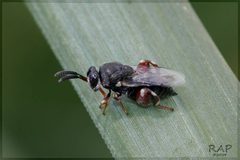
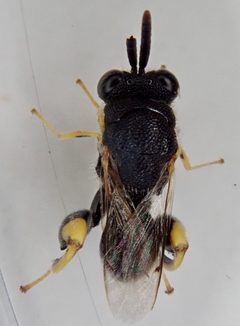
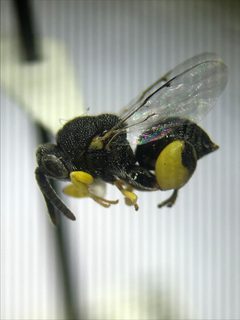
Brachymeria are distinguished from other chalcidid by their compact body form and the characteristic "thunder thighs"—greatly swollen hind with bowed tibiae that fit the curvature of the preceding leg segment. Most species are predominantly black with limited yellow markings. They range 3–6 mm in length. Specific species identification requires examination of wing venation, antennal structure, and other microscopic features.
Images
Habitat
Brachymeria are found in diverse terrestrial associated with their . are often observed near colonies where they feed on honeydew, or visiting flowers such as wild carrot (Daucus carota). In arid regions, adults seek shade during hot periods, sheltering among vegetation such as cattails or on shaded cottonwood leaves near wetlands. The is associated with decaying organic matter where host flies develop, as well as agricultural and natural hosting lepidopteran larvae.
Distribution
distribution with over 300 described worldwide. Documented occurrence includes North America (26+ species), Europe, the Middle East, the Indomalayan realm, South America, Africa, and Asia. Specific regional records include the United Arab Emirates, western Europe, and across the United States including Arizona and California.
Diet
Brachymeria feed on honeydew from colonies and nectar from flowers. Larvae are endoparasitoids developing within insects.
Host Associations
- Lepidoptera (pupae) - primary primary ; females lay inside lepidopteran pupae using ovipositor
- Muscoid flies (Diptera) - primary including Sarcophaga dux and other flesh flies, blow flies
- Parasitic Hymenoptera - hyperparasitoidsome attack other
- Parasitic Diptera - hyperparasitoidsome attack tachinid or sarcophagid flies
- Galleria mellonella - laboratory used for rearing B. lasus in laboratory colonies
- Polistes erythrocephalus - attacked by some
- Grasshoppers (Orthoptera) - indirect possibly via flies that attack grasshoppers
Life Cycle
Brachymeria are solitary idiobiont endoparasitoids. Females inject into larvae (typically third-stage larvae of muscoid flies or lepidopteran pupae). The host is allowed to pupate before the completes development. Multiple eggs may be deposited in a single host, but (ciblicide) results in only one offspring surviving to emerge. Preimaginal development at 26°C lasts 20–28 days; may take 155–180 days. emerge from host by nibbling along the line of weakness.
Behavior
Females initially appear neutral to larvae, then attack by crawling onto hosts and inserting the ovipositor through larval skin. Contact is brief as hosts attempt to dislodge the . No special selection for particular body sites has been observed. Multiple assaults on a single host can lead to envenomation and host death. When disturbed, may "play possum"—hugging legs to the body and remaining motionless. Males establish territories around nectar sources and defend them from other males.
Ecological Role
Brachymeria serve as important natural regulators of insect , particularly filth flies and pest caterpillars. They contribute to of blow flies and flesh flies that infest animal carcasses, and help regulate lepidopteran pests in agricultural systems. Some species have forensic importance as for postmortem interval estimation. The has been utilized in classical and programs.
Human Relevance
Several Brachymeria have been employed in programs against agricultural and nuisance pests. B. fonscolombei may limit of blow flies and flesh flies around animal carcasses. The has potential in for criminal investigations. Laboratory colonies are maintained for research purposes using such as Galleria mellonella and Sarcophaga species.
Similar Taxa
- Other Chalcididae generaBrachymeria is distinguished by its compact body form and specific wing venation patterns; other may share enlarged hind but differ in antennal structure and body proportions
- Nasonia vitripennis (Pteromalidae)similar size and pupal lifestyle, but Nasonia has different hind leg structure (not enlarged ) and faster development, competitively dominating Brachymeria in mixed
- Dirhinus himalayanus (Chalcididae)co-occurs as of Sarcophaga dux; differs in body form and competitive interaction dynamics
More Details
Competitive interactions
In mixed with Nasonia vitripennis, Brachymeria podagrica is competitively dominated due to the faster development of Nasonia. When superinfected with Dirhinus himalayanus, sex ratios shift from 6:1 (male-biased) in monoinfection to 3:1, indicating complex interspecific interactions.
Venom and immune suppression
Brachymeria lasus injects venom during oviposition that suppresses cellular through apoptosis-like mechanisms in , involving elevated ROS and calcium ions and decreased mitochondrial potential. This enhances offspring survival and development.
Taxonomic history
The was established by Westwood in 1829. It is the type genus of Brachymeriinae within Chalcididae. Over 300 are currently recognized, making it one of the larger genera in the .
Sources and further reading
- BugGuide
- Wikipedia
- GBIF taxonomy match
- iNaturalist taxon
- NCBI Taxonomy
- Catalogue of Life
- Publications | Entomology Research Museum
- Bug Eric: Wasp Wednesday: Brachymeria
- Bug Eric: Wasp Wednesday: The Wasp Tree Part II
- Effects of Parasitism and Venom from the Endoparasitoid Brachymeria lasus on Immunity of the Host Galleria mellonella.
- Development and Competition of Three Parasitoid Wasps, Brachymeria podagrica, Dirhinus himalayanus, and Nasonia vitripennis, in Their Host, Sarcophaga dux, in Single and Mixed Infections.