
Hyposoter fugitivus
(Say, 1835)
Hyposoter fugitivus is an ichneumonid first described by Thomas Say in 1835. Molecular studies have established that this carries integrated into its , representing a stable symbiotic relationship. The polydnavirus is transmitted vertically and likely plays a role in manipulating physiology during , though specific host associations remain undocumented in available sources.
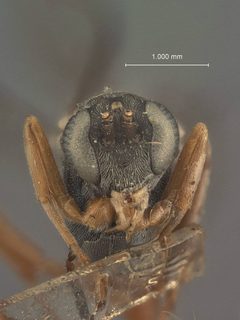
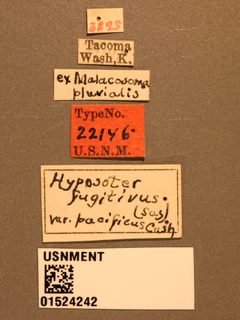
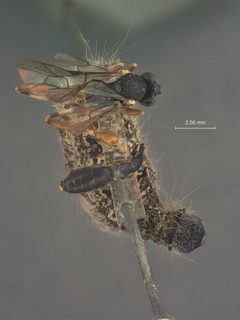
Pronunciation
How to pronounce Hyposoter fugitivus: /haɪˈpɒsətər fjuːˈɡɪtɪvəs/
These audio files are automatically generated. While they are not always 100% accurate, they are a good starting point.
Images
Distribution
Documented occurrence records from Gladstone, California and Piney, California, USA. Specific native range beyond these points is not established in available sources.
More Details
Polydnavirus Integration
H. fugitivus has been demonstrated through molecular hybridization studies to carry sequences integrated at specific chromosomal loci. Each viral segment typically hybridizes to a single cognate chromosomal locus, with some loci containing multiple related segments derived from common templates. This represents one of the best-characterized examples of viral DNA integration in .
Research Significance
This has served as a model organism for understanding and the evolutionary relationship between ichneumonid wasps and their associated viruses. Studies on H. fugitivus provided early evidence that polydnavirus is not merely episomal but stably integrated into , with viral and genomic DNAs being largely colinear.