
Phobetron
Hübner, 1825
hag moth, monkey slug
Species Guides
1- Phobetron pithecium(Hag Moth)
Phobetron is a of slug caterpillar moths in the Limacodidae, containing at least four described distributed across North, Central, and South America. The genus is notable for its distinctive caterpillars, commonly called "monkey slugs" or "hag ," which possess stinging urticating spines concealed beneath a cloak of hair-like setae. These caterpillars are and feed on a wide range of woody and herbaceous plants. The genus includes the well-known species Phobetron pithecium, whose caterpillar is frequently encountered in eastern North America.

Pronunciation
How to pronounce Phobetron: /foʊˈbiːtrɒn/
These audio files are automatically generated. While they are not always 100% accurate, they are a good starting point.
Identification
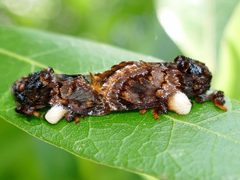
The caterpillars are immediately recognizable by their unique : a flattened, amorphous body covered with shaggy hair-like setae and possessing multiple pairs of fleshy, leg-like lateral projections. This appearance is unlike any other North American caterpillar and is diagnostic for the . The combination of slug-like form, hairy covering, and stinging capability distinguishes Phobetron from all other Limacodidae genera. are more difficult to identify and require examination of genitalia or association with known caterpillars.
Images
Appearance
are relatively small with muted coloration. The caterpillars are highly distinctive: they appear as flattened, irregular masses covered with long, hair-like setae, giving them a shaggy or disheveled appearance. The body form is reduced, with paired, fleshy lateral appendages that resemble legs but are not true thoracic legs. These appendages are often curled or twisted, contributing to the "monkey slug" . Beneath the hair-like covering, the caterpillar possesses stinging spines that can deliver venom upon contact.
Habitat
Found in diverse including deciduous forests, urban and suburban environments, agricultural settings (notably oil palm plantations), and areas with ornamental plantings. The caterpillars are associated with their plants, which range from native trees to cultivated .
Distribution
North America, Central America, and South America. Specific records include: United States (eastern and central regions), Mexico, El Salvador, Rica, Panama, Colombia, Venezuela, Guyana, Brazil, Paraguay, Argentina, and Ecuador.
Seasonality
Activity patterns vary by and latitude. In temperate regions, are active during summer months; in tropical regions, multiple may occur annually. In the Colombian Caribbean, fluctuations have been recorded throughout the year with peaks correlating to agents rather than climatic variables.
Diet
herbivory. Larvae feed on foliage of diverse plant including Arecaceae (palms), Myrtaceae (Syzygium), Malvaceae (Theobroma cacao, Hibiscus), Rosaceae, Fagaceae (oaks), Fabaceae, Anacardiaceae, Moraceae, and others. Specific consumption rates documented: P. hipparchia larvae consume approximately 682.9 cm² of oil palm leaf blade per individual.
Host Associations
- Elaeis guineensis - oil palm, major agricultural pest in Colombia
- Syzygium aqueum - Myrtaceae, ornamental and fruit tree in Panama
- Theobroma cacao - cacao, backyard in Panama
- Quercus spp. - oaks, native in North America
- Hibiscus spp. - rose mallow and relatives
Life Cycle
Complete with four stages: , larva, pupa, and . Laboratory studies of P. hipparchia at 27.3°C and 85% RH determined: egg stage 6.3 days, larval stage with nine instars 49.1 days, pupal stage 14.4 days, and adult stage 4.5 days; total development time 74.3 days. Field observations indicate variable timing based on temperature and humidity.
Behavior
Caterpillars are slow-moving and rely on and aposematic defense. When disturbed, the urticating spines beneath the hair-like setae can break off and embed in skin, delivering venom. The unusual lateral appendages may serve in defense, , or sensory functions. are and attracted to light. Larvae are solitary feeders.
Ecological Role
Herbivore and occasional agricultural pest. In oil palm plantations, P. hipparchia has emerged as a significant defoliating pest in Colombia. The is subject to natural by (Baryceros sp.) and fungi (Cordyceps sp.). Caterpillars serve as prey for and parasitoids.
Human Relevance
Medical significance due to erucism (caterpillar stings). Contact with urticating spines causes immediate burning pain, localized swelling, redness, and blistering; allergic reactions may occur requiring medical attention. Stings to and mucous are particularly serious. Agricultural pest status in oil palm . Caterpillars are frequently encountered in urban and suburban environments on ornamental plants, creating public health concerns.
Similar Taxa
- Megalopyge opercularisBoth are limacodid caterpillars with dense hair-like setae concealing stinging spines; however, Megalopyge has a more compact, oval body form without the lateral appendages characteristic of Phobetron
- Acharia stimuleaSaddleback caterpillar shares stinging spine defense and limacodid membership, but has prominent paired horns and contrasting color pattern unlike Phobetron
- Automeris ioIo moth caterpillar has long branching spines rather than hair-concealed spines, and maintains a more conventional cylindrical caterpillar body form
- Norape ovinaWhite flannel moth caterpillar has dense setae and stinging capability but lacks the flattened, appendage-bearing of Phobetron
More Details
Venom composition
The venom delivered by urticating spines contains multiple bioactive compounds; medical literature documents cases requiring hospitalization for severe reactions
Agricultural monitoring
In Colombian oil palm plantations, monitoring at 20-day intervals has been implemented to track and effectiveness
Taxonomic history
The was established by Hübner in 1825; boundaries and relationships within the genus require further phylogenetic study
Sources and further reading
- BugGuide
- Wikipedia
- GBIF taxonomy match
- iNaturalist taxon
- NCBI Taxonomy
- Catalogue of Life
- Look but do not touch: puss caterpillar, Megalopyge opercularis; White flannel moth, Norape ovina; Io moth, Automeris io; buck moth Hemileuca spp.; and hag moth, Phobetron pithecium — Bug of the Week
- Ascalaphidae | Beetles In The Bush
- August | 2022 | Beetles In The Bush
- Archive — Bug of the Week
- entomology | Beetles In The Bush | Page 5
- Phobetron hipparchia (Lepidoptera: Limacodidae) asociado a Syzygium aqueum (Myrtaceae) y Theobroma cacao (Malvaceae) en Villa Lucre, Panamá Phobetron hipparchia (Lepidoptera: Limacodidae) associated with Syzygium aqueum (Myrtaceae) and Theobroma cacao (Malvaceae) in Villa Lucre, Panama
- LIFE CYCLE, FOLIAR CONSUMPTION RATE, NATURAL ENEMIES AND POPULATION FLUCTUATION OF Phobetron hipparchia CRAMER, 1777 (LEPIDOPTERA: LIMACODIDAE): AN EMERGING PEST OF OIL PALM IN COLOMBIA