
Norape virgo
(Butler, 1877)
Virgin flannel moth, White flannel moth
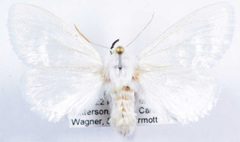
Norape virgo is a of flannel in the Megalopygidae, described by Arthur Gardiner Butler in 1877. The species name derives from Latin 'virgo' meaning virgin, referring to the all-white coloration. It occurs from southern Texas and southern Arizona south to Colombia. Adults are smaller than the related Norape walkeri, with shorter, broader, and less forewings. The larvae feed on legumes and possess that can deliver painful stings.
Pronunciation
How to pronounce Norape virgo: /nɔˈra.pe ˈwir.ɡo/
These audio files are automatically generated. While they are not always 100% accurate, they are a good starting point.
Identification
Distinguished from the similar Norape walkeri by smaller overall size, shorter and broader forewings, and less wing surface. The all-white coloration is distinctive within the . Larvae can be identified by their flannel-like hair covering and association with legume plants.
Images
Habitat
Found in subtropical and tropical regions from the southern United States through Central America to northern South America. Associated with areas supporting leguminous plants for larval development.
Distribution
Southern Texas, southern Arizona, south through Mexico and Central America to Colombia.
Diet
Larvae feed on legumes (Fabaceae). Specific plant records require further documentation.
Host Associations
- Fabaceae - larval food plantlegumes
Behavior
are presumably based on characteristics. Larvae are folivorous and possess defensive urticating spines.
Ecological Role
Larvae serve as herbivores on leguminous plants. The is subject to by braconid wasps in the Cotesia, which lay in caterpillars and emerge from cocoons on the 's exterior.
Human Relevance
Larvae can deliver painful stings through , causing burning sensation, redness, swelling, and blistering that may persist for hours or days. Medical attention may be needed for severe reactions or contact with mucous .
Similar Taxa
- Norape walkeriSimilar white flannel with larger size, longer and narrower forewings, and glossier wing surface
- Norape ovinaAnother white flannel with similar larval appearance and stinging capability, differing in distribution and details
More Details
Etymology
The epithet 'virgo' refers to the virgin-white coloration of the .
Defensive adaptations
Like other Megalopygidae larvae, N. virgo caterpillars possess urticating spines with associated poison glands that deliver toxins upon contact, serving as defense against and causing reactions in humans.
Sources and further reading
- BugGuide
- Wikipedia
- GBIF taxonomy match
- iNaturalist taxon
- NCBI Taxonomy
- Catalogue of Life
- Look but do not touch: puss caterpillar, Megalopyge opercularis; White flannel moth, Norape ovina; Io moth, Automeris io; buck moth Hemileuca spp.; and hag moth, Phobetron pithecium — Bug of the Week
- Stinging caterpillars - White flannel moth, Norape ovina, and Saddleback caterpillar, Archaria stimulea — Bug of the Week
- Araneae | Beetles In The Bush | Page 5
- Archive — Bug of the Week