
Norape
Walker, 1855
Species Guides
4- Norape cretata(White Flannel Moth)
- Norape sorpresa
- Norape tener(Mesquite Stinger Moth)
- Norape virgo(Virgin flannel moth)
Norape is a of in the Megalopygidae, commonly known as flannel moths. The genus was established by Francis Walker in 1855 and contains approximately 60 described distributed primarily in the Americas. Caterpillars of at least some species, including N. ovina (white flannel moth), possess that deliver painful stings upon contact with human skin. The genus is part of the Trosiinae within the Megalopygidae family.
Pronunciation
How to pronounce Norape: /ˈnɔɹəpi/
These audio files are automatically generated. While they are not always 100% accurate, they are a good starting point.
Identification
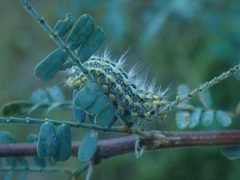
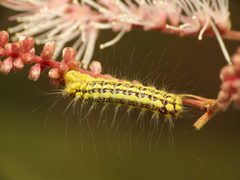
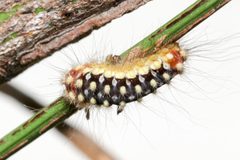
Norape can be distinguished from other Megalopygidae by genitalia and wing venation patterns, requiring microscopic examination. Within the genus, species identification relies on subtle differences in wing pattern, coloration, and body proportions. The white flannel moth (N. ovina) is recognizable by its pale coloration and, in the larval stage, by its dense white hair covering and association with plants including redbud, black locust, elm, and hackberry. N. ovina caterpillars may be confused with the puss caterpillar (Megalopyge opercularis), but differ in having more distinctly segmented tufts of hair rather than the uniform shaggy coat of the puss caterpillar. Megalopyge caterpillars also tend to be more uniformly oval in shape when viewed from above.
Images
Habitat
Found in wooded areas, forests, and suburban landscapes where plants occur. Larvae feed on a variety of woody plants including trees and shrubs. N. ovina has been documented in redbud, black locust, greenbrier, elm, and hackberry. The occurs across a range of from temperate deciduous forests to tropical regions in the Americas.
Distribution
The is distributed in the Americas, with ranging from the eastern United States through Central America and into South America. N. ovina specifically ranges from the mid-Atlantic region (DMV area) south to Florida and Texas, with two annually in southern portions of its range.
Seasonality
activity varies by and latitude. In the eastern United States, N. ovina appears to have multiple with caterpillars active during spring and summer months. In southern regions, two generations occur annually. Specific periods for most species are poorly documented.
Diet
Larvae feed on leaves of woody plants. N. ovina caterpillars have been documented feeding on redbud (Cercis canadensis), black locust (Robinia pseudoacacia), greenbrier (Smilax), elm (Ulmus), and hackberry (Celtis). feeding habits are not well documented but adults in related groups typically do not feed or consume only liquids such as nectar or water.
Host Associations
- Cercis canadensis - larval food plantredbud
- Robinia pseudoacacia - larval food plantblack locust
- Smilax - larval food plantgreenbrier
- Ulmus - larval food plantelm
- Celtis - larval food planthackberry
Life Cycle
Complete with , larva, pupa, and stages. Larvae are the feeding and growing stage, bearing defensive . likely occurs in silken cocoons, as is typical for the , though specific details for most Norape are not well documented. duration varies with latitude, with multiple possible in warmer climates.
Behavior
Caterpillars are solitary or may occur in on single branches of plants. When disturbed, the break off easily and embed in skin or mucous . The caterpillars do not actively attack but rely on passive defense through their venomous spines. are and attracted to light. Specific mating and adult activity patterns are not well documented for most .
Ecological Role
Larvae function as herbivores, consuming leaf tissue of various woody plants. They serve as prey for , including in the Cotesia (Braconidae), which lay in caterpillars and eventually kill them. The dense hair covering and venomous spines represent an anti- defense that influences predator-prey dynamics. may contribute to pollination if they feed on nectar, though this has not been documented.
Human Relevance
Caterpillars pose a medical concern due to their . Contact with skin causes immediate burning pain, redness, swelling, and may produce blisters or persistent rash lasting days. allergic reactions are possible in sensitive individuals. Medical attention should be sought for severe reactions or contact with or mucous . The caterpillars are sometimes encountered by gardeners, landscapers, and outdoor handling vegetation. Despite their defensive capabilities, the are not considered agricultural pests of major economic importance.
Similar Taxa
- MegalopygeAlso in Megalopygidae; caterpillars similarly covered with dense hair and bearing urticating spines. Megalopyge caterpillars (puss caterpillars) have a more uniform, shaggy hair coat without distinct tufts, and the body appears more uniformly oval from above.
- EuchaetesRelated tiger moth (Erebidae) with hairy caterpillars, but lacks the concealed venomous spines beneath soft hair; setae are not urticating in the same way.
- LymantriaTussock moths (Erebidae) have hairy caterpillars with urticating properties, but differ in having distinct tussock hair tufts and more prominent paired glands; not in the same .
More Details
Venom chemistry
The venom delivered by contains toxins that produce immediate pain and inflammatory responses. The specific chemical composition has not been fully characterized for Norape .
Parasitoid relationships
Caterpillars are to including Cotesia . Female wasps inject along with that suppress the caterpillar's immune system, allowing wasp larvae to develop and eventually emerge through the caterpillar's skin.
Taxonomic history
The was established by Francis Walker in 1855. Many were described by Hopp in the 1920s-1930s, resulting in a large number of described whose validity and relationships require modern revision.
Sources and further reading
- BugGuide
- Wikipedia
- GBIF taxonomy match
- iNaturalist taxon
- NCBI Taxonomy
- Catalogue of Life
- Look but do not touch: puss caterpillar, Megalopyge opercularis; White flannel moth, Norape ovina; Io moth, Automeris io; buck moth Hemileuca spp.; and hag moth, Phobetron pithecium — Bug of the Week
- Stinging caterpillars - White flannel moth, Norape ovina, and Saddleback caterpillar, Archaria stimulea — Bug of the Week
- Archive — Bug of the Week