
Norape tener
(Druce, 1897)
Mesquite Stinger Moth
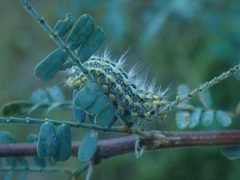
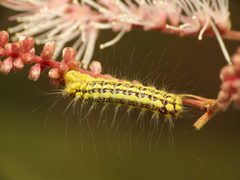
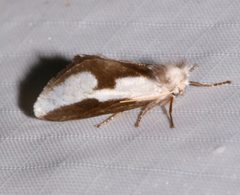
Norape tener is a flannel in the Megalopygidae, described by Herbert Druce in 1897. The "mesquite stinger moth" refers to the larval plants and the defensive stinging hairs possessed by caterpillars in this . are small white moths with distinctive dark markings on the wings and . The occurs in the southwestern United States and Mexico.
Pronunciation
How to pronounce Norape tener: //ˈnɔɹəpi ˈtɛnɛɹ//
These audio files are automatically generated. While they are not always 100% accurate, they are a good starting point.
Identification
distinguished from other Norape by the specific wing pattern: broad brown-black costal edge on forewings with matching marginal and fringe coloration, and the distinctive branch of the inner border reaching to the at 2 origin. The small size (29 mm wingspan) and southwestern distribution help separate it from similar white flannel moths in other regions. Larvae with black and white striping on green background differ from the all-white or differently patterned larvae of related species such as Norape ovina.
Images
Habitat
Desert and semi-arid environments. Associated with mesquite, acacia, paloverde and other desert vegetation that serve as larval plants.
Distribution
Southeastern Arizona, southern New Mexico, and Mexico.
Diet
Larvae feed primarily on mesquite (Prosopis), acacia, paloverde (Parkinsonia), and other desert plants.
Host Associations
- mesquite - larval primary
- acacia - larval
- paloverde - larval
Ecological Role
Larvae are herbivores on desert leguminous trees and shrubs. Stinging hairs provide defense against .
Human Relevance
Larvae possess stinging hairs that can cause skin irritation upon contact. The "stinger " reflects this defensive capability. Not a significant agricultural pest despite feeding on mesquite and related plants.
Similar Taxa
- Norape ovinaAlso a white flannel moth with stinging larvae, but occurs in eastern and central North America rather than the Southwest; larvae are white rather than green with black and white stripes.
More Details
Etymology
The epithet "tener" is derived from Latin "tenera" meaning soft, likely referring to the soft, flannel-like appearance of the .
Sources and further reading
- BugGuide
- Wikipedia
- GBIF taxonomy match
- iNaturalist taxon
- NCBI Taxonomy
- Catalogue of Life
- Look but do not touch: puss caterpillar, Megalopyge opercularis; White flannel moth, Norape ovina; Io moth, Automeris io; buck moth Hemileuca spp.; and hag moth, Phobetron pithecium — Bug of the Week
- Stinging caterpillars - White flannel moth, Norape ovina, and Saddleback caterpillar, Archaria stimulea — Bug of the Week
- Hooray for the red, white, and blue! Milkweed longhorned beetle, Tetraopes tetraophthalmus; dogbane tiger moth, Cycnia tenera; and familiar bluet, Enallagma civile — Bug of the Week
- New Species of Bizarre, Worm-like Mite Discovered on Ohio State University Campus
- indicator species | Blog
- Weevil genus beats records in Macaronesia | Blog