
Norape cretata
(Grote, 1864)
White Flannel Moth
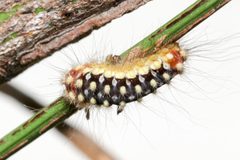
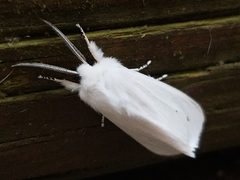
The white flannel moth is a of flannel in the Megalopygidae. Its caterpillars are covered in dense, hair-like setae that conceal venomous spines capable of delivering painful stings to humans. The species ranges across eastern and central North America, from the mid-Atlantic states to the Deep South and west to Texas and Montana. are relatively nondescript white moths, while the larvae are distinctive and often encountered when they aggregate on plants.
Pronunciation
How to pronounce Norape cretata: /ˈnoʊrəpi ˈkrɛtəˌtɑ/
These audio files are automatically generated. While they are not always 100% accurate, they are a good starting point.
Identification
can be distinguished from other small white by their fuzzy, flannel-like scaling and relatively plain appearance. The caterpillars are unmistakable due to their dense, soft hair covering that resembles tufts of cotton or flannel; however, they closely resemble the puss caterpillar (Megalopyge opercularis), which has longer, more hair-like setae and a more elongated, slug-like form. The white flannel moth caterpillar has a more compact, less elongated body shape. The saddleback caterpillar (Acharia stimulea) is easily distinguished by its prominent brown saddle-shaped marking on the back.
Images
Habitat
Found in deciduous forests, woodlands, suburban areas, and parks where trees grow. Caterpillars are commonly encountered on ornamental trees and shrubs in residential settings, particularly redbud, elm, and hackberry.
Distribution
Eastern and central United States from Washington, D.C. and Maryland south to Florida, west to Montana and Texas. Range extends south through Mexico, Guatemala, and Panama to Venezuela, Suriname, and Bolivia.
Seasonality
Two per year in the southern part of the range; one generation in northern areas. are active from late spring through summer. Caterpillars are present from summer through early fall, with peak abundance varying by latitude.
Behavior
Caterpillars are gregarious and may be found in large numbers feeding on a single branch or cluster of leaves. When disturbed, they do not exhibit rapid escape ; their defense relies entirely on the urticating spines concealed within their hair covering. are and attracted to light.
Ecological Role
Caterpillars serve as herbivores on deciduous trees and shrubs. They are prey for , particularly braconid wasps in the Cotesia, which can successfully attack despite the caterpillar's defenses. The injected by female wasps during oviposition disables the caterpillar's immune system, allowing wasp larvae to develop.
Human Relevance
Caterpillars pose a medical concern due to their urticating spines, which cause painful stings, burning sensations, localized swelling, redness, and blistering that can persist for hours to days. Reactions vary from mild to severe; some individuals experience intense pain comparable to yellow jacket stings. Contact often occurs during gardening, pruning, or accidental brushing against infested foliage. Medical attention is recommended for severe reactions or contact with or mucous .
Similar Taxa
- Megalopyge opercularisPuss caterpillar has longer, more hair-like setae and a more elongated, slug-like body form; venom is considered more potent and medically significant
- Acharia stimuleaSaddleback caterpillar has a distinctive brown saddle-shaped marking on the back and projecting fleshy lobes at front and rear, rather than uniform hair covering
- Automeris ioIo moth caterpillar has prominent branched spines and green coloration with red and white stripes, lacking the dense flannel-like hair covering
Sources and further reading
- BugGuide
- GBIF taxonomy match
- iNaturalist taxon
- Catalogue of Life
- Look but do not touch: puss caterpillar, Megalopyge opercularis; White flannel moth, Norape ovina; Io moth, Automeris io; buck moth Hemileuca spp.; and hag moth, Phobetron pithecium — Bug of the Week
- Stinging caterpillars - White flannel moth, Norape ovina, and Saddleback caterpillar, Archaria stimulea — Bug of the Week
- Archive — Bug of the Week