
Megalopyge
Hübner, 1820
flannel moths, puss moths
Species Guides
6- Megalopyge crispata(Black-waved Flannel Moth)
- Megalopyge immaculata
- Megalopyge lacyi
- Megalopyge lapena
- Megalopyge opercularis(southern flannel moth)
- Megalopyge pyxidifera(Yellow Flannel Moth)
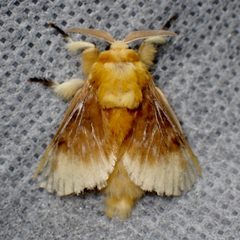
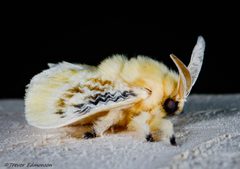
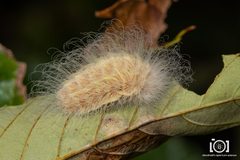
Megalopyge is a of in the Megalopygidae, commonly known as flannel moths or puss moths. The genus contains approximately 50 described distributed primarily in the Americas. Larvae are densely covered in hair-like setae that conceal venomous spines, making them medically significant due to severe stinging reactions in humans. are relatively small, stout-bodied moths with reduced mouthparts.
Pronunciation
How to pronounce Megalopyge: //ˌmɛɡəloʊˈpaɪdʒi//
These audio files are automatically generated. While they are not always 100% accurate, they are a good starting point.
Identification
Larvae are distinguished from other hairy caterpillars by the extreme of long, hair-like setae that completely obscure the body form, combined with concealed venomous spines—unlike tussock moths (Erebidae: Lymantriinae) which have prominent tussocks of hair but different spine arrangement, or slug caterpillars (Limacodidae) which have reduced legs and a flattened, slug-like form. are recognized by their stout, furry bodies and reduced wing venation lacking a in the forewing. The Megalopygidae is distinguished from related Zygaenoidea families by the combination of flannel-like scaling, reduced mouthparts, and distinctive larval .
Images
Habitat
Larvae occur in diverse terrestrial including deciduous forests, woodlands, forest edges, and tallgrass prairie remnants. They feed on foliage of broadleaf trees and shrubs. are typically and attracted to light. Specific microhabitat preferences vary by , with some associated with oak-hickory forests and others found in prairie-forest transition zones.
Distribution
The is distributed throughout the Americas, from the eastern United States south through Mexico, Central America, and into South America. Individual have more restricted ranges: Megalopyge opercularis occurs from Maryland to Florida and west to Texas; M. crispata is found in the central United States including Missouri; other species are restricted to Neotropical regions.
Seasonality
periods vary by and latitude. In temperate regions, adults are active primarily during summer months (June–August). In subtropical and tropical regions, multiple may occur with adults present across warmer months. Larvae are typically observed from late spring through early autumn.
Diet
Larvae feed on foliage of various woody plants including oaks (Quercus), hickories (Carya), black walnut (Juglans nigra), persimmon (Diospyros virginiana), apple (Malus), birch (Betula), pecan (Carya illinoinensis), and rose (Rosa). Specific associations vary by . have reduced, non-functional mouthparts and do not feed.
Host Associations
- Quercus - larval plantmultiple
- Carya - larval plantmockernut hickory and others
- Juglans nigra - larval plantblack walnut
- Diospyros virginiana - larval plantpersimmon
- Malus - larval plantapple
- Betula - larval plantbirch
- Carya illinoinensis - larval plantpecan
- Rosa - larval plantrose
Life Cycle
Holometabolous development with four life stages: , larva, pupa, . Females lay eggs on plant foliage. Larvae pass through multiple instars, with early instars often appearing as small, white, fluffy clusters. Later instars develop more hair and may show color pattern changes. occurs within a dense, felted cocoon attached to vegetation or in leaf litter. Number of per year varies from one in northern temperate regions to multiple generations in southern and tropical areas.
Behavior
Larvae are solitary feeders on plant foliage. When disturbed, they may curl into a defensive ball, concealing the and exposing the dense hair covering. The urticating spines beneath the hairs serve as a potent chemical defense against . are and readily attracted to ultraviolet light. Females release to attract males; males use their to detect these chemical signals.
Ecological Role
Larvae function as primary consumers, feeding on woody plant foliage and contributing to nutrient cycling. Their potent chemical defenses make them unpalatable to most vertebrate , though some specialized and predators may exploit them. The ichneumon Calliephialtes grapholithae has been recorded as a parasitoid of Megalopyge opercularis larvae.
Human Relevance
Larvae are medically significant due to severe envenomation caused by urticating spines. Contact produces intense burning pain, localized swelling, erythema, and blister formation; reactions including nausea, headache, and lymphadenopathy may occur. Medical attention is recommended for severe reactions or contact. Despite this, larvae are sometimes handled inadvertently due to their innocuous, furry appearance—earning like 'puss caterpillar' that suggest petting. have no economic importance.
Similar Taxa
- Limacodidae (slug caterpillar moths)Both have stinging larvae, but Limacodidae larvae have reduced and move with a slug-like gliding motion, lacking the dense hair covering of Megalopyge; have different wing venation and body form.
- Erebidae: Lymantriinae (tussock moths)Larvae of some tussock moths are hairy and possess , but they display prominent tussock tufts and a more visible body form beneath the hair, unlike the completely obscured body of Megalopyge larvae.
- Norape (white flannel moth genus)Also in Megalopygidae; larvae are similar in general appearance but typically have different color patterns and hair ; show subtle differences in wing shape and pattern.
More Details
Venom composition
Venom from Megalopyge larvae contains multiple bioactive compounds; severe envenomation cases may require medical intervention. The spines are hollow, barbed structures that break off in skin and continue to release venom.
Taxonomic history
The was established by Hübner in 1820. The Megalopygidae was formerly placed in various superfamilies but is now firmly established in Zygaenoidea based on molecular and morphological evidence.
Bacterial associations
A 2022 study characterized bacterial associated with M. opercularis across all life stages, finding diverse that may contribute to the caterpillar's chemical or defense systems.
Sources and further reading
- BugGuide
- Wikipedia
- GBIF taxonomy match
- iNaturalist taxon
- NCBI Taxonomy
- Catalogue of Life
- Look but do not touch: puss caterpillar, Megalopyge opercularis; White flannel moth, Norape ovina; Io moth, Automeris io; buck moth Hemileuca spp.; and hag moth, Phobetron pithecium — Bug of the Week
- Megalopygidae | Beetles In The Bush
- Bug Eric: A Potential New Host Record for Calliephialtes grapholithae (Hymenoptera: Ichneumonidae) from a Paper Wasp nest (Hymenoptera: Vespidae: Polistes metricus)
- Bacterial Communities Associated with Megalopyge opercularis (Smith) (Lepidoptera: Megalopygidae): Exploring Poisonous Lepidopterans