
Megalopyge crispata
(Packard, 1864)
Black-waved Flannel Moth, Crinkled Flannel Moth, White Flannel Moth
Megalopyge crispata is a flannel in the Megalopygidae, found in the eastern United States from the Atlantic coast westward to Oklahoma. are active from May to October, with one annually in northern and two or more in southern populations. The is notable for its venomous caterpillars, which possess hollow capable of delivering painful stings to humans.
Pronunciation
How to pronounce Megalopyge crispata: //ˌmɛɡəloʊˈpaɪdʒi krɪsˈpeɪtə//
These audio files are automatically generated. While they are not always 100% accurate, they are a good starting point.
Identification
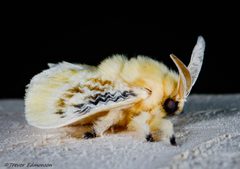
are distinguished from other Megalopyge by the black wavy or crinkled transverse lines on the forewings. The wingspan range and overall flannel-like appearance help separate this species from unrelated with similar coloration. Larvae are identified by their white fluffy appearance combined with their association with specific plants; however, definitive larval identification may require rearing to adulthood.
Images
Habitat
Occurs in diverse wooded and forested including oak-hickory forests, prairie edges, and restored tallgrass prairie remnants. Larvae have been observed on mockernut hickory (Carya tomentosa) in prairie-forest transition zones.
Distribution
Eastern United States, ranging from the Atlantic coast westward to Oklahoma. The inland western limit reaches approximately the 100th meridian.
Seasonality
are on the wing from May to October. One per year occurs in northern portions of the range; two or more generations occur in southern portions.
Diet
Larvae feed on various trees and shrubs, specifically documented on Carya tomentosa (mockernut hickory). The full range of larval plants has not been comprehensively documented.
Host Associations
- Carya tomentosa - larval Mockernut hickory; observed with early-instar caterpillars in Missouri prairie remnant
Life Cycle
Holometabolous with complete . One annually in northern , two or more in southern populations. Specific details of , larval instar progression, sites, and stage are not well documented in available sources.
Behavior
are and attracted to ultraviolet light. Larvae are solitary feeders on foliage. The caterpillars possess defensive venomous hairs used for protection against .
Ecological Role
Larvae function as herbivores on woody vegetation. The venomous hairs provide defense against vertebrate . likely serve as prey for predators including bats and birds, and may contribute to pollination through incidental nectar feeding.
Human Relevance
The caterpillars pose a medical concern due to their venomous . Contact can cause pain, burning sensation, lymphadenopathy, headache, and inflammatory dermatitis. The is of interest to entomologists and naturalists for its distinctive appearance and defensive adaptations.
Similar Taxa
- Megalopyge opercularisSimilar flannel with venomous caterpillars; later instars of M. opercularis reportedly resemble a distinctive hair-like form, while M. crispata is distinguished by wing pattern and geographic range overlap in some areas
- Other Megalopyge speciesShare the flannel-like appearance and venomous larval hairs; require examination of wing patterns and genitalia for definitive separation
More Details
Venom apparatus
The caterpillar's venom is delivered through hollow that can penetrate human skin. This is a defensive common to the Megalopygidae, though the specific venom composition of M. crispata has not been chemically characterized.
Generational variation
The difference in number between northern () and southern (multivoltine) suggests phenotypic plasticity or genetic variation in response to seasonal length and temperature regimes.