
Cydia caryana
(Fitch, 1856)
Hickory Shuckworm Moth
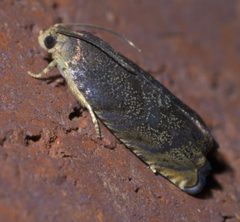
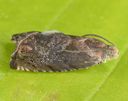
Cydia caryana, the hickory shuckworm , is a tortricid moth native to North America and a significant pest of pecan and hickory crops. Larvae tunnel within the shucks of developing nuts, disrupting nutrient and water flow to kernels. The completes multiple annually and overwinters as mature larvae in old shucks. It is subject to by , particularly Calliephialtes grapholithae.

Pronunciation
How to pronounce Cydia caryana: /ˈsɪdiə kaɪˈreɪniə/
These audio files are automatically generated. While they are not always 100% accurate, they are a good starting point.
Identification
Distinguished from similar tortricid pests by specificity to Carya (pecan and hickory) and larval habit of tunneling in shucks rather than kernels. are smaller and darker than pecan nut casebearer (Acrobasis nuxvorella). Larval damage produces black and silk on shuck exteriors, with larvae found inside shucks rather than within nut kernels. larvae occur in old shucks on trees or orchard floors.
Images
Habitat
Pecan and hickory orchards; natural stands of Carya . Larval development occurs entirely within the shucks of developing nuts. Overwinters in senesced shucks remaining on trees or fallen to the ground.
Distribution
North America: Canada (Quebec, Ontario); eastern United States. Also recorded in Mexico (Coahuila, Tamaulipas).
Seasonality
active June to July in northern parts of range; multiple completed annually with extended activity in southern regions. larvae present from late fall through spring.
Diet
Larval stage feeds on tissues of pecan (Carya illinoinensis) and hickory (Carya ovata) shucks. Does not feed on kernel tissue directly.
Host Associations
- Carya illinoinensis - primary pecan; larval development in shucks
- Carya ovata - primary shagbark hickory
- Juglans nigra - secondary black walnut; recorded but less common
- Calliephialtes grapholithae - ichneumonid ; primary agent
- Phanerotoma fasciata - braconid ; recorded in Mexico
Life Cycle
: attached singly to shuck surface with visible creamy white adhesive. Larva: hatches in a few days, burrows into shuck, feeds for 15–20 days. Pupa: formed within shuck; emerges in 9–14 days. : full-grown larvae remain in old shucks on tree or ground through winter, pupating in spring. Multiple per year; exact number varies by latitude.
Behavior
Female deposit single on shuck surfaces at night. Larvae tunnel into shucks immediately after hatching, creating concealed feeding galleries. Males exhibit upwind response to female in laboratory assays. larvae remain inactive in old shucks until spring conditions trigger .
Ecological Role
Herbivore and agricultural pest; reduces nut quality and yield by disrupting shuck development. Creates 'sticktights' (shucks that adhere to nuts and prevent normal dehiscence). Serves as for specialized , supporting natural enemy in orchard .
Human Relevance
Major economic pest of pecan production in the United States and Mexico. Larval feeding causes direct yield loss through nut drop (early ) and quality reduction (kernel damage, sticktights). Managed through applications timed to shell hardening stages, and cultural practices including removal of shucks. components identified for potential monitoring applications.
Similar Taxa
- Acrobasis nuxvorellaPecan nut casebearer; larvae feed directly on nut kernels in spring rather than shucks, and produce more conspicuous black on nut exteriors. are larger (~10 mm body length vs. smaller C. caryana) and gray rather than dark brown to black.
- Cydia latiferreanaFilbertworm moth; similar size and appearance but associated with hazelnut and oak acorns rather than Carya . Geographic range overlaps but plants distinguish.
More Details
Pheromone biology
Electroantennogram studies indicate male respond strongly to (E,E)-8,10-dodecadien-1-ol acetate and (Z)-9-dodecadien-1-ol acetate, suggesting these are major or minor components of the female .
Altitude effects on parasitism
Studies in Mexico found abundance highest at mid-high elevations (1,470–1,600 m), with parasitoid absence at lower elevation sites (1,110 m) potentially due to intensive use in adjacent cotton crops.
Laboratory rearing
Can be maintained on artificial diets containing soybean or cottonseed protein; pecan-based diets show high larval mortality.
Sources and further reading
- BugGuide
- Wikipedia
- GBIF taxonomy match
- iNaturalist taxon
- NCBI Taxonomy
- Catalogue of Life
- Insects that feed on the pecan nut - AgriLife Extension Entomology
- Blacklighting at the Bohart: They Saw the Light | Bug Squad
- What Will You See at Bohart Museum Open House | Bug Squad
- Like a Moth to a Flame: Moth Night at Bohart Museum of Entomology | Bug Squad
- Bug Eric: A Potential New Host Record for Calliephialtes grapholithae (Hymenoptera: Ichneumonidae) from a Paper Wasp nest (Hymenoptera: Vespidae: Polistes metricus)
- Line Trapping: A Promising Method for More Accurate Pest Monitoring
- Cydia caryana (Fitch). [Distribution map].
- Hickory shuckworm Cydia caryana: electroantennogram and flight tunnel studies of potential sex pheromone components
- Incidencia del parasitoide Calliephialtes grapholithae Cresson (Hymenoptera: Ichneumonidae) en larvas de Cydia caryana Fitch (Lepidoptera: Tortricidae)
- EVALUACIÓN DE TRES DIETAS ARTIFICIALES PARA LA CRÍA DE Cydia caryana (FITCH, 1856) (LEPIDOPTERA: TORTRICIDAE) EN LABORATORIO DESTINADA PARA MANTENER POBLACIONES DEL PARASITOIDE Calliephialtes grapholithae CRESSON (HYMENOPTERA: ICHNEUMONIDAE). EVALUATION OF THREE ARTIFICIAL DIETS FOR THE REARING OF Cydia caryana (FITCH, 1856) (LEPIDOPTERA: TORTRICIDAE) IN LABORATORY CONDITIONS AIMED AT MAINTAINING PARASITOID Calliephialtes grapholithae CRESSON (HYMENOPTERA: ICHNEUMONIDAE).
- Abundancia relativa de los parasitoides Calliephiates grapholithae Cresson (Hymenoptera: Ichneumonidae) y Phanerotoma fasciata Provanche (Hymenoptera: Braconidae) sobre larvas del barrenador del ruezno Cydia caryana Fitch (Lepidoptera: Tortricidae) en seis localidades de Coahuila, México Relative abundance of the parasitoides Calliephiates grapholithae Cresson (Hymenoptera: Ichneumonidae) and Phanerotoma fasciata Provanche (Hymenoptera: Braconidae) on russet barrels Cydia caryana Fitch (Lepidoptera: Tortricidae) in six localities in Coahuila, Mexico