
Cydia latiferreana
(Walsingham, 1879)
Filbertworm Moth
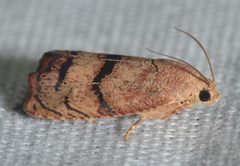
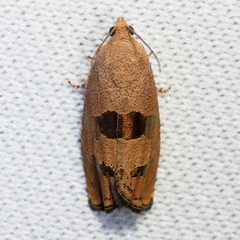
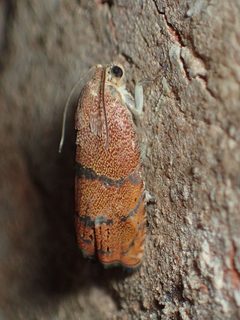
Cydia latiferreana, the filbertworm , is a small tortricid moth (wingspan approximately 18 mm) found across most of North America. are active from July to October, with timing varying by location. The is a significant agricultural pest, particularly of hazelnut orchards in the Pacific Northwest, and also infests acorns of multiple oak species. Larvae develop inside nuts, reducing germination success and crop viability.
Pronunciation
How to pronounce Cydia latiferreana: //ˈsɪdiə ˌlætɪfəˈreɪə//
These audio files are automatically generated. While they are not always 100% accurate, they are a good starting point.
Identification
Distinguished from similar tortricid moths by its small size (~18 mm wingspan) and distinctive metallic appearance. Previously placed in Melissopus, now classified in Cydia. Conclusive identification to may require examination of genitalia, as is common for many microlepidoptera.
Images
Appearance
Small with wingspan of approximately 18 mm. have a distinctive metallic or iridescent appearance described as resembling 'molten metal' when observed at light traps. Specific color pattern details of forewings and hindwings are not documented in available sources.
Habitat
Associated with oak woodlands and hazelnut orchards. Found in dry mixed conifer forests with oaks at elevations up to 7,000 feet. specificity is tied to presence of plants—oaks (Quercus spp.) and hazelnuts (Corylus spp.)—rather than particular abiotic conditions.
Distribution
Most of North America, including: Pacific Northwest (major pest region), southwestern United States (New Mexico, Colorado), California, British Columbia, and eastern North America (Vermont). Specific distribution records include Victoria, British Columbia; Colorado Springs, Colorado; Davis, California; and Pinos Altos, New Mexico.
Seasonality
on wing from July to October, with exact timing dependent on location. Activity period extends through late summer and early autumn across its range.
Diet
Larvae feed internally on nuts. Primary are hazelnuts (Corylus spp.), particularly in commercial orchards. Also feeds on acorns of white oak (Quercus alba), bur oak (Quercus macrocarpa), red oak (Quercus rubra), black oak (Quercus velutina), Garry oak (Quercus garryana), and coast live oak (Quercus agrifolia).
Host Associations
- Corylus spp. - primary Major pest of hazelnut orchards in Pacific Northwest
- Quercus alba - white oak acorns
- Quercus macrocarpa - bur oak acorns
- Quercus rubra - red oak acorns
- Quercus velutina - black oak acorns
- Quercus garryana - Garry oak acorns; rates up to 80% in some years
- Quercus agrifolia - coast live oak acorns
Life Cycle
Complete with , larval, pupal, and stages. Larvae develop inside nuts, feeding on kernel tissue. occurs within the nut or in soil. Specific details of egg-laying , larval instars, and stage are not documented in available sources.
Behavior
are attracted to ultraviolet light and frequently captured at blacklight stations. activity pattern typical of tortricid moths. Larvae are endophagous, feeding internally within nuts rather than externally on foliage.
Ecological Role
Significant seed of oaks and hazelnuts. rates in Garry oak acorns reached 51-81% across three study years in British Columbia. Heavily damaged acorns fail to germinate; lightly to moderately damaged acorns show reduced germination success but unaffected seedling growth if they do germinate. Potentially impacts oak recruitment and persistence in Garry oak ecosystems, though moderate damage has relatively low impact on seedling establishment. In agricultural systems, classified as major economic pest.
Human Relevance
Major agricultural pest of hazelnut orchards in the Pacific Northwest, causing economic losses through kernel damage. Also identified as pest of pomegranate. Subject of ongoing research regarding strategies. Frequently encountered by citizen scientists and lepidopterists at -lighting events.
Similar Taxa
- Cydia pomonellaCodling moth, congeneric also in Tortricidae; similar size and appearance but associated with apple and other pome fruits rather than nuts
- Grapholita prunivoraLesser appleworm moth, also tortricid; similar association with orchard crops but different plant specificity
More Details
Taxonomic History
Formerly placed in Melissopus; now classified in Cydia. Some sources still use Melissopus latiferreana.
Research Significance
Subject of ecological studies examining within-tree distribution patterns and impacts on oak , particularly in threatened Garry oak of British Columbia.
Detection Methods
readily attracted to blacklight/UV light traps. Larvae detected by examining nuts for exit holes or internal feeding damage.
Sources and further reading
- BugGuide
- Wikipedia
- GBIF taxonomy match
- iNaturalist taxon
- NCBI Taxonomy
- Catalogue of Life
- Blacklighting at the Bohart: They Saw the Light | Bug Squad
- What Will You See at Bohart Museum Open House | Bug Squad
- Like a Moth to a Flame: Moth Night at Bohart Museum of Entomology | Bug Squad
- Oh, What a (Moth) Night! | Bug Squad
- Bug Eric: National Moth Week Recap for Colorado Springs
- Bug Eric: New Mexico Night Bugs
- Within-Tree Distribution of Acorns Infested by Curculio occidentis (Coleoptera: Curculionidae) and Cydia latiferreana (Lepidoptera: Tortricidae) on the Coast Live Oak
- Within-crown distribution, attack, and germination of Curculio occidentis-damaged and Cydia latiferreana-damaged Garry oak acorns in Victoria, British Columbia, Canada