
Chalcoela iphitalis
Walker, 1859
Sooty-winged Chalcoela, Sooty-winged Chalcoela Moth
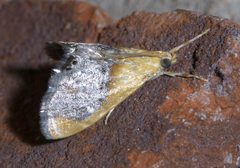
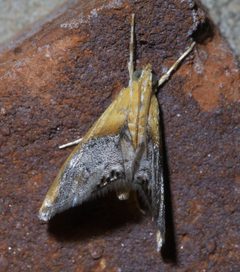
Chalcoela iphitalis is a small in the Crambidae that functions as a of social paper wasps. The is notable for its striking coloration: the , , and forewings are yellow-orange, while the forewings and hindwings are gray-silver with black marginal spots. are active from May to August across North America. The larvae are specialized of pupae and pre-pupae within Polistes and Mischocyttarus nests, and represent a rare case of a lepidopteran acting as a of hymenopterans.
Pronunciation
How to pronounce Chalcoela iphitalis: //kælˈkoʊ.ə ˌɪfɪˈteɪlɪs//
These audio files are automatically generated. While they are not always 100% accurate, they are a good starting point.
Identification
The combination of yellow-orange and with gray-silver hindwings is distinctive. The black spots along the hindwing margin separate it from similar Crambidae. When found near paper wasp nests, the association strongly supports identification. Resembles a paper wasp larva in its stage, which may be an for avoiding detection within nests.
Images
Appearance
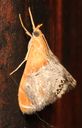
Small with distinct bicolored wings. , , and basal two-thirds of forewings are yellow-orange. third of forewings and entire hindwings are gray to silver. Hindwing margin bears a series of black spots along the edge. . Overall size small, consistent with other 'micro' moths in the .
Habitat
Found in association with nests of social paper wasps, primarily Polistes and Mischocyttarus flavitarsis. Occurs in diverse environments where construct nests, including urban and suburban areas (under eaves, in door frames), parks, and natural areas. attracted to blacklights and porch lights.
Distribution
Throughout North America. Documented from southern Canada (Ontario) south to California, Arizona, and South Carolina. Field studies confirm presence in southern Louisiana. Records extend into Mexico and Central America.
Seasonality
active May to August. with adult peaks in spring and late summer. Overwinters as larvae or pupae within abandoned nests.
Diet
Larval stage feeds exclusively on pupae and pre-pupal within nests. do not feed on wasp ; adult feeding habits unreported but presumed nectar or non-feeding based on patterns.
Host Associations
- Polistes dominula - European paper wasp, introduced
- Polistes exclamans - Field rate 7.6% in Louisiana study
- Polistes metricus - Field rate 14.2% in Louisiana study
- Polistes bellicosus - Highest field rate: 41% in Louisiana study
- Polistes fuscatus - Field rate 21% in Louisiana study
- Polistes dorsalis - Field rate 14.6% in Louisiana study
- Polistes apachus - Previously reported
- Mischocyttarus flavitarsis - Western yellowjacket; larvae invade nests at night
- Mischocyttarus basimacula - Central American record
- Mischocyttarus mexicanus - no observedZero in Louisiana field study despite sympatry
Life Cycle
with two per year. laid at night on substrate adjacent to nests (walls, ceiling, floor), never directly on nest surface. Larvae enter nest and feed on pupae and pre-pupae, moving between cells through holes in cell walls. Developmental time approximately 4 weeks at 22°C. occurs within silken cocoons spun in empty cells, with air pocket layers in cocoon structure. Overwinters inside abandoned wasp nests.
Behavior
oviposition : females active only at night, remaining motionless during day with tucked back. At night, flies with antennae fully extended and oscillating. Oviposition stimulated by contact with nest or wasps; female moves side-to-side while during -laying. Avoidance response to adult wasps: tucks antennae and retreats rapidly. Rarely walks on nest surfaces. Wasp display alarm behavior including jerking movements, wing flipping, and prolonged substrate walking when detected.
Ecological Role
that can significantly impact paper wasp colony success. Heavy destroy large percentages of pupae, reducing replacement and potentially causing colony failure. May contribute to rarity of nest re-use by paper wasps due to in old nests. Serves as for ichneumon wasp Calliephialtes grapholithae, linking wasp-- .
Human Relevance
Occasionally noticed by homeowners when infesting paper wasp nests on structures. attracted to porch lights and blacklights, making them observable during -watching activities. interest due to role against paper wasps, though not commercially utilized.
Similar Taxa
- Other Crambidae (Glaphyriinae)Similar small size and wing shape, but lack the distinctive yellow-orange and gray-silver bicolored pattern with black hindwing spots
- Paper wasp larvae (Polistes spp.)Larval stage convergently resembles larvae in color and form, an for living undetected within nests; differentiated by presence of silk webbing and movement between
More Details
Parasitoid biology
One of few known lepidopteran of Hymenoptera. The larval resemblance to larvae and oviposition represent adaptations for exploiting well-defended social insect colonies.
Differential host parasitism
Field studies demonstrate strong preference among , with Polistes bellicosus showing 41% nest versus zero infestation in sympatric Mischocyttarus mexicanus. Mechanism for host selection remains unclear.
Hyperparasitism
Documented as for ichneumon Calliephialtes grapholithae, which normally attacks concealed larvae. This creates a rare three-level interaction: wasp → moth → ichneumon wasp.
Sources and further reading
- BugGuide
- Wikipedia
- GBIF taxonomy match
- iNaturalist taxon
- NCBI Taxonomy
- Catalogue of Life
- Bug Eric: A Potential New Host Record for Calliephialtes grapholithae (Hymenoptera: Ichneumonidae) from a Paper Wasp nest (Hymenoptera: Vespidae: Polistes metricus)
- Bug Eric: National Moth Week, 2016: What's at Your Blacklight?
- Bug Eric: Wasp Wednesday: Polistes exclamans
- A Preliminary Investigation of the Interactions between the Brood Parasite Chalcoela iphitalis and Its Polistine Wasp Hosts